
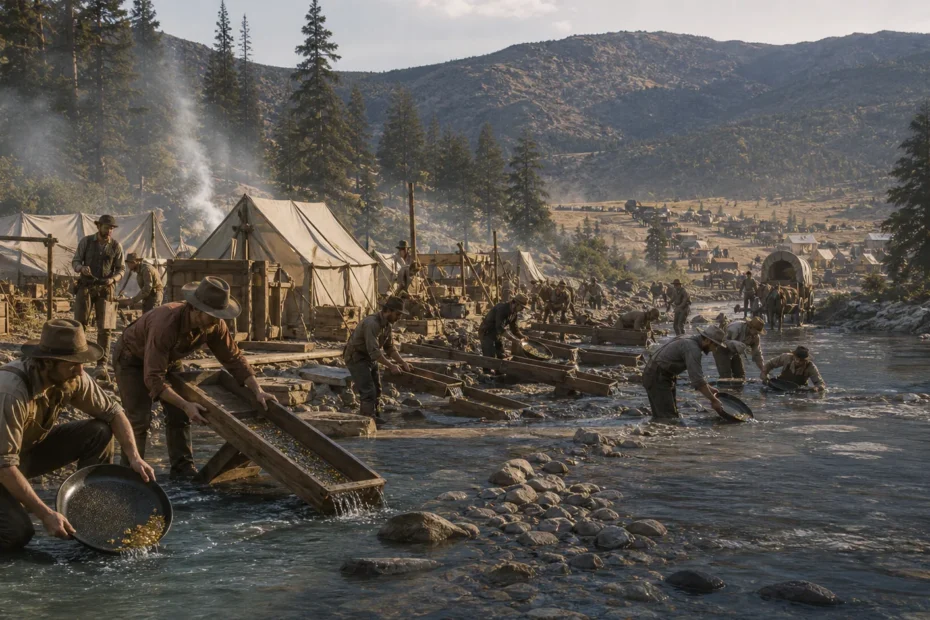
Understand the California Gold Rush through discovery, migration, boomtowns, mining methods, Indigenous displacement, law, and the economic legacy.
- Track how Sutter's Mill became migration, statehood, and boomtown growth.
- Include Indigenous displacement and environmental damage in the impact.
- Separate early placer mining from later industrial hydraulic methods.
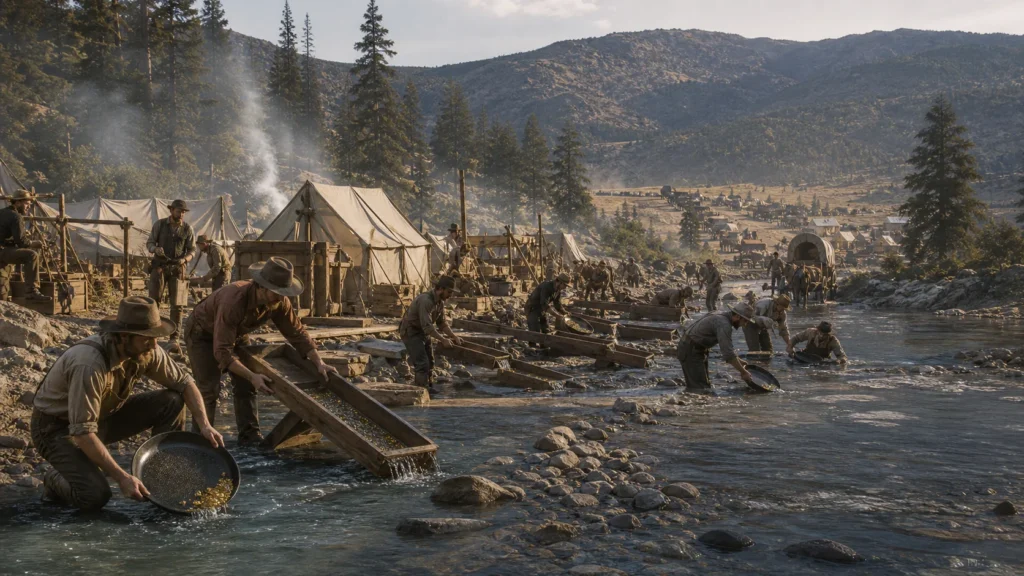
The California Gold Rush began with a small discovery and became a continental shock. It moved people, capital, law, transport, agriculture, mining technology, and political power faster than California’s institutions could absorb.
The California Gold Rush began with a small discovery and became a continental shock. It moved people, capital, law, transport, agriculture, mining technology, and political power faster than California’s institutions could absorb.
The useful story is not just that gold was found. It is how the discovery at Sutter’s Mill turned into mass migration, boomtown growth, Indigenous dispossession, statehood, industrial mining, and a long environmental bill that did not end when the richest placers ran out.
TL;DR: California Gold Rush in plain English
- Discovery: James W. Marshall found gold on January 24, 1848, in the tailrace of Sutter’s sawmill at Coloma.
- Migration: News spread slowly at first, then explosively after confirmation; the “forty-niners” made California a global destination.
- Economy: Miners mattered, but merchants, transport operators, bankers, land speculators, and suppliers often captured steadier profits.
- Human cost: Indigenous Californians faced land loss, violence, disease, forced labor, legal exclusion, and ecological destruction.
- Legacy: The rush accelerated California statehood, transformed San Francisco, and left mercury and hydraulic-mining debris in western watersheds.
Why the California Gold Rush still matters
The California Gold Rush is one of the clearest examples of how a mineral discovery can reorganize a region. Before the rush, California was a recently acquired U.S. territory with Indigenous nations, Californios, missions, ranchos, military posts, trading ports, and small settlements. After the rush, it was pulled into a faster American state-building project.
Gold did not simply attract miners. It attracted ship owners, merchants, lawyers, printers, gamblers, cooks, laundries, stage lines, banks, claim buyers, land speculators, and government officials. That is why the California Gold Rush should be read as economic history, political history, and environmental history at the same time.
For wider context, compare it with GoldConsul’s guides to when gold was discovered, Gold Rush towns, and the later Witwatersrand Gold Rush. The details differ, but the pattern is familiar: discovery, rumor, migration, capital, conflict, and legacy.
The 1848 discovery at Sutter’s Mill
The key date is January 24, 1848. James W. Marshall was inspecting the sawmill he was building for John Sutter on the South Fork of the American River when he noticed gold in the tailrace.
California State Parks describes the discovery site at present-day Coloma as the place where Marshall found gold in the valley known to the Nisenan as Cullumah. That detail matters because the famous discovery did not happen in an empty landscape. It happened in a Native homeland already shaped by deeper histories than the mining rush.
At first, Sutter and Marshall tried to control the news. That was unrealistic. Workers, traders, and newspapers carried the story outward, and official confirmation helped turn local rumor into international movement.
From local rumor to global migration
The rush became famous in 1849, which is why the migrants are remembered as “forty-niners.” People came by sea around Cape Horn, across the Isthmus of Panama, across the continent by overland routes, and from Latin America, Europe, China, Australia, and elsewhere.
The Library of Congress California Gold Rush collection preserves letters and journals from miners and camp residents, including accounts of mining hardship, homesickness, mining methods, and impressions of places such as Sacramento, Placerville, Nevada City, Mariposa, and Downieville. Those records are a useful check against later romantic images.
Migration changed San Francisco most visibly. A small port became a gateway city for ships, goods, labor, mail, finance, law, and speculation. The goldfields also pulled supply chains across oceans and over mountains, making California less isolated and more deeply connected to U.S. and Pacific trade.
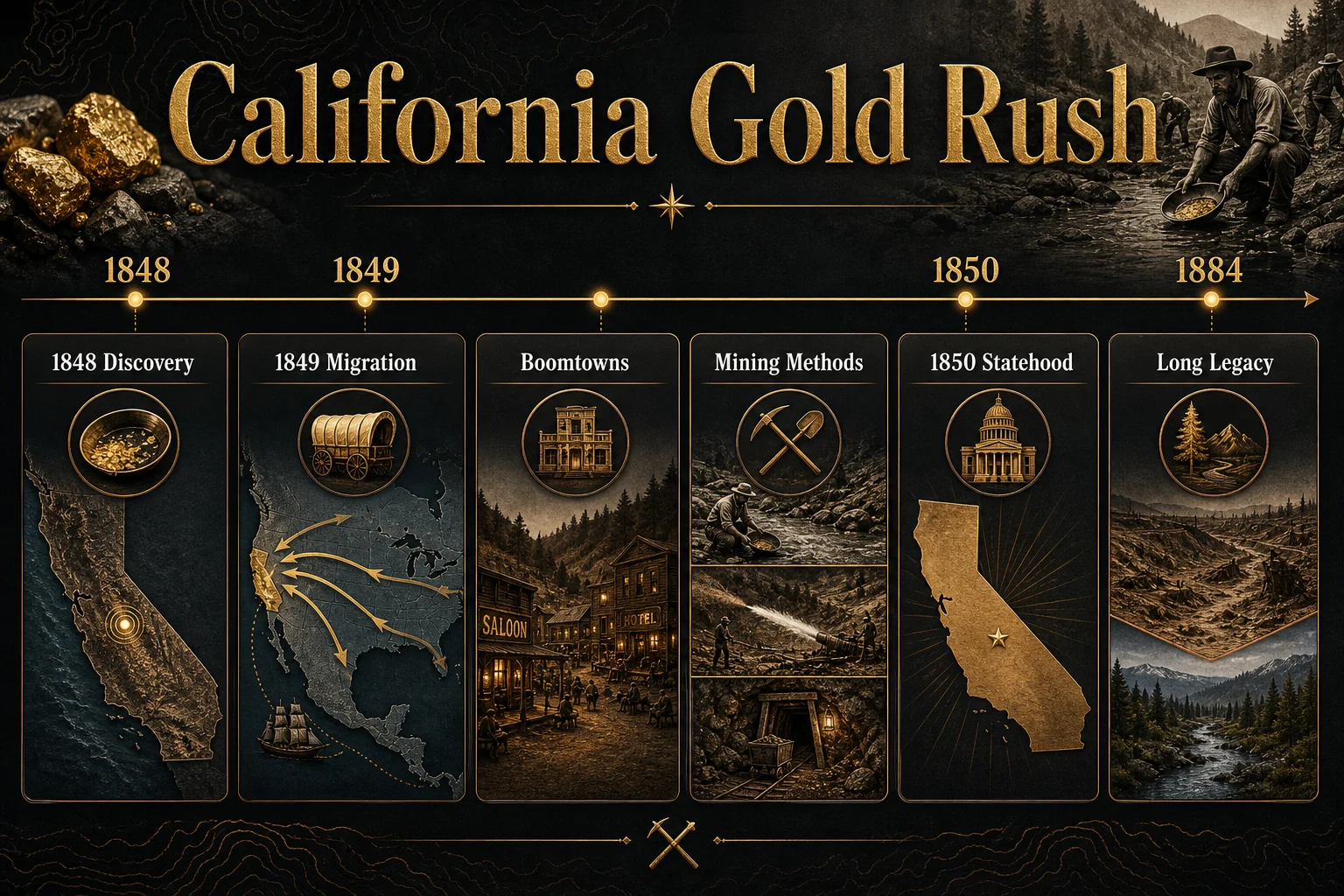
Timeline: the California Gold Rush at a glance
| Period | What happened | Why it mattered |
|---|---|---|
| January 1848 | Marshall found gold at Sutter’s Mill in Coloma. | The discovery created the spark, but news still had to spread and be believed. |
| Late 1848 | Reports reached wider audiences; official confirmation strengthened credibility. | California shifted from rumor to destination. |
| 1849 | Large migration brought miners and suppliers from the U.S. and abroad. | The rush became a global movement and overwhelmed local institutions. |
| 1850 | California entered the Union as a state. | Gold accelerated political organization, representation, courts, taxation, and land conflict. |
| 1850s | Mining moved from simple placer work toward sluices, hydraulic mining, and hard-rock operations. | Capital and water control became more important than individual luck. |
| 1884 | The Sawyer decision restricted hydraulic mining debris discharge. | Downstream damage became too large to treat as a private mining problem. |
Boomtowns, camps, and the service economy
California Gold Rush settlements formed quickly because people needed places to sleep, buy food, repair tools, write letters, store gold dust, settle disputes, and obtain credit. Some camps were temporary. Others became towns with newspapers, courts, schools, churches, stores, saloons, boarding houses, and transport links.
The town story is not separate from the mining story. A camp based on shallow placers behaved differently from a district that later depended on water ditches, hydraulic nozzles, hard-rock shafts, or stamp mills. For a dedicated treatment, see our companion guide to Gold Rush towns.
Merchants often had a better risk profile than individual miners. A miner might find rich ground, earn modest wages, or lose everything. A supplier could sell flour, boots, picks, pans, shovels, candles, lodging, freight, banking services, and legal help to everyone, including unsuccessful miners.
Mining methods: from pan to hydraulic mining
The earliest image is the miner with a pan. Panning was real, cheap, and useful for testing gravel, but it was slow. As easy gold declined, miners used rocker boxes, long toms, sluices, river diversions, drift tunnels, hydraulic mining, and hard-rock mining.
That technical progression changed who could compete. A person with a pan needed little capital. A hydraulic operation needed water rights, ditches, reservoirs, pipes, nozzles, labor, and legal protection. A hard-rock operation needed shafts, timbering, pumps, mills, explosives, and investors.
For the technical side of the shift, read GoldConsul’s guide to Gold Rush mining techniques. The short version is that higher throughput usually meant higher infrastructure, more environmental disturbance, and more concentrated control.
Indigenous displacement and violence
No serious account of the California Gold Rush can treat Indigenous people as background. Mining and settlement entered Indigenous homelands, damaged food systems, polluted waterways, redirected labor, and increased violence.
Indigenous Californians faced disease, hunger, militia violence, forced labor, debt peonage, legal exclusion, and the destruction of rivers and landscapes that supported community life. The mining economy created new towns for arrivals while undermining land security for people already there.
This is also why Coloma’s Nisenan context matters. The discovery site is often framed as the beginning of opportunity. For Native communities, the same event intensified dispossession. Evidence-oriented history has to hold both realities at once.
Editorial Perspective
GoldConsul treats the California Gold Rush as a system, not a treasure tale. The discovery mattered, but the fuller history includes migration, speculative finance, boomtown commerce, mining technology, Indigenous displacement, racial exclusion, state power, and environmental cost.
Statehood, law, and the reshaping of California
California became a U.S. state in 1850, unusually fast by normal territorial standards. Gold accelerated the need for courts, taxation, representation, policing, land records, and infrastructure.
Law did not arrive all at once. Mining districts used claim rules, meetings, notices, customs, and local enforcement before institutions caught up. Those systems could create order among miners, but they also excluded people by race, nationality, language, power, and violence. For a closer look at claim rules, see how miners staked claims in the Gold Rush.
The political consequences extended beyond the goldfields. California’s admission affected national debates over slavery and western expansion, while gold revenues and trade helped expand banking, shipping, agriculture, and urban development.
Environmental legacy: sediment, mercury, and rivers
Hydraulic mining became the most visible environmental escalation. Miners used pressurized water to wash away gold-bearing gravels, moving enormous volumes of sediment into rivers and valleys.
A USGS study of mercury-contaminated hydraulic mining debris found that sediment created by Sierra Nevada hydraulic mining between 1852 and 1884 traveled more than 250 kilometers to San Francisco Bay. The same research connects hydraulic mining debris with mercury contamination that persisted long after the rush.
Mercury was used to recover fine gold. It could be lost in sluices, tailings, and processing sites, then moved through sediments and watersheds. This is why the Gold Rush legacy includes modern environmental management, not just museum interpretation.
Myths vs facts about the California Gold Rush
| Myth | Evidence-based correction |
|---|---|
| Most miners became rich. | A minority found substantial gold. Many earned little, spent heavily on supplies, or left in debt while merchants captured steadier income. |
| The rush began in empty wilderness. | The goldfields were Indigenous homelands with existing communities, economies, and land relationships. |
| Panning was the whole Gold Rush. | Panning was important early, but rockers, sluices, hydraulic mining, and hard-rock operations became central as easy placers declined. |
| Boomtowns were simply lawless. | Violence and disorder existed, but so did miners’ codes, courts, newspapers, sheriffs, churches, schools, and municipal government. |
| The environmental story ended in the 1850s. | Mercury, sediment, altered rivers, tailings, and abandoned workings made the legacy much longer. |
How to read Gold Rush evidence carefully
Use this quick evidence checklist before repeating a Gold Rush claim:
- Anchor the date: 1848 discovery, 1849 migration, 1850 statehood, and later mining phases are not the same moment.
- Separate placer from hard-rock mining: each used different labor, capital, risk, and evidence.
- Follow the money: compare miner income with merchant, freight, land, banking, and equipment profits.
- Ask who is missing: Indigenous people, Californios, Chinese miners, Mexican and Chilean miners, Black residents, women, and children are often underrepresented.
- Check the landscape: rivers, tailings, mercury records, and mining pits can preserve evidence that memoirs simplify.
Popular Gold Rush stories can be useful starting points, but they should be tested against primary records, maps, mining reports, legal cases, archaeological evidence, and environmental studies. For related human context, see GoldConsul’s evidence-based article on women in the Gold Rush.
Knowledge Gap
Many Gold Rush summaries still lean on English-language miner memoirs, booster newspapers, and preserved town streets. Those sources are valuable, but they can undercount Indigenous losses, immigrant labor, women, children, failed miners, informal workers, and environmental damage that did not fit the success story.
Bottom line
The California Gold Rush began with gold at Sutter’s Mill, but its importance came from the chain reaction. It accelerated migration, urban growth, statehood, mining technology, commerce, racial conflict, Indigenous dispossession, and environmental change.
The strongest history is neither romantic nor purely cynical. It asks what the evidence shows: who came, who profited, who was harmed, which institutions formed, and what the rivers and landscapes still carry from the rush.
FAQ: California Gold Rush
When did the California Gold Rush start?
The California Gold Rush began after James W. Marshall found gold at Sutter’s Mill in Coloma on January 24, 1848. The largest migration wave followed in 1849.
Why were Gold Rush migrants called forty-niners?
They were called forty-niners because many arrived in California in 1849, after news of the discovery had spread widely and the rush became a global migration event.
Did most California Gold Rush miners get rich?
No. Some miners made money, especially early arrivals on rich ground, but many earned little or lost money after paying for tools, food, transport, lodging, and claims.
How did the California Gold Rush affect Indigenous Californians?
It intensified land loss, disease, violence, forced labor, legal exclusion, food-system disruption, and ecological damage. Indigenous communities paid a major human cost for the rush.
What mining methods were used in the California Gold Rush?
Early miners used pans, rocker boxes, long toms, and sluices. Later operations used river diversions, hydraulic mining, drift mining, hard-rock shafts, stamp mills, and mercury recovery.
Why is mercury part of the Gold Rush legacy?
Mercury helped recover fine gold, but lost mercury entered sediments and waterways. Former Gold Rush watersheds can still carry contamination from 19th-century mining.
 When you purchase a service or a product through our links, we sometimes earn a commission, at no extra cost to you.