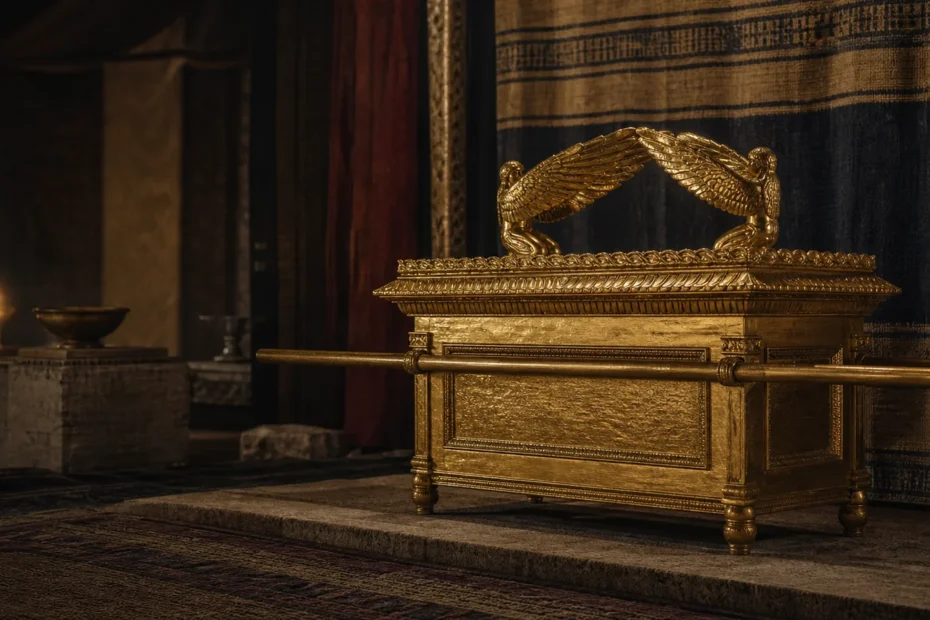
Review the Ark of the Covenant through gold imagery, biblical setting, traditions, archaeology limits, and why evidence must be separated from legend.
- Separate biblical description from archaeology and later tradition.
- Gold imagery can be studied even when the object itself is not verified.
- Treat modern discovery claims cautiously unless evidence is public.
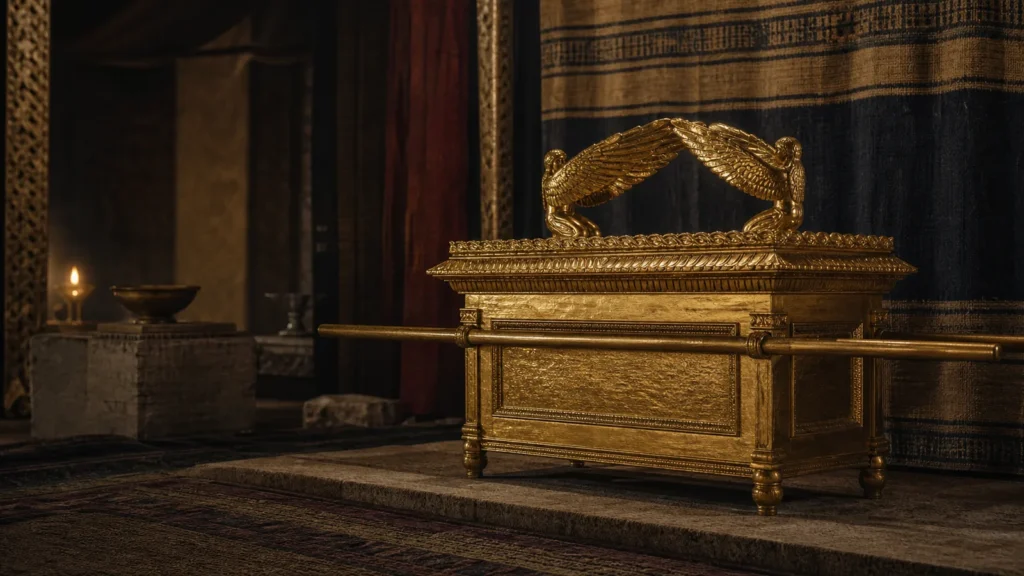
The Ark of the Covenant is one of the most famous biblical relics, but the safest way to discuss it is also the most disciplined one: separate the scriptural description from archaeology, later tradition, and modern speculation. In the Hebrew Bible, the Ark is a sacred chest associated with the covenant tablets, the Tabernacle, and later the Jerusalem Temple. What cannot currently be verified is whether a recoverable object matching that description survives today.
The Ark of the Covenant is one of the most famous biblical relics, but the safest way to discuss it is also the most disciplined one: separate the scriptural description from archaeology, later tradition, and modern speculation.
In the Hebrew Bible, the Ark is a sacred chest associated with the covenant tablets, the Tabernacle, and later the Jerusalem Temple. What cannot currently be verified is whether a recoverable object matching that description survives today.
TL;DR: Ark of the Covenant
- The Bible describes the Ark as an acacia-wood chest overlaid with gold, with a gold cover and two cherubim.
- The Ark belongs first to the Tabernacle tradition, then to narratives about Shiloh, David, Solomon, and the Temple in Jerusalem.
- Archaeology can illuminate First Temple-period Jerusalem and ancient cultic practice, but it has not verified the Ark as a surviving artifact.
- Later Jewish, Christian, Ethiopian, and popular traditions preserve powerful claims, but those claims are not the same as physical evidence.
- The most responsible conclusion is limited: the Ark is a major biblical and cultural relic tradition whose material survival remains unproven.
What the Bible Says the Ark Was
The central biblical description appears in Exodus 25. The passage presents the Ark as a chest made of acacia wood, overlaid with gold inside and outside, fitted with rings and carrying poles, and covered by a gold lid often called the mercy seat or atonement cover.
The same passage describes two cherubim of hammered gold placed on the cover. Readers can compare the wording directly in Exodus 25:10-22, while remembering that modern translations make interpretive choices about terms such as “ark,” “mercy seat,” and “cherubim.”
The gold imagery matters. In the biblical text, gold marks sacred status, controlled access, and ritual distinction. It does not give modern readers a measured inventory of recoverable bullion, nor does it prove that any present-day object is the original Ark.
For a nearby GoldConsul context, the Ark sits within a wider family of sacred gold objects, including the golden altar of incense. Both examples show how biblical gold can function as theology, material culture, and literary memory at the same time.
The Tabernacle and Temple Context
The Ark is first tied to the portable sanctuary tradition of the Tabernacle. In that setting, it is not a decorative chest but the most restricted sacred object in a structured ritual space.
Later biblical narratives move the Ark through Israelite memory: associated with wilderness traditions, Shiloh, military episodes, David’s transfer to Jerusalem, and Solomon’s Temple. Britannica summarizes the Ark as the gold-plated wooden chest that housed the tablets of the Law and places it within Jewish and Christian scripture in its overview of the Ark of the Covenant.
The Temple context is crucial because many modern claims jump straight to “where is it now?” before asking what kind of evidence would be needed. A sacred object housed in the inner sanctuary would leave a different evidence trail from pottery, inscriptions, tools, coins, or architecture.
Claim and Evidence Table
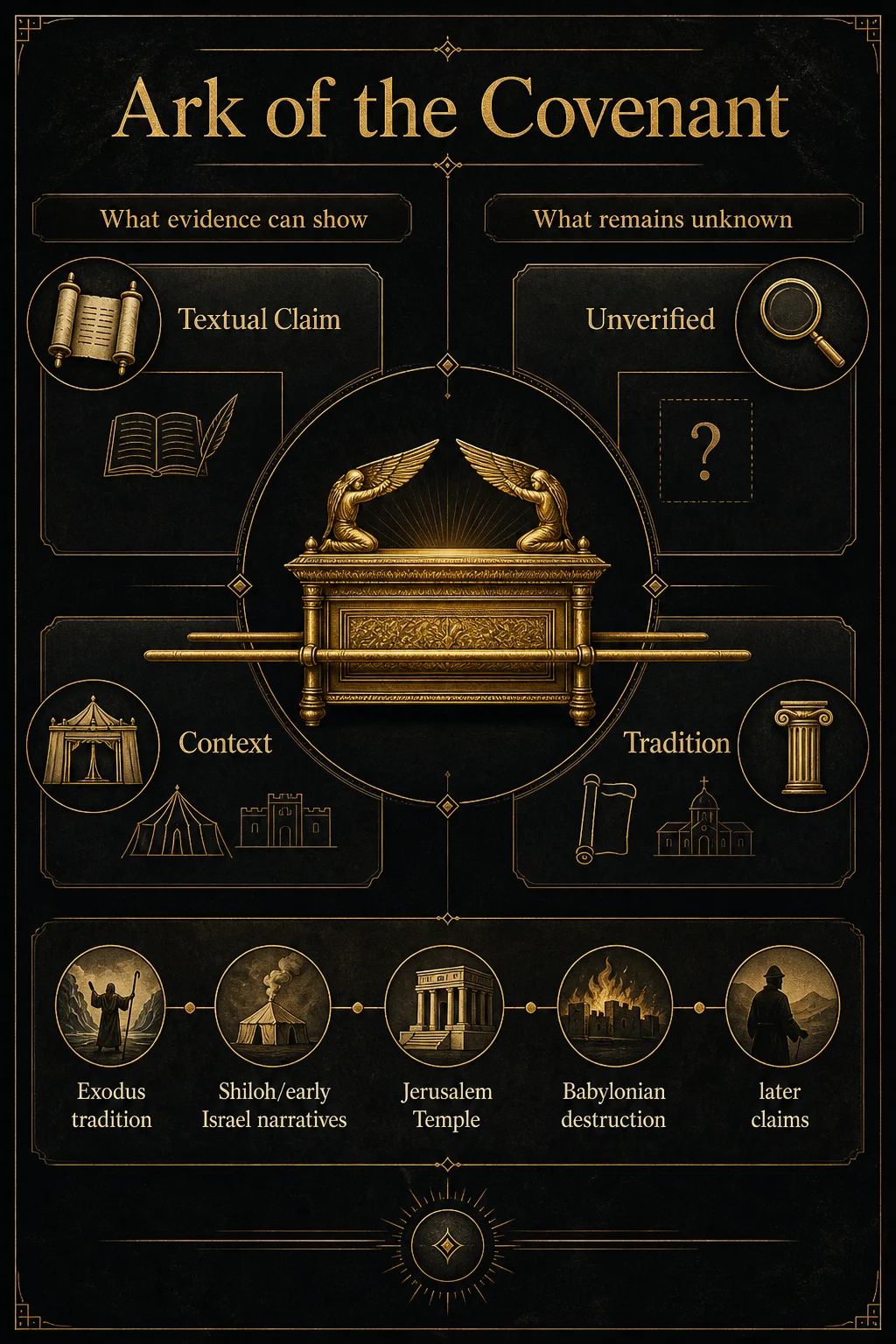
The Ark should be read through claim categories. Some claims are textual, some are plausible historical context, and some remain unverifiable with current evidence.
| Claim | Evidence type | Responsible confidence |
|---|---|---|
| The Ark is described as gold-covered acacia wood with a gold cover and cherubim. | Biblical text, especially Exodus 25 and related passages. | Strong for what the text says; not physical proof of a surviving object. |
| The Ark belonged to Israelite sanctuary and Temple tradition. | Biblical narrative, later religious tradition, and broader ancient Near Eastern cultic context. | Strong as a tradition; historical reconstruction depends on dating and source-critical questions. |
| First Temple-period Jerusalem was a real historical setting. | Archaeology, destruction layers, inscriptions, architecture, and regional history. | Meaningful context, but not direct evidence for the Ark itself. |
| The Ark is hidden in a specific modern location. | Later tradition, pilgrimage claims, private reports, or sensational narratives. | Unverified unless supported by accessible, testable, provenance-rich evidence. |
Credibility Check
Best-supported: the biblical description and the Ark’s role in sanctuary tradition.
Contextually supported: First Temple-period Jerusalem and ancient Israelite cultic practice, though not the Ark as a recovered object.
Weakly supported: modern location claims that lack open inspection, documentation, chain of custody, and independent material testing.
What Archaeology Can and Cannot Verify
Archaeology is very good at context. It can identify destruction layers, settlement patterns, inscriptions, seals, pottery, architecture, cultic installations, and trade connections.
It is much weaker when asked to verify a specific sacred object that has not been excavated, documented, and made available for study. That distinction is where many popular Ark stories become misleading.
First Temple-period Jerusalem is not a blank. Excavations connected with the City of David and Israel Antiquities Authority work have reported Iron Age structures and evidence tied to the Babylonian destruction horizon. The City of David summary of an exposed wall section describes remains associated with Jerusalem’s defense before the Babylonian conquest in 586 BCE in its report on the missing city wall section.
That kind of evidence helps anchor the broader world in which Temple traditions developed. It does not prove where the Ark went, whether it survived, or whether any later claim possesses the original artifact.
Gold Imagery: Material, Symbol, and Sacred Status
Gold in the Ark tradition is not incidental. The text uses gold to distinguish the Ark from ordinary containers and to place it within the visual language of sanctity, purity, and royal-sacred value.
At the same time, “gold-covered” is not the same as a solid gold chest. The biblical description points to wood overlaid with gold, a construction logic that appears in many ancient luxury and sacred objects because thin gold surfaces could transform a wooden core.
GoldConsul readers can compare this with wider ancient gold economies in gold trade and economy in ancient times and gold mining in ancient Mesopotamia. Sacred gold objects were never only about metal; they were about access, labor, trade, authority, and memory.
Later Traditions and Location Claims
After the biblical period, traditions about the Ark multiply. Some Jewish traditions discuss concealment before the destruction of the Temple. Ethiopian Orthodox tradition connects the Ark to Axum. Christian interpretation often reads the Ark typologically, connecting it with covenant, presence, Mary, or heavenly sanctuary imagery.
These traditions deserve respectful treatment, but respect does not require treating every claim as a verified artifact report. A tradition can be religiously meaningful and historically influential while still lacking public archaeological verification.
Popular culture has also changed the Ark’s public image. Films, treasure-hunt narratives, and internet claims often collapse three separate questions into one: what the text says, what ancient history can support, and whether a modern location claim is testable.
For comparison, GoldConsul’s article on El Dorado shows a similar pattern: a powerful gold-centered tradition can preserve real historical pressures while becoming far more definite in popular retelling than the evidence allows.
How to Evaluate Ark Claims
When you encounter a claim that the Ark has been found, hidden, photographed, or guarded, apply the same evidence standards you would use for any high-value antiquity.
- Access: Has the object been independently inspected by qualified specialists?
- Provenance: Is there a documented chain of custody that reaches beyond modern rumor?
- Material testing: Are wood, metal, tool marks, residue, and construction methods testable?
- Context: Was it excavated in a controlled archaeological setting?
- Publication: Are results published in a form other scholars can evaluate?
- Claim discipline: Does the claim distinguish religious tradition from physical verification?
The same caution applies to other treasure traditions. Lost-object stories are culturally important, but they need careful handling; see GoldConsul’s broader discussion of lost gold mines for the difference between tradition, evidence, and speculation.
What Remains Unknown
The biggest unknown is straightforward: no publicly verified Ark artifact is available for independent archaeological study. That means the strongest claims remain textual and traditional rather than material.
There are also historical questions. Scholars debate the dating, composition, and historical layering of biblical narratives. They also debate how to reconstruct early Israelite worship, the development of Jerusalem’s Temple traditions, and the relationship between text and material culture.
None of that makes the Ark unimportant. It makes the Ark a case study in how valuable objects can live in several records at once: scripture, ritual memory, archaeology, art, politics, and popular imagination.
Editorial Perspective
GoldConsul’s view is that the Ark of the Covenant should be handled as a high-importance biblical relic tradition, not as a solved treasure story. The gold description is central to the text, but the evidence does not justify modern certainty about survival or location.
Knowledge Gap
Popular summaries often ask only “where is the Ark?” The better question is “what kind of claim is being made?” Textual description, historical context, liturgical tradition, and archaeological proof are different categories of evidence.
Bottom Line
The Ark of the Covenant remains one of the most influential sacred-object traditions in biblical history. The text describes a gold-covered chest tied to covenant, holiness, and restricted access, and later traditions gave it an even larger religious and cultural afterlife.
What can be verified is narrower. The biblical description can be read closely. First Temple-period Jerusalem can be studied archaeologically. Gold imagery can be placed in ancient sacred-material culture. But the Ark itself has not been publicly verified as a surviving artifact.
FAQ: Ark of the Covenant
Was the Ark of the Covenant made of solid gold?
The biblical description says the Ark was made of acacia wood overlaid with gold, with a gold cover and gold cherubim. That is different from saying the entire chest was solid gold.
Has the Ark of the Covenant ever been found?
No publicly verified artifact has been accepted as the Ark of the Covenant. Location claims exist, but they have not met normal standards for independent archaeological confirmation.
What was inside the Ark of the Covenant?
The core biblical association is with the covenant tablets. Other biblical passages and later traditions discuss items such as manna and Aaron’s rod, but readers should distinguish between different textual traditions and interpretations.
Where was the Ark kept in the Temple?
Biblical tradition places the Ark in the inner sanctuary, often called the Holy of Holies, in Solomon’s Temple. That claim is part of the scriptural tradition, not a directly excavated artifact context.
Why is gold important in the Ark story?
Gold marks the Ark as sacred, set apart, and visually distinct from ordinary objects. In ancient religious settings, gold could signal value, permanence, restricted access, and divine or royal association.
Can archaeology prove the Ark existed?
Archaeology can support the broader historical setting of ancient Judah and Jerusalem, but it cannot prove the Ark as a specific object unless a testable artifact with strong context and provenance is available.
 When you purchase a service or a product through our links, we sometimes earn a commission, at no extra cost to you.