Understand Herod's Temple through history, archaeology, biblical context, sacred architecture, evidence limits, and why gold symbolism matters today.
- Separate historical sources, archaeology, biblical text, and later memory.
- Use Herod's building program to frame scale, politics, and meaning.
- Respect evidence limits where the Temple record becomes interpretive.
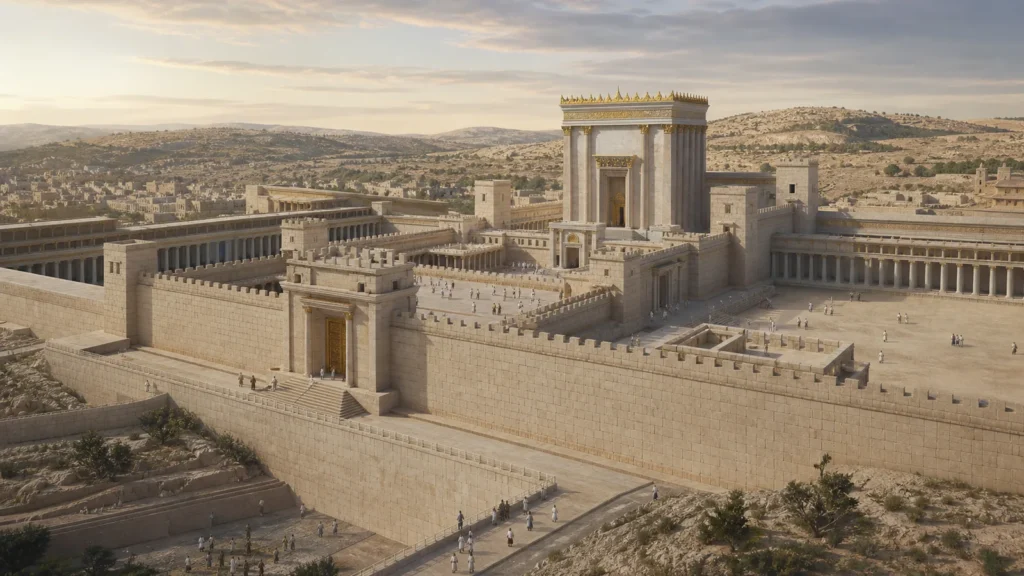
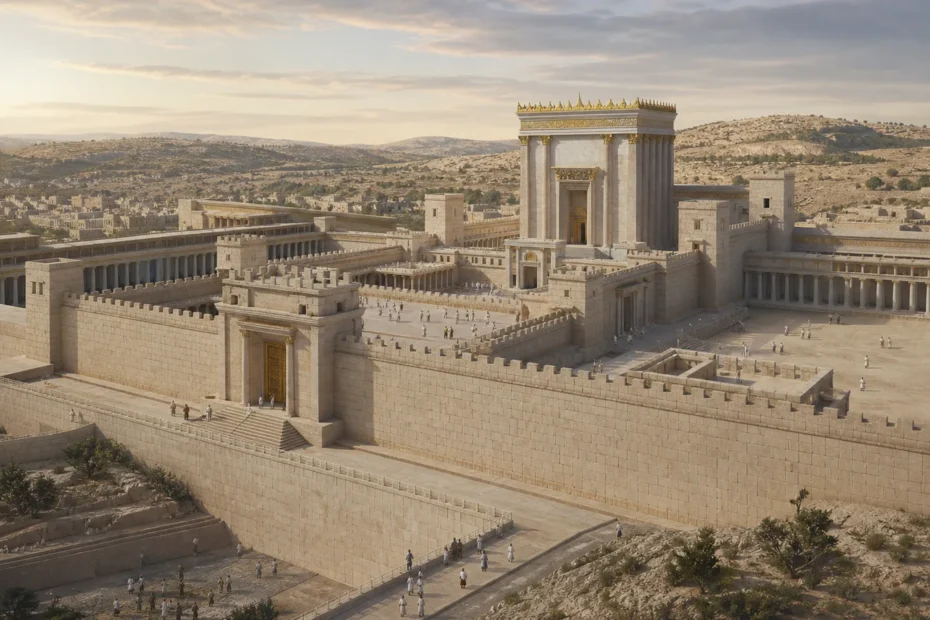
Herod’s Temple was not a separate "third temple." It was the Second Temple rebuilt, expanded, and monumentalized under Herod the Great, the Roman-backed king of Judaea. The biblical Temple was a sacred institution; Herod’s project was also an engineering, political, and urban-planning statement. The best reading holds those layers together without pretending the archaeological record can answer every theological or architectural question.
Herod’s Temple was not a separate “third temple.” It was the Second Temple rebuilt, expanded, and monumentalized under Herod the Great, the Roman-backed king of Judaea.
That distinction matters. The biblical Temple was a sacred institution; Herod’s project was also an engineering, political, and urban-planning statement. The best reading holds those layers together without pretending the archaeological record can answer every theological or architectural question.
TL;DR
- Herod’s Temple was the grand Herodian renovation of the Second Temple, begun around 20/19 BCE.
- The Temple itself was destroyed by Roman forces in 70 CE, but parts of the expanded Temple Mount retaining walls survive.
- Literary sources describe the sanctuary in detail, while archaeology is strongest for the platform, streets, gates, stones, inscriptions, and adjacent buildings.
- The site is sacred to Judaism and also sits within a living religious landscape important to Islam and Christianity, so careful language is essential.
- Gold belonged to the Temple’s symbolic world, but the strongest evidence is architectural and textual, not surviving golden fittings from the sanctuary.
What Was Herod’s Temple?
Herod’s Temple was the expanded late Second Temple in Jerusalem. The earlier Second Temple had been completed after the Babylonian exile, but Herod transformed the complex into one of the most imposing sacred sites of the eastern Roman world.
Britannica’s overview of the Temple of Jerusalem summarizes the key sequence: the Second Temple was rebuilt and enlarged under Herod, the Temple Mount area was expanded, and the sanctuary was destroyed during the Roman suppression of the Jewish revolt in 70 CE.
In plain terms, Herod did three things at once:
- He enlarged the Temple Mount platform with massive retaining walls.
- He rebuilt and beautified the sanctuary and courts.
- He made Jerusalem’s sacred center capable of handling large pilgrimage crowds.
This is why the Temple belongs in both biblical history and architectural history. It was a place of sacrifice, pilgrimage, purity practice, teaching, money-changing, and public identity.
Site, History, and Evidence Table
| Layer | What it tells us | Evidence strength | Main caution |
|---|---|---|---|
| Temple Mount platform | Herod’s project expanded the usable sacred precinct with large retaining walls. | Strong | The platform survives better than the sanctuary building. |
| Sanctuary layout | Texts describe courts, barriers, priestly zones, and the Holy of Holies. | Moderate | No complete archaeological floor plan of the Temple building is available. |
| Adjacent excavations | Streets, tunnels, ritual baths, coins, and public buildings help date the surrounding city. | Strong but local | Nearby finds do not automatically prove details inside the sanctuary. |
| Gold and sacred objects | Gold signaled holiness, royal patronage, and visual splendor in Temple memory. | Textual and comparative | Most sanctuary treasures were destroyed, removed, or lost. |
Herod’s Building Program in Context
Herod ruled Judaea under Roman authority from the late first century BCE. His building program included palaces, fortresses, harbors, theatres, and urban renovations. The Temple project was his most sensitive undertaking because it touched the center of Jewish worship.
That sensitivity explains a central tension. Herod was politically controversial, yet the Temple renovation became a lasting landmark of Jewish religious life. The project could serve Herod’s legitimacy while still functioning as the sacred house around which priestly service and pilgrimage revolved.
For readers interested in the wider ancient gold context, GoldConsul’s guides to gold trade and economy in ancient times and gold mining in ancient Mesopotamia help explain why precious metals carried religious, diplomatic, and royal meaning across the Near East.
What Archaeology Can Show
The most secure archaeological evidence relates to the expanded platform and its surrounding urban setting. The Western Wall is not the wall of the Temple building itself; it is part of the retaining-wall system around the Temple Mount.
Britannica’s Temple Mount entry notes that the lower Western Wall preserves part of the retaining wall connected to the ancient compound. That distinction prevents a common mistake: equating surviving walls directly with the sanctuary.
Excavations around the Western Wall tunnels and nearby areas add important chronological data. A 2025 Israel Antiquities Authority publication in Atiqot discusses coins from Western Wall tunnel excavations, showing how numismatic finds can anchor dates for adjacent Herodian and post-Herodian structures.
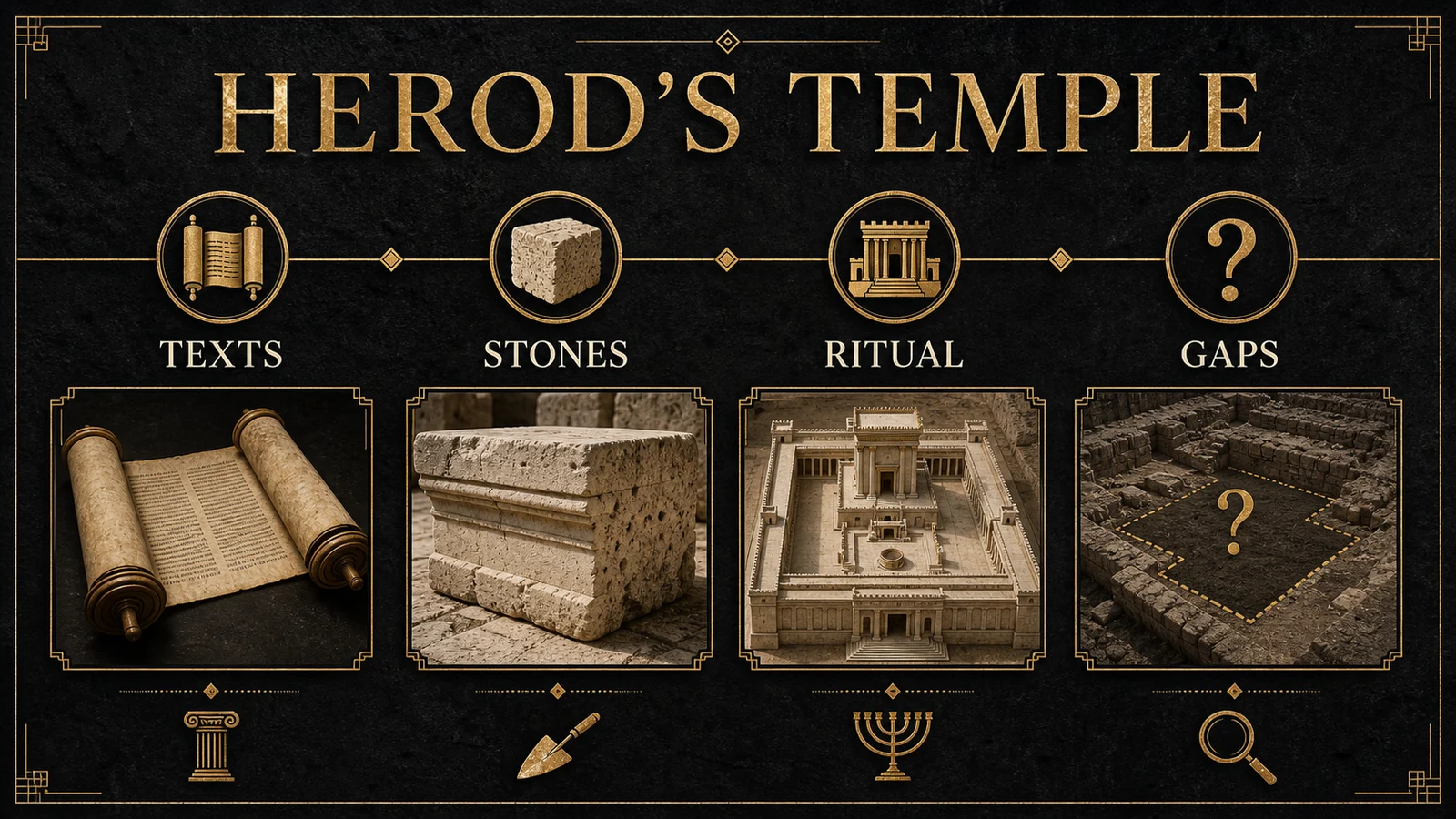
Credibility Check: What Is Solid and What Is Reconstructed?
- Solid: Herod’s expansion of the Temple Mount, surviving retaining-wall masonry, and Roman destruction in 70 CE.
- Well supported: The Temple’s pilgrimage, sacrificial, and priestly functions in late Second Temple Judaism.
- Partly reconstructed: The precise appearance of the sanctuary facade, decorative program, and some court arrangements.
- Unknown: A complete archaeological plan of the sanctuary building under the present sacred platform.
Biblical and Historical Sources
The Hebrew Bible describes the First Temple in the Solomonic tradition, but Herod’s Temple belongs to the Second Temple period. That means biblical memory, later Jewish literature, Josephus, the New Testament, rabbinic traditions, and archaeology all have to be read with genre in mind.
Bible Odyssey, drawing on the HarperCollins Bible Dictionary, frames the Temple as the religious structure at the center of Israelite national life and notes the two major reconstructions: after the exile and under Herod.
Gold imagery also appears across biblical religion, from sacred vessels to royal gifts and tabernacle language. For related background, see GoldConsul’s articles on gold in Solomon’s Temple, the golden altar of incense, and gold in ancient religions.
Gold, Splendor, and Temple Meaning
Ancient descriptions often emphasize the Temple’s brightness, white stone, ornament, and precious materials. Gold was not merely decoration. In sacred architecture, it could signal purity, separation, divine kingship, and the costly seriousness of worship.
Still, a careful historian separates symbolism from recoverable inventory. We can discuss gold as part of the Temple’s literary and ritual world, but we should avoid claiming that specific Herodian golden fittings survive unless a source actually demonstrates it.
That restraint is especially important because modern readers often arrive through treasure stories. The history of the Temple is more than missing gold; it is a record of worship, empire, identity, destruction, memory, and contested sacred space.
Why the Temple Was Destroyed
The Temple was destroyed in 70 CE during the First Jewish Revolt against Rome. Roman forces under Titus captured Jerusalem, and the sanctuary was burned and dismantled.
This destruction reshaped Judaism. Sacrifice could no longer continue at the Temple, and Jewish religious life developed around Torah study, prayer, synagogue practice, law, memory, and hope. The Temple also remained central to Christian interpretation and later Islamic sacred geography, making the site historically layered rather than single-purpose.
For broader religious symbolism around gold and worship, the article on the Golden Calf offers a useful contrast: gold could represent sacred offering, royal wealth, or idolatrous misuse depending on context.
Editorial Perspective
Editorial Perspective: The most responsible way to write about Herod’s Temple is to avoid both flattening and exaggeration.
It was a Jewish sacred institution, a Herodian prestige project, a Roman-period urban landmark, and a destroyed site remembered through texts, masonry, pilgrimage, and conflict. Strong claims should name their evidence level.
Knowledge Gap
Knowledge Gap: The biggest gap is the sanctuary building itself.
Because of the religious and political sensitivity of the Temple Mount, direct excavation of the central sacred platform is not comparable to ordinary archaeological sites. That makes nearby excavations, ancient texts, architectural parallels, and surviving retaining walls essential, but incomplete, evidence.
How to Read Claims About Herod’s Temple
Use a simple evidence filter before accepting dramatic claims:
- Does the claim refer to the Temple building, the Temple Mount platform, or the wider city?
- Is the evidence textual, archaeological, numismatic, architectural, or devotional tradition?
- Does the source distinguish Herod’s renovation from the earlier Second Temple?
- Does it acknowledge the 70 CE destruction and the limits of direct excavation?
- Is modern political meaning being smuggled into an ancient-history claim?
This filter does not make the subject less meaningful. It makes the meaning more defensible.
FAQ: Herod’s Temple
Was Herod’s Temple the same as the Second Temple?
Yes, in historical terms. Herod’s Temple was the grand renovation and expansion of the Second Temple, not a separate third temple.
When was Herod’s Temple built?
Herod’s major reconstruction is usually placed around 20/19 BCE, with work continuing for decades. The Temple was destroyed by Roman forces in 70 CE.
Does any part of Herod’s Temple still stand?
The sanctuary building does not stand. Parts of the Herodian Temple Mount retaining-wall system and surrounding archaeological remains survive, including sections associated with the Western Wall.
Was Herod’s Temple covered in gold?
Ancient descriptions emphasize splendor and precious materials, including gold, but surviving evidence is strongest for the stone platform and surrounding structures. Specific claims about surviving golden sanctuary fittings require caution.
Why is Herod’s Temple important today?
It remains central to Jewish historical memory and religious longing, important in Christian biblical interpretation, and part of a sacred landscape that also includes major Islamic holy sites. Its history therefore requires precision and respect.
Bottom Line
Herod’s Temple was the monumental late Second Temple of Jerusalem: a sacred Jewish center enlarged by a controversial king, documented by texts, partly visible through surviving Herodian masonry, and remembered through destruction in 70 CE.
The strongest account is neither treasure legend nor bare architecture. It is a layered history of worship, empire, stone, gold symbolism, and evidence limits.
 When you purchase a service or a product through our links, we sometimes earn a commission, at no extra cost to you.