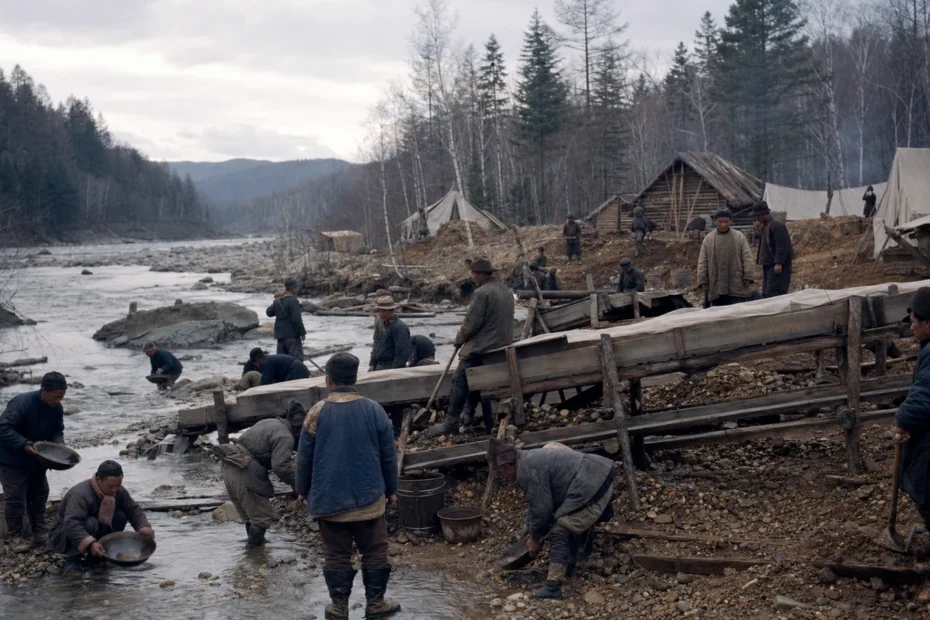
Explore the 1880s Amur gold rush: Zheltuga’s mixed mining camp, Qing suppression in 1886, and the organized Mohe mine that followed in 1888.
- The clearest Chinese gold-rush parallel was Zheltuga, a multi-ethnic illegal camp on Qing territory near the Amur from 1883 to 1886.
- Qing forces ended the settlement; the state then organized the nearby Mohe Gold Mine, operating from 1888 under official supervision.
- The episode reshaped border control, migration and mining finance, but population and production totals vary sharply by source.
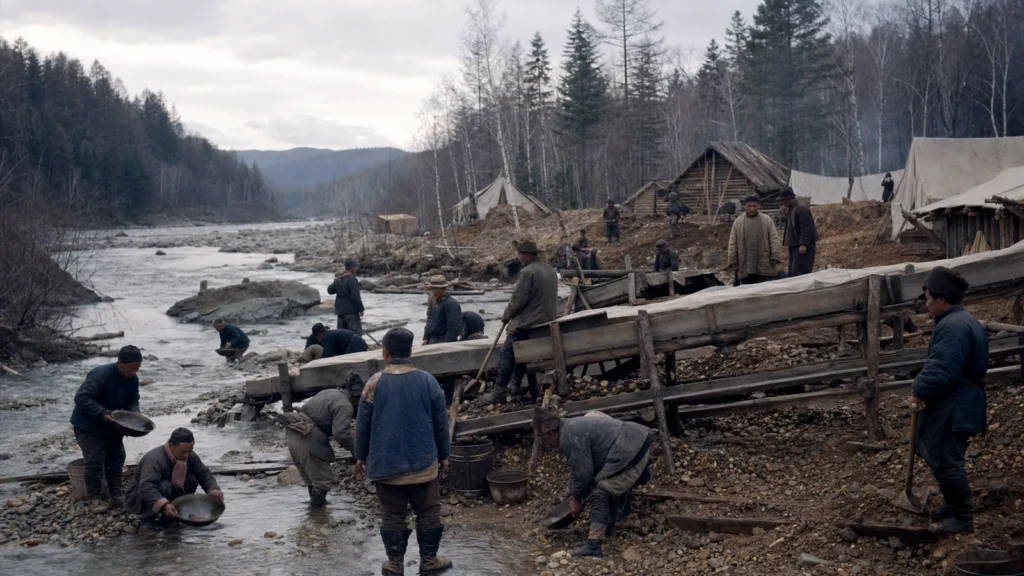
- Zheltuga and the Mohe Gold Mine were connected frontier episodes, not the same institution.
- Russian and Chinese miners—and people from other regional communities—joined the rush.
- The Qing state viewed unauthorized mining as a sovereignty and border-control problem.
- The later “Zheltuga Republic” label can overstate how formal or ideological the settlement was.
- Population, output and discovery stories vary sharply across later accounts.
A gold rush on an imperial border
The Amur frontier made mineral discovery inseparable from sovereignty. Gold seekers crossed or moved along a boundary contested by the Qing Empire and Imperial Russia, while the nearest administrative centers struggled to control a fast-growing camp.
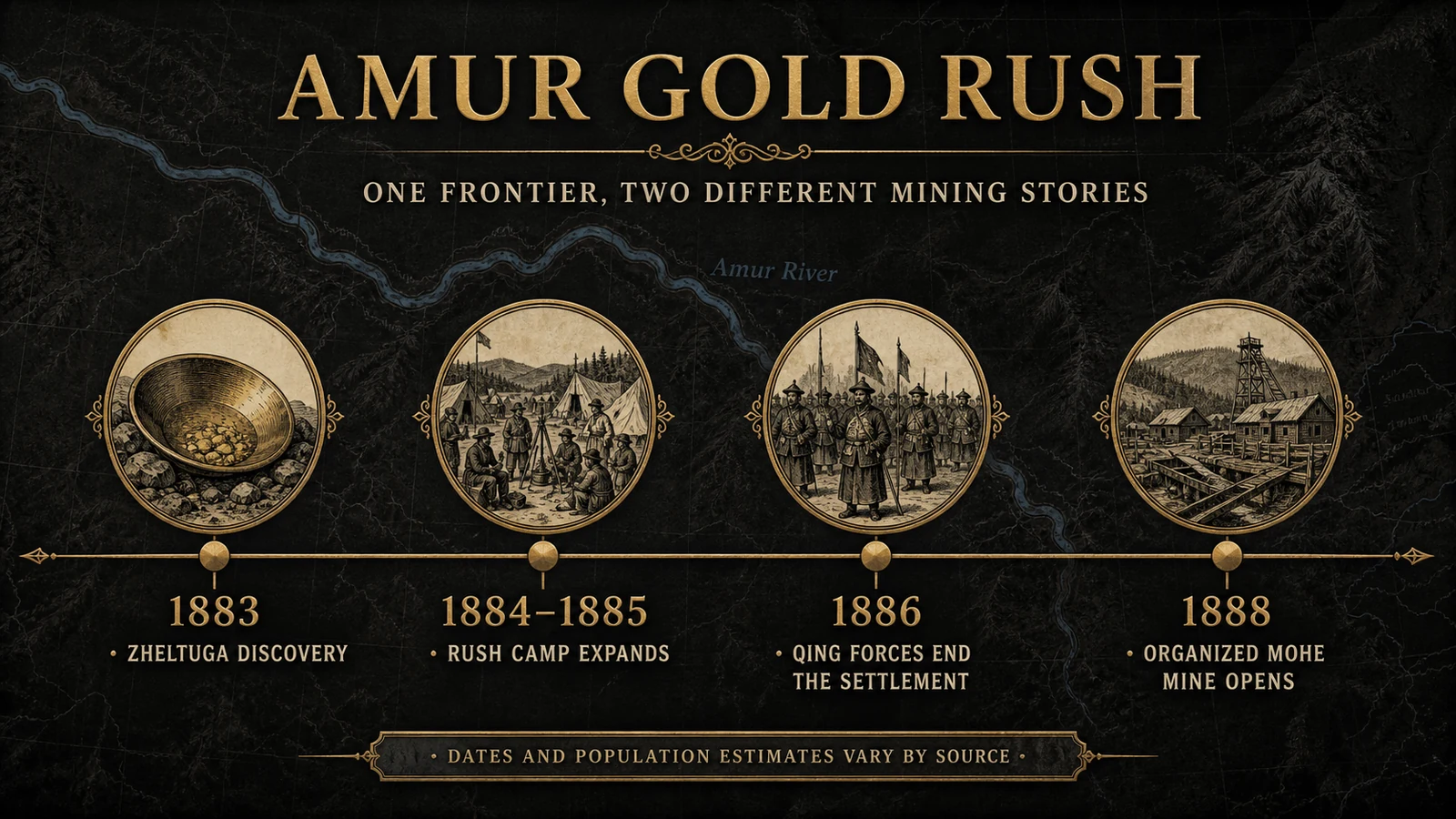
Zheltuga and Mohe: a practical timeline
| Date | Development | Why it matters |
|---|---|---|
| 1883 | Gold discovery reports draw miners to the Zheltuga/Albazi River area on Qing territory. | The discovery story has variants; the rush effect is better documented than one definitive discoverer. |
| 1884–1885 | The illegal camp expands into a large, mixed settlement with mining rules, commerce and coercive institutions. | Later writers compare it to California and call it a republic. |
| 1885–1886 | Qing pressure increases; troops clear the settlement and end unauthorized mining. | The action asserts territorial control and changes migration. |
| 1887–1888 | Li Jinyong prepares an organized mining enterprise; the Mohe Gold Mine begins operation in 1888. | Mining shifts from unauthorized rush camp to state-supervised commercial development. |
| 1889–1899 | Regional records describe a high period of officially supervised commercial production. | Gold revenue becomes tied to frontier administration and military finance. |
Why Zheltuga grew so quickly
Gold had already shaped migration across Siberia and the Russian Far East. When news spread of payable placer ground on the Chinese side of the Amur, Russian miners crossed illegally and Chinese workers and prospectors also arrived. The remote location offered opportunity but weak formal enforcement.
The settlement developed rules, leadership, courts, taxation and armed enforcement because thousands of people needed claims, trade and order. Yet the peer-reviewed Cambridge reassessment cautions that later accounts helped invent a more romantic and politically coherent “republic” than contemporary evidence supports.
Who participated?
Russian and Chinese participants dominated many accounts, but the frontier was ethnically and linguistically diverse. Indigenous peoples of the Amur region, migrants, traders, laborers, service workers and armed figures all appear unevenly in the record. The category “miner” can conceal major differences in ownership, labor, risk and access to claims.
Population estimates ranging into the many thousands should be treated as ranges, not a census. The academic reconstruction of Zheltuga describes a proto-state-like social organization, while other scholarship emphasizes the mythology created by later narratives.
Why the Qing ended the settlement
Unauthorized extraction removed resources from Qing territory and challenged the state’s ability to police its frontier. The presence of many Russian subjects also made the camp a diplomatic and sovereignty issue. Expulsion was therefore more than a response to crime or disorder.
After the camp was suppressed, the Qing did not simply abandon the goldfield. Regional chronology and a recent Chinese historical study date the organized Mohe enterprise to the Guangxu era, with operation beginning in 1888. Official supervision sought both revenue and territorial control.
Mining methods and environmental cost
Zheltuga was primarily a placer rush: workers dug and washed river gravels, using water and gravity to separate dense gold. Such methods required timber, diverted water, disturbed channels and generated tailings. The organized mine could bring more capital and administration without eliminating environmental or labor costs.
For process context, compare gold mining methods, early mining techniques, gold mining in ancient China, the wider gold-rush era, the Black Hills rush and Nome.
- Does the source distinguish Zheltuga from the official Mohe mine?
- Does it identify whether a date comes from a contemporary record or later retelling?
- Is a population number a census, estimate or repetition?
- Does “republic” describe documented institutions or later romantic language?
- Are Chinese, Russian and Indigenous participants treated with source-supported specificity?
- Are gold-output figures tied to a unit, period and geography?
Was this China’s California Gold Rush?
“California on the Amur” captures the rapid migration, rough settlement and placer speculation. It can also mislead by importing a U.S. frontier script. Zheltuga arose between two empires, on Qing territory, with cross-border movement and a later state mine designed to consolidate border rule.
China’s longer mining history is broader than this episode. Major regions such as Jiaodong have ancient and modern importance, but “gold rush in China” is best answered with this specific 1880s Amur case rather than a collage of unrelated modern production statistics.
What official supervision meant at Mohe
The Qing model is often summarized as official supervision and merchant management. The state authorized and monitored a commercial operation while relying on managers, investors, labor and technical expertise. Revenue could support provincial administration and frontier defense.
Li Jinyong became central to the Mohe story because he was assigned to prepare and lead the mine. The enterprise required transport, equipment, supplies, accounts and labor control—systems different from an improvised placer camp. It also strengthened Qing administrative presence in a remote region.
How the episode changed the frontier
- Migration: gold drew workers and traders toward a sparsely administered border.
- Security: unauthorized cross-border movement exposed weak enforcement.
- Finance: organized mining offered revenue for military and civil administration.
- Infrastructure: supply routes and settlements became tied to extraction.
- Memory: later narratives transformed a labor camp into an “Amur California” or romantic republic.
These effects continued beyond one rush. Research on Manchurian mining connects Mohe and other sites to a wider reorganization of Qing frontier governance from the 1880s into the early twentieth century.
Knowledge Gap and Editorial Perspective
Surviving accounts disagree about the discoverer, peak population, leadership titles and output. Russian-language, Chinese and later European narratives were created for different audiences and sometimes turned a mining camp into a political legend.
Read Zheltuga as a border and labor story, not only an adventure. The key transition is from unauthorized rush settlement to Qing-supervised mining: gold changed who moved, who governed and who captured revenue.
Video walkthrough: This narrative reconstructs Zheltuga visually; use the academic sources in this guide to separate documented facts from dramatic framing.
Bottom Line
The 1880s Amur gold rush produced Zheltuga, a short-lived unauthorized settlement ended in 1886, and helped prompt the organized Mohe mine from 1888. Keeping those stories separate makes China’s gold-rush history more accurate.
FAQ: Gold Rush in China
When did the Chinese gold rush begin?
The best-documented Amur rush began around Zheltuga in 1883 and expanded during 1884–1885.
Where was Zheltuga?
It was on Qing territory in the Amur basin near today’s Mohe and the Russian border.
Was Zheltuga really a republic?
It had organized institutions, but scholars caution that the formal “republic” image was amplified by later storytelling.
Why did the Qing government close it?
Unauthorized mining challenged resource control, public order, diplomacy and Qing sovereignty on a sensitive frontier.
Was the Mohe Gold Mine the same as Zheltuga?
No. The Mohe mine was a later Qing-authorized enterprise that began operating in 1888 after Zheltuga had been suppressed.
Sources and verification
- Cambridge Core — How a Republic of Chinese Red Beards Was Invented in Paris — Peer-reviewed reassessment of Zheltuga and the later “republic” label.
- ScienceDirect — Zheltuga Republic: Social Development at the Chinese-Russian Border — Academic reconstruction of the illegal mining settlement and its institutions.
- CNKI — Qing Court and Tsarist Russia During Mohe Gold Mining — Chinese academic abstract dating organized Mohe mining to 1888 and emphasizing border conflict.
- Heilongjiang Gazetteer — Mohe Gold Mining — Regional historical chronology of Qing preparation and the state-supervised commercial mine.
- ScienceDirect — History and Economics of Gold Mining in China — Broader historical and geological context for Chinese gold mining.
- Bazaar of YouTube — The Golden Republic — Visual narrative of Zheltuga; sensational framing is checked against the academic sources above.
 When you purchase a service or a product through our links, we sometimes earn a commission, at no extra cost to you.