
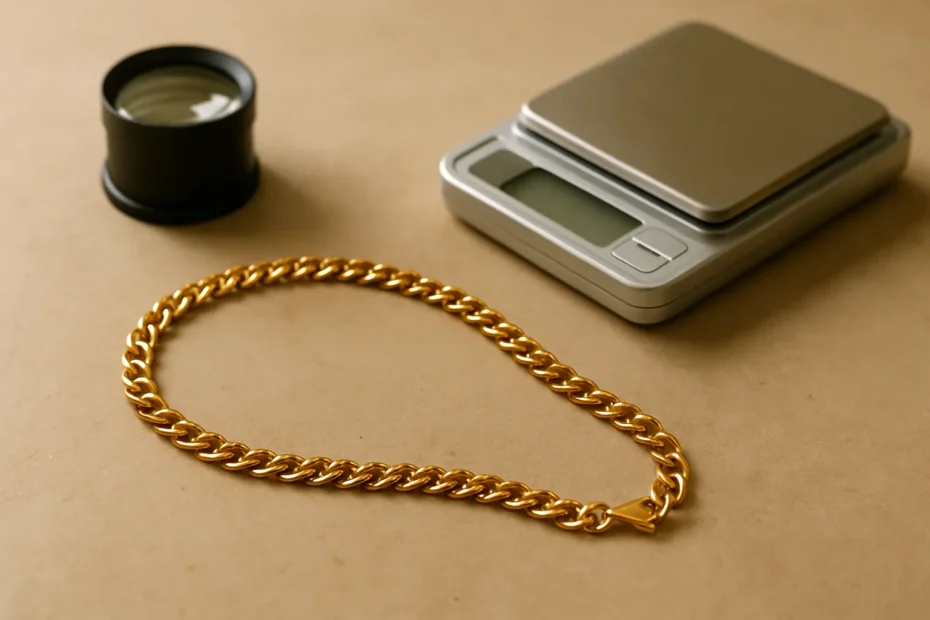
Short answer: NuraGold sells real-gold jewelry lines, but buyers still need to verify the specific listing they are buying. The biggest mistakes happen when people assume “brand name” automatically means “solid gold item” without checking karat, construction type, seller identity, and return terms.
TL;DR
- NuraGold can be real gold, but not every listing has the same construction type.
- Always verify karat mark (10K/14K/18K), seller identity, and product details.
- “Real gold” does not always mean solid; hollow and plated products behave differently.
- For high-ticket buys, confirm with a professional jeweler test within the return window.
Is NuraGold Real Gold?
Yes, NuraGold offers genuine gold jewelry in multiple karat options. But the useful question is not only “is the brand real,” it is “is this exact listing the exact gold product I think it is?”
That means checking four things before purchase:
- the stated karat (10K, 14K, 18K)
- construction (solid vs hollow vs plated/filled)
- who is actually selling the item (official vs third-party seller)
- return and verification window
If you are unsure how karat translates into actual value, see our related explainer on how karat affects gold worth.
What Most Buyers Miss
Most disputes are not “fake vs real” in a simple sense. They are usually expectation mismatches about construction type, weight, and seller/channel details.
Brand Authenticity vs Listing Authenticity
This is the key knowledge gap. A brand can be legitimate while a specific listing still has incomplete or confusing details. Always separate:
- Brand-level legitimacy: whether the brand exists and sells gold products.
- Listing-level accuracy: whether this exact item description matches what you receive.
For broader consumer protection framing, review the FTC guidance on buying precious-metal jewelry at consumer.ftc.gov.
The GoldConsul Editorial Perspective
Treat gold-jewelry buying like a verification workflow, not a trust shortcut. You protect your money by validating the listing data, then validating the physical item within return eligibility.
Solid, Hollow, Plated, Filled: Why the Label Changes the Outcome
Many buyers search “is it real gold” when the bigger issue is product class:
| Type | What It Means | Practical Impact |
|---|---|---|
| Solid gold | Gold alloy throughout | Best durability/resale profile |
| Hollow gold | Gold alloy shell with less mass | Lighter; can dent easier |
| Gold-filled | Thick bonded outer layer | Not same as solid gold value |
| Gold-plated | Thin surface layer over base metal | Usually weakest long-term resale case |
For durability context, compare with our guides on white-gold maintenance cycles and how to verify rose gold.
Knowledge Gap: “Real Gold” and “Good Buy” Are Not the Same Decision
A piece can be genuine gold alloy and still be a weak purchase if pricing, weight, or resale assumptions are wrong.
- Verification question: Is the metal claim accurate?
- Value question: Is the price fair for weight, karat, and construction?
- Execution question: Can you validate and return easily if mismatch appears?
Buy-Safe Verification Checklist (Use Before and After Delivery)
- Confirm karat is stated clearly in title/details (10K/14K/18K).
- Check whether the listing says solid, hollow, filled, or plated.
- Confirm seller identity and return policy terms before checkout.
- On delivery, inspect hallmark and weight consistency with listing data.
- For expensive items, do a jeweler verification within return window.
When to Escalate to a Professional Test
If the price is high, the listing is ambiguous, or the hallmark/weight feels inconsistent, move beyond home checks. A jeweler can use stronger methods (for example XRF-based testing) and provide a clearer validation basis.
You can also review complaint patterns and seller-response history through profiles like BBB records as one additional risk signal, not as the only decision factor.
Video walkthrough: watch this buyer-oriented walkthrough to see common expectation gaps before purchase.
Bottom Line
NuraGold can be real gold, but intelligent buying depends on listing-level verification, not brand-name assumptions. Validate karat, construction type, seller identity, and return/testing workflow before you commit.
For additional value framing, see what hollow gold means and how price headlines can mislead across asset types.
FAQ: Is NuraGold Real Gold?
Is NuraGold solid gold or plated gold?
How can I verify a NuraGold chain after delivery?
Does 14K automatically mean high resale value?
What is the biggest buying risk with marketplace jewelry?
Should I avoid NuraGold entirely?
 When you purchase a service or a product through our links, we sometimes earn a commission, at no extra cost to you.