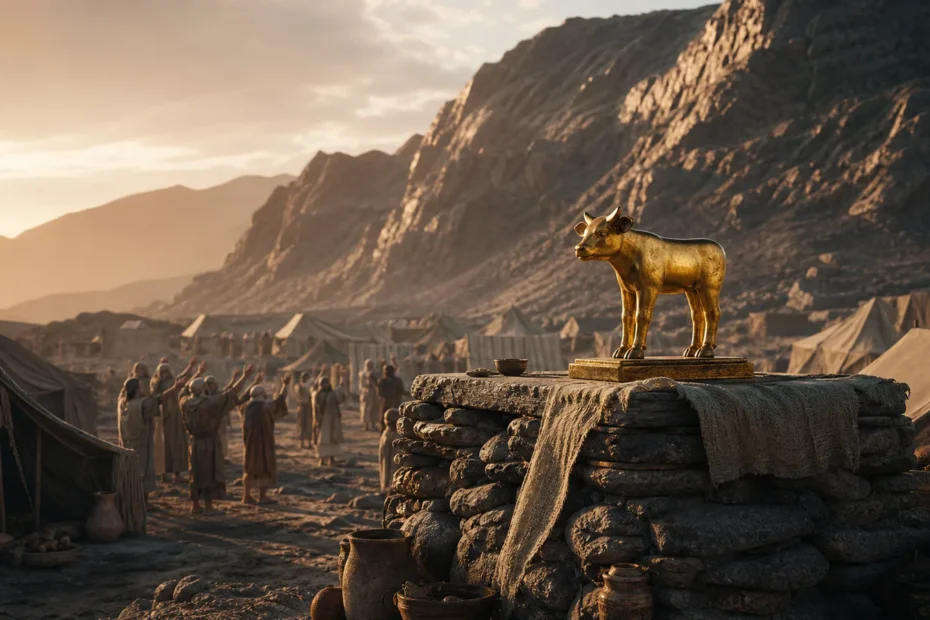
Understand the Golden Calf story through biblical context, symbolism, ancient worship, gold imagery, and the limits of historical evidence behind the account.
- The story links gold with fear, power, visible symbols, and misplaced trust.
- Read Exodus 32 in context before reducing it to a simple idol tale.
- Separate biblical meaning from later art, sermons, and popular shortcuts.
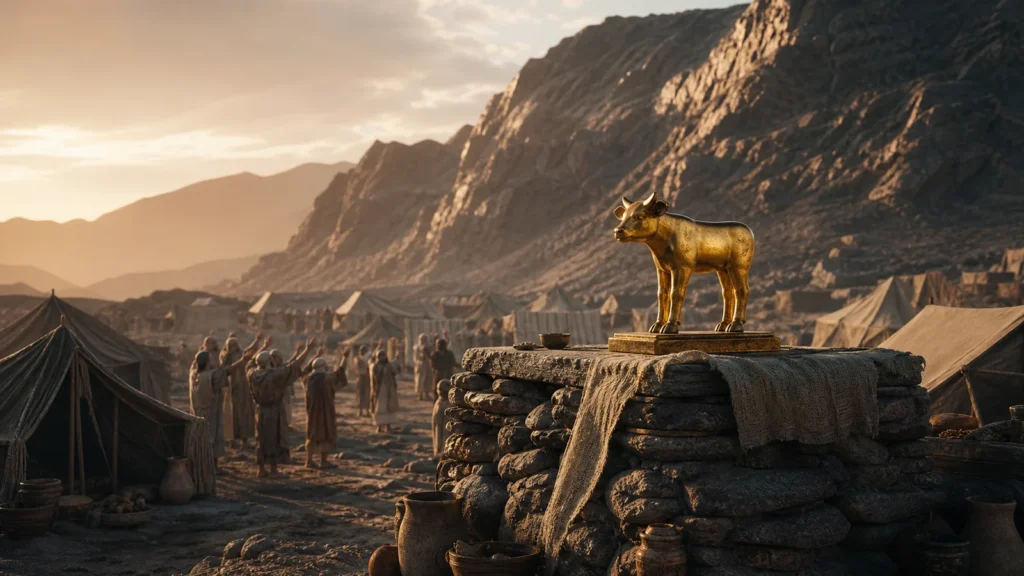
The golden calf story is one of the Bible’s sharpest scenes about gold, power, fear, and misplaced trust. It appears most fully in Exodus 32 , where the Israelites ask Aaron for a visible divine symbol while Moses is absent on Sinai.
The golden calf story is one of the Bible’s sharpest scenes about gold, power, fear, and misplaced trust. It appears most fully in Exodus 32, where the Israelites ask Aaron for a visible divine symbol while Moses is absent on Sinai.
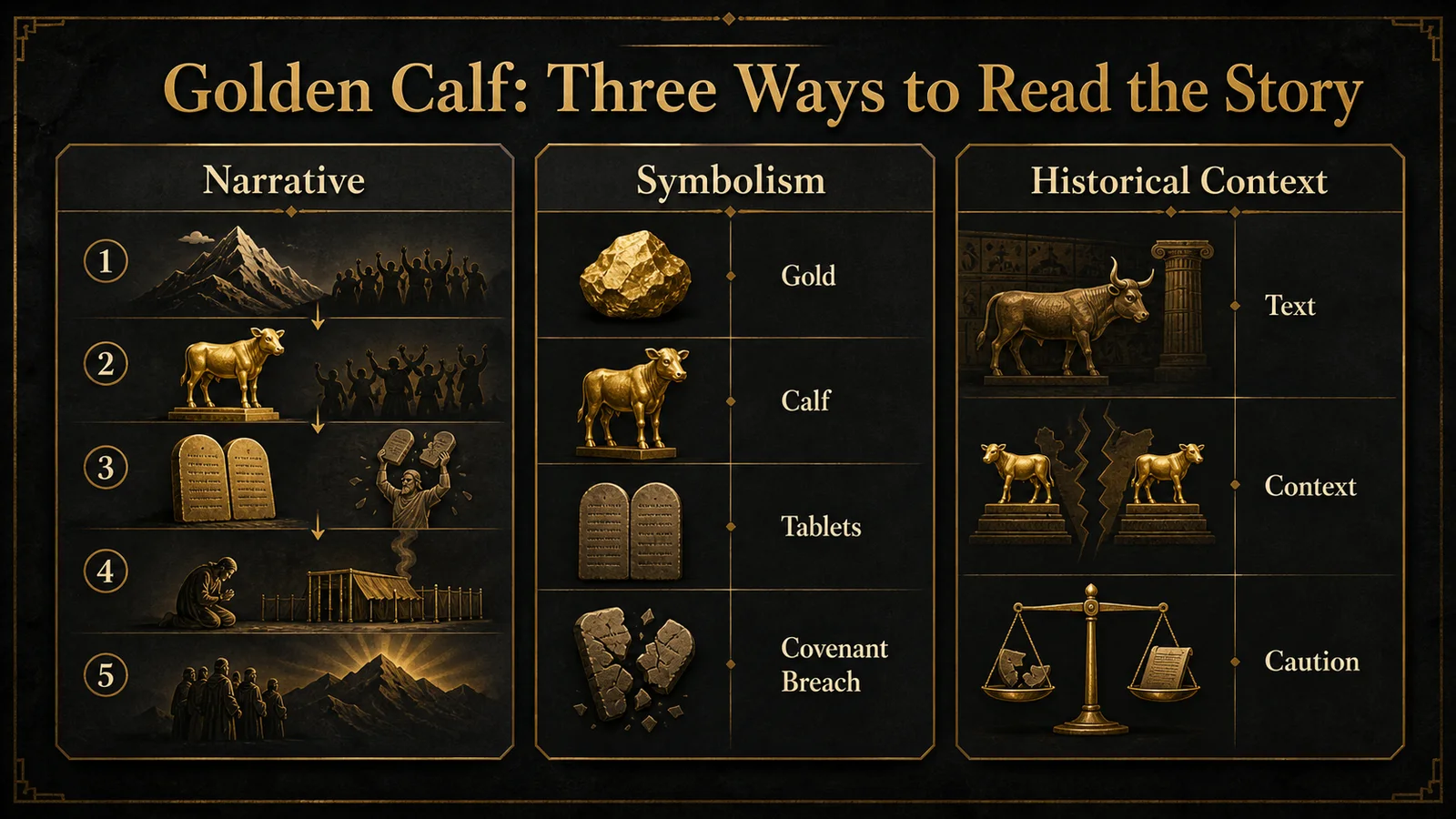
This article reads the episode in three layers: what the biblical narrative says, what the calf and gold symbolize, and what historians can cautiously say about the ancient Near Eastern setting.
TL;DR: The Golden Calf in One Minute
- The golden calf is a biblical image of covenant failure, not a confirmed archaeological object.
- In Exodus 32, Aaron makes the calf from donated gold jewelry while Moses is on Mount Sinai.
- The calf likely draws on familiar ancient bull imagery, but the text’s main concern is theological loyalty.
- Jeroboam’s later calves at Bethel and Dan show how calf imagery also became political in ancient Israel.
- For gold history, the episode shows how precious metal could become a public symbol of wealth, legitimacy, and religious danger.
What Is the Golden Calf Story?
In the Exodus narrative, Moses goes up Mount Sinai to receive the covenant tablets. The people become anxious during his absence and ask Aaron to make “gods” to go before them.
Aaron collects gold earrings, forms a calf, builds an altar, and announces a festival. The people sacrifice, eat, drink, and celebrate around the image.
When Moses descends, he breaks the tablets, destroys the calf, confronts Aaron, and intercedes for the people. The story ends with judgment and with the covenant relationship wounded but not abandoned.
That narrative frame matters. The text is not simply saying “gold is bad.” Gold also appears positively in the tabernacle, priestly objects, and temple traditions. Gold becomes dangerous here because it is turned into a rival focus of trust and worship, a theme that also appears in GoldConsul’s guide to gold in biblical times.
Narrative Timeline: Exodus 32
| Stage | What Happens in the Text | Why It Matters |
|---|---|---|
| Moses is absent | The people fear that Moses may not return. | The crisis begins with uncertainty, not with a formal plan to abandon the covenant. |
| Gold is collected | Aaron asks for gold earrings and shapes the material into a calf. | Personal wealth becomes public religious imagery. |
| Festival is declared | Aaron announces a festival “to the Lord” before the calf. | The transgression may involve confused worship, not only outright replacement. |
| Moses returns | He breaks the tablets and destroys the calf. | The broken tablets dramatize a broken covenant. |
| Intercession follows | Moses pleads for the people after judgment. | The story holds judgment and mercy together. |
Why a Calf, and Why Gold?
The calf is usually read against the wider world of ancient bull symbolism. Bulls could represent strength, fertility, royal power, or divine presence in several ancient Near Eastern cultures.
That does not prove the Exodus calf was a direct copy of one specific Egyptian or Canaanite deity. It does show why a bovine image would have been an intelligible symbol in the region.
Gold added another layer. It was rare, durable, bright, and socially visible. In ancient religious art and elite display, gold could suggest permanence and authority. GoldConsul’s broader article on gold trade and economy in ancient times gives useful background on why the metal carried so much symbolic weight.
History-Claim Credibility Check
High confidence
Exodus 32 and 1 Kings 12 are the core biblical texts for the Golden Calf tradition.
Moderate confidence
Calf and bull imagery fits known ancient Near Eastern symbolic patterns, though exact dependence is debated.
Low confidence
Claims that archaeologists have identified the specific Exodus calf should be treated as unsupported.
The Golden Calf as Symbolism, Not Just Incident
The power of the story comes from its symbolism. A frightened community wants something visible, immediate, and controllable. Gold turns that desire into an object.
The calf therefore becomes more than an idol in the narrow sense. It is a substitute for patient trust, a visible replacement for a difficult covenant, and a political object around which a crowd can organize.
| Symbol | Narrative Role | Interpretive Caution |
|---|---|---|
| Gold | Wealth is redirected into religious display. | The Bible does not condemn gold itself. |
| Calf | A visible image becomes the focus of celebration. | Its precise cultural model is uncertain. |
| Tablets | Moses breaks them when he sees the scene. | The action is symbolic within the story, not an archaeological datapoint. |
| Mountain | Sinai separates revelation from impatience below. | Location debates should not be confused with the narrative’s theological point. |
Historical Context: Bull Imagery in the Ancient Near East
Many readers connect the calf with Egypt, especially because the story follows the Exodus from Egypt. Britannica summarizes the traditional comparison with Egyptian and Canaanite bull symbolism.
That comparison is plausible as cultural context, but it should not be overstated. Exodus 32 is a literary and theological narrative preserved in Israel’s scriptures. It is not a neutral excavation report.
For GoldConsul readers, the useful point is narrower: gold objects in ancient religion often carried meaning beyond material value. That pattern also appears in discussions of gold in ancient religions and in specific sanctuary objects such as the golden altar of incense.
Jeroboam’s Golden Calves: A Second Layer
The Golden Calf theme does not end in Exodus. In 1 Kings 12, Jeroboam I sets up calves at Bethel and Dan after the kingdom divides.
That later scene is political as well as religious. Jeroboam wants northern worship centers that reduce dependence on Jerusalem. The calves become symbols of statecraft, identity, and disputed worship.
TheTorah.com is especially useful here because it reads the Sinai calf and Jeroboam’s calves together, showing how later political memory can echo through the Exodus story.
What the Story Does Not Prove
The Golden Calf is often used too quickly. It does not prove that ancient Israelites were simply Egyptian idol worshippers. It does not prove that a particular museum object is the biblical calf. It does not prove that biblical authors opposed all material beauty.
It does show a recurring biblical anxiety: a community can use wealth, ritual, and leadership language to make disobedience look normal. That is why the episode remains central in Jewish and Christian interpretation.
Editorial Perspective
Our reading treats the Golden Calf as a biblical narrative first and a historical-context question second. That is the most responsible order: start with what the text says, compare it with ancient Near Eastern patterns, and avoid turning plausible background into proof.
Knowledge Gap
No surviving artifact can be securely identified as Aaron’s Golden Calf. The strongest evidence is textual: Exodus 32, later biblical references, and the way calf imagery is reused in the northern kingdom story. Archaeology can illuminate the world of bull imagery, but it cannot verify every narrative detail.
Why Gold Matters in the Golden Calf Story
Gold is not incidental. The story turns household jewelry into a communal object, then turns that object into a crisis.
That movement helps explain why gold is so potent in ancient texts. It can honor sacred space, as in temple and tabernacle traditions. It can also concentrate prestige so strongly that the object begins to compete with the truth it was supposed to serve.
For wider context on gold as a cultural and economic material, see GoldConsul’s guides to gold mining in ancient Mesopotamia and gold in medieval myths and legends.
Bottom Line
The Golden Calf is best read as a layered story. In the biblical narrative, it is a breach of covenant. In symbolic terms, it shows how fear can turn wealth into a false center of trust. In historical context, it belongs to a world where bull imagery and gold both carried public authority.
The careful reading is neither dismissive nor sensational. It respects the text, uses history where history helps, and admits where the evidence stops.
FAQ: The Golden Calf
What is the Golden Calf in the Bible?
The Golden Calf is the idol made by Aaron in Exodus 32 while Moses is on Mount Sinai. The people use donated gold to create a calf image and celebrate around it, leading to a major covenant crisis.
Was the Golden Calf a real historical object?
The biblical story presents it as a made object, but no artifact has been verified as the Exodus calf. Historically, the strongest evidence is the text itself plus broader context for bull imagery in the ancient Near East.
Why did Aaron make a calf from gold?
In the story, Aaron responds to public pressure after Moses’ long absence. Gold gives the image prestige, and the calf shape likely draws on familiar regional symbols of strength and divine or royal power.
Does the Golden Calf story mean gold is sinful?
No. Biblical texts also use gold positively in sacred objects and temple imagery. The problem in Exodus 32 is not the metal itself but the use of gold as an object of misplaced worship and trust.
How are Jeroboam’s golden calves connected to Exodus 32?
Jeroboam’s calves in 1 Kings 12 echo the language and imagery of Exodus 32. They show how calf imagery could become politically useful in ancient Israel, especially after the kingdom divided.
 When you purchase a service or a product through our links, we sometimes earn a commission, at no extra cost to you.