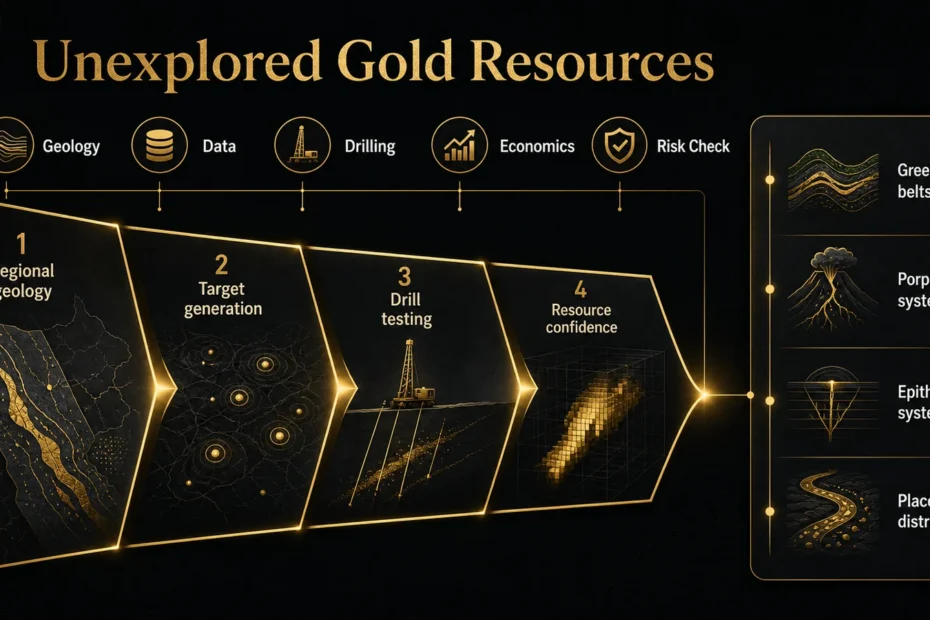
Evaluate unexplored gold resources by geology, access, permitting, infrastructure, economics, environmental risk, and why potential is not the same as value.
- Unexplored resources are possibilities, not proven deposits or reserves.
- Geology signals need drilling, assays, permits, and economics before value exists.
- Treat early exploration as high-risk until data and ownership are verified.
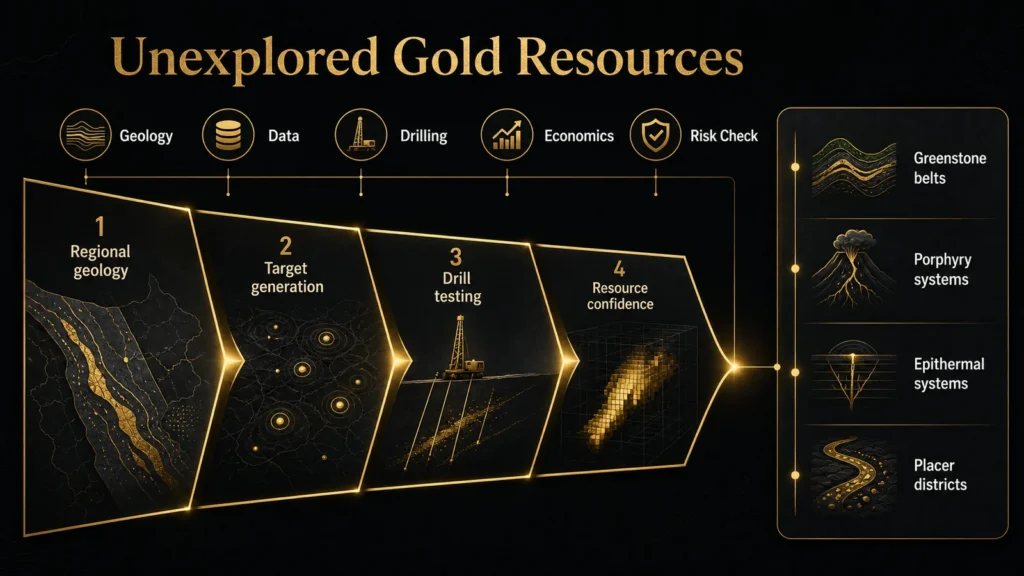
Unexplored gold resources are not hidden vaults waiting for a lucky guess. They are geological possibilities that have not yet been tested well enough to become defined deposits, reserves, or mines.
The practical question is simple: where can modern geology, better data, and disciplined due diligence still turn uncertainty into a credible gold opportunity?
TL;DR
- Unexplored gold resources are early-stage targets, not proven reserves.
- The strongest opportunities combine favorable geology, credible data, access, permitting clarity, and realistic economics.
- Greenstone belts, porphyry systems, epithermal districts, Carlin-type trends, and reworked placer fields all need different evidence.
- Due diligence should test the geology first, then ownership, metallurgy, infrastructure, environmental risk, and funding path.
- For investors, the main danger is promotional language that treats exploration potential as if it were mineable gold.

What “Unexplored” Really Means
In gold exploration, “unexplored” rarely means nobody has ever walked the ground. It usually means the area has limited modern drilling, incomplete geophysics, patchy geochemistry, old assays, poor mapping, or a known district that was ignored when gold prices, technology, or access conditions were different.
That distinction matters. A mineral occurrence, a historical showing, a geochemical anomaly, and a compliant mineral resource are not the same thing. The U.S. Geological Survey Mineral Commodity Summaries separates broad resources from economic reserves because confidence, recoverability, and market conditions change the meaning of the ounces.
If you are new to the geology, start with the basics of gold ore and how to identify gold ore. Most exploration mistakes begin when visual excitement outruns evidence.
Why Unexplored Gold Resources Still Exist
Gold has been mined for thousands of years, but exploration coverage is uneven. Remote terrain, political risk, deep cover, small historic datasets, and low past gold prices left many regions only lightly tested.
Modern exploration can reopen these areas with satellite imagery, airborne magnetics, gravity surveys, hyperspectral mapping, machine-learning target ranking, and deeper drilling. Those tools do not create gold, but they can expose patterns that old prospectors and shallow programs missed.
The supply context is also important. The World Gold Council reported record annual gold supply and mine production for 2025, yet mine growth remains hard-won because new deposits take years to define, permit, finance, and build.
Resource, Geology, and Opportunity Table
| Resource setting | Geology signal | Opportunity | Main caution |
|---|---|---|---|
| Greenstone belts | Shear zones, quartz-carbonate veins, structural repetition | Can host high-grade lodes and district-scale extensions | Grade continuity can be difficult to prove |
| Porphyry copper-gold systems | Large alteration halos, stockwork veining, copper association | Large tonnage potential with by-product economics | Low grades require scale, infrastructure, and metallurgy |
| Epithermal districts | Veins, breccias, silica caps, pathfinder elements | Shallow discoveries can move quickly from target to drilling | Bonanza samples may not represent mineable width |
| Carlin-type trends | Micron gold, arsenic-antimony-mercury signature, carbonate hosts | Covered targets can remain underexplored beside mature districts | Gold is often invisible and requires disciplined assays |
| Placer and paleoplacer fields | Ancient channels, heavy mineral traps, reworked gravels | Useful for small-scale and district-history clues | Recoverable grade can vary sharply over short distances |
Where Opportunity Is Most Often Misread
The weakest exploration stories usually lean on one attractive fact: a famous district nearby, one spectacular rock-chip assay, an old mine name, or a large land package. None of those facts is worthless, but none is enough.
A serious target needs a chain of evidence. Regional geology should explain why gold could be present. Surface work should narrow the target. Drilling should test the model. Metallurgy should show that gold can be recovered. Economics should survive realistic costs.
This is why articles about gold mining methods, major gold mining companies, and testing gold all point back to the same principle: verification beats story.
Editorial Perspective
The best unexplored gold resource is not the one with the loudest headline. It is the one where each new piece of evidence narrows uncertainty instead of asking readers or investors to ignore it.
Risk and Due-Diligence Checklist
Use this checklist before treating any unexplored gold resource as an opportunity. It applies whether you are reading a company presentation, reviewing a private claim, or comparing exploration districts.
- Geological model: Is the deposit type named, and does the evidence actually fit it?
- Assay quality: Are samples from channel cuts, drill core, or selective rock chips?
- Scale: Is there enough strike length, width, depth, and continuity to matter?
- Metallurgy: Is the gold free-milling, refractory, fine-grained, or tied to sulfides?
- Land status: Are claims, licenses, royalties, surface rights, and community agreements clear?
- Permitting: Are water, tailings, habitat, cultural heritage, and closure obligations realistic?
- Infrastructure: Is there road, power, water, labor, and processing access?
- Capital path: Can the owner fund drilling without excessive dilution or promotional financing?
- Responsible sourcing: Does the project fit modern expectations for traceability and ethical supply? The LBMA Responsible Sourcing Programme is a useful benchmark for downstream expectations.
- Comparable deposits: Are comparisons geological and economic, or just marketing name-dropping?
Educational note: This article is for general education only. It is not financial, investment, legal, tax, or mining-permit advice. Exploration projects can lose capital even when the geology is interesting.
Knowledge Gap: The Missing Middle
Public discussions often jump from “gold found” to “mine potential.” The missing middle is resource definition: enough drilling, sampling, modeling, recovery testing, and cost work to estimate what might be mined under real constraints.
This gap is especially visible in old districts. Historical mining can prove that gold existed, but it does not automatically prove that remaining material is economic today. Some lost gold mines are historically fascinating and commercially weak. Some dull-looking extensions become valuable only after systematic drilling.
How to Read an Exploration Opportunity
A useful review starts with the deposit type and works outward. If a company claims a greenstone-hosted lode target, look for structural controls, alteration, vein orientation, drill intercept widths, and repeatability. If it claims a porphyry target, look for alteration zoning, geophysics, copper-gold relationships, and scale.
Then ask whether the project can become a mine even if the gold is real. A deposit in a remote area with no water, difficult permitting, poor metallurgy, and no processing route may need exceptional grade to compete. A modest-grade target near roads, power, mills, and skilled labor can sometimes be more practical.
Regional examples can help with context, but they should not be copied blindly. A placer-oriented article such as gold mining in Arizona answers different questions than a district-scale hard-rock exploration thesis.
Bottom Line
Unexplored gold resources are best understood as structured uncertainty. They can become valuable when geology, data, access, metallurgy, and economics align, but they remain speculative until drilling and technical work improve confidence.
The pragmatic approach is to respect the upside without borrowing certainty from the future. Look for evidence that compounds, risks that are named clearly, and management teams that explain what must still be proven.
FAQ: Unexplored Gold Resources
Are unexplored gold resources the same as gold reserves?
No. A reserve is the economically mineable part of a measured or indicated resource after technical and economic studies. An unexplored resource is much earlier and may never become a reserve.
What is the best sign of a credible unexplored gold target?
The best sign is a coherent evidence chain: favorable geology, repeatable geochemistry, geophysics that fits the model, and drilling that tests the target rather than only supporting a story.
Can old mining districts still hold undiscovered gold?
Yes. Old districts can retain deep, covered, low-grade, refractory, or structurally complex targets that historic miners could not detect or process. The opportunity still needs modern evidence.
Why do exploration projects fail even after good assays?
Good assays can fail to become mines because of poor continuity, narrow widths, difficult metallurgy, high strip ratios, weak infrastructure, permitting limits, or financing problems.
How should investors approach unexplored gold resources?
Treat them as speculative exploration, not as established gold ownership. Review technical reports, funding needs, jurisdiction, dilution risk, and whether the company clearly separates targets from defined resources.
 When you purchase a service or a product through our links, we sometimes earn a commission, at no extra cost to you.