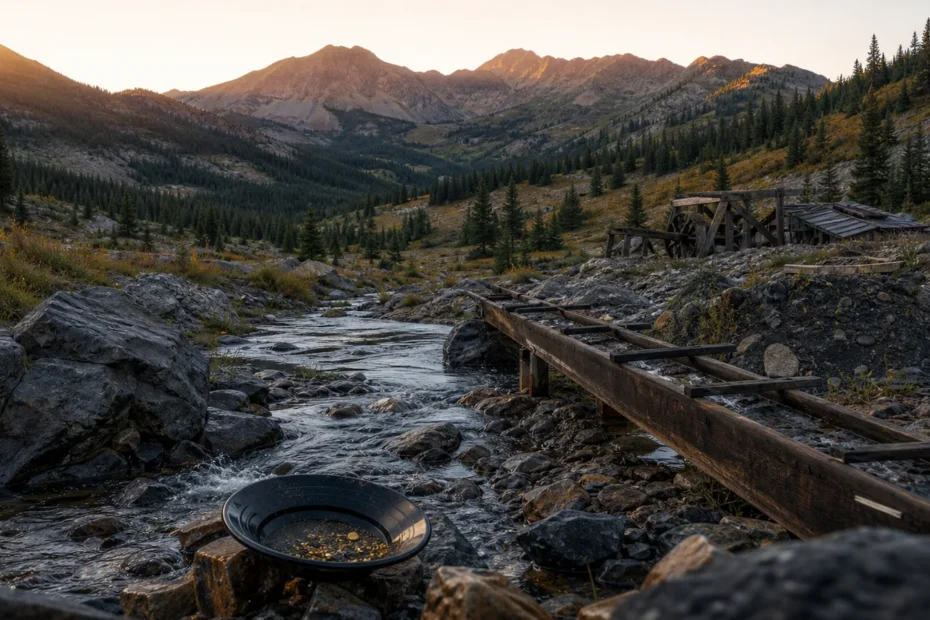
Review Montana gold mining by district, geology, placer history, public land rules, safety, and realistic expectations before prospecting or assessing claims.
- Montana prospecting starts with geology, land status, and disturbance rules.
- Historic placer districts do not guarantee legal or productive access today.
- Match your method to public-land rules before sampling a stream or claim.
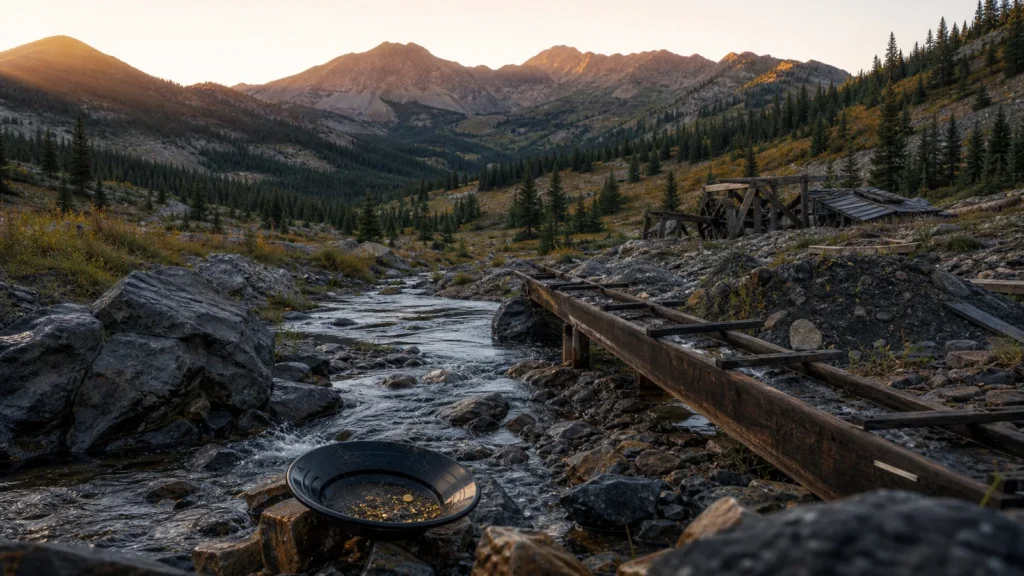
Gold mining in Montana is a story of rich placer strikes, hard-rock camps, copper byproduct gold, and modern public-land rules that are easy to misunderstand. The state still attracts recreational panners, but the useful question is no longer simply where gold was found.
The better question is: what kind of ground are you looking at, who controls it, and what level of disturbance is legal today? This guide explains Montana’s main gold districts, geology, history, and a practical prospecting checklist for modern readers.
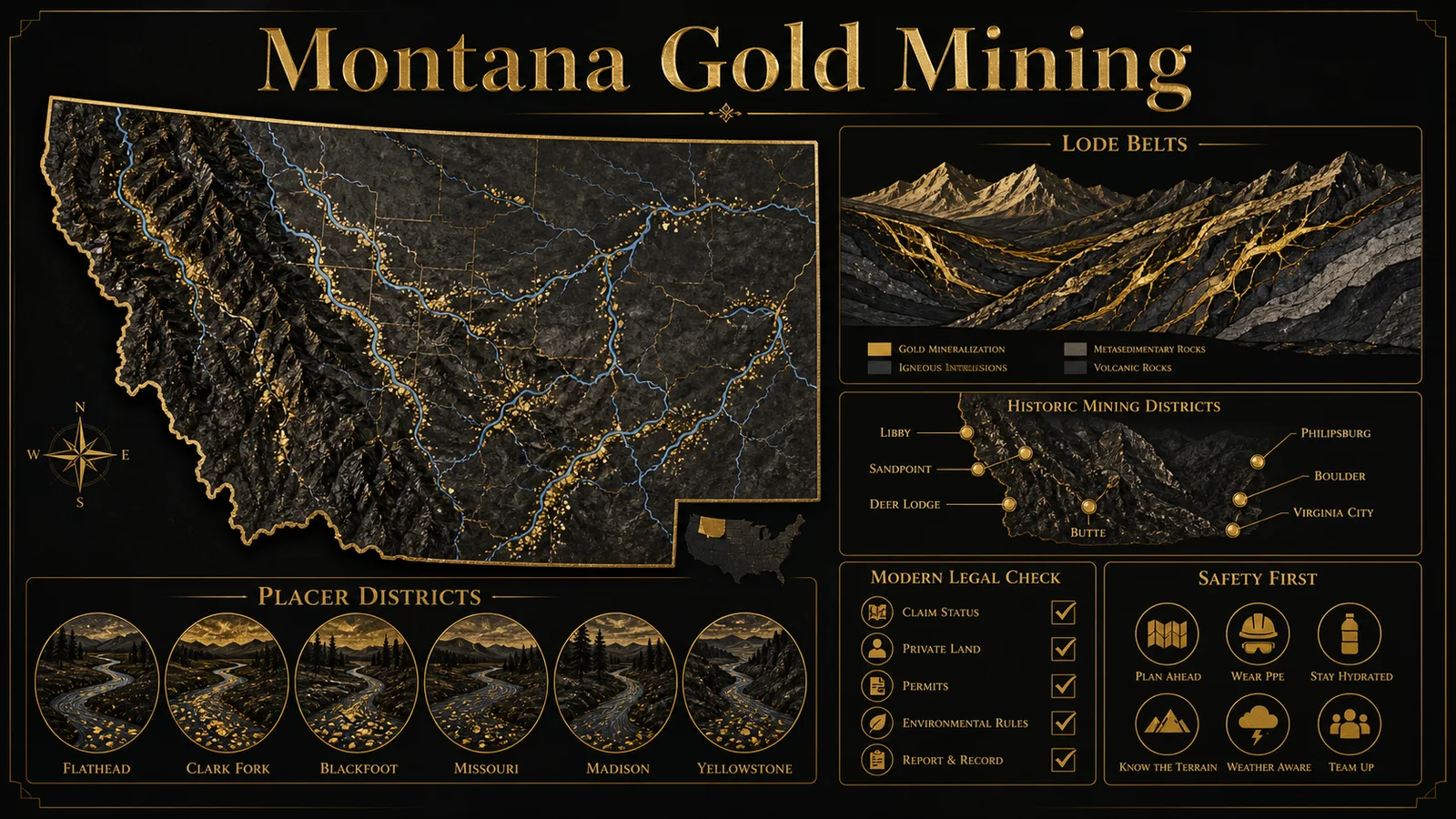
- Montana’s best-known gold areas are mostly in the western and southwestern part of the state, including Bannack, Virginia City, Helena, Butte, Philipsburg, and Libby-area districts.
- Placer gold occurs in stream gravels, bars, benches, and older channels; lode gold is tied to veins, intrusions, shear zones, and polymetallic mining districts.
- Historic production matters, but it does not automatically mean open public access or legal recreational panning today.
- Hand panning and non-motorized sluicing can fall under federal casual-use rules on some BLM lands, but claims, private land, state rules, closures, and water permits can change the answer.
- Modern prospecting should start with land status, claim status, local agency contact, low-impact methods, and a written plan for safety and reclamation.
Why Montana Became a Gold Mining State
Montana’s gold history accelerated after major 1860s discoveries at places such as Bannack on Grasshopper Creek, Alder Gulch near Virginia City, and Last Chance Gulch at Helena. Those strikes drew miners into a mountainous region where erosion had concentrated gold in creek gravels and older placer benches.
The early rush was mostly placer mining. Miners used pans, rockers, sluices, and ditches to separate dense gold from lighter sand and gravel, using the same basic gravity logic explained in our guide to Gold Rush mining techniques.
As the richest shallow gravels were worked, attention shifted toward lode deposits and larger mining camps. Butte became globally famous for copper, yet byproduct gold from copper, lead, zinc, and silver ores also made Montana’s gold story more complex than a simple panning map.
The USGS overview of gold prospecting in the United States notes that Montana’s principal placer districts are concentrated mainly in the southwestern part of the state. That is a useful starting point, not a permission slip.
Montana Gold Districts, Geology, and History
Montana gold districts differ because the state combines placer systems, quartz veins, intrusive rocks, and polymetallic mining belts. A creek can show fine placer color while the nearby hills record a very different lode-mining history.
| District or Area | Mining Type | Geology Signal | Historic Importance | Modern Prospecting Note |
|---|---|---|---|---|
| Bannack / Grasshopper Creek | Placer with nearby lode potential | Creek gravels draining mineralized terrain | One of Montana’s defining 1860s gold rush camps | Historic status, private parcels, claims, and park boundaries make access research essential. |
| Alder Gulch / Virginia City | Rich placer and later lode work | Gold-bearing gravels below mineralized uplands | Among the most famous Montana placer discoveries | Do not assume old tailings or creek access are open; verify ownership and claim status. |
| Last Chance Gulch / Helena | Placer followed by regional lode mining | Gulch placers connected to broader Helena-region mineralization | The discovery helped anchor Helena’s growth | Urbanization and land control are bigger constraints than geology in many spots. |
| Butte / Silver Bow | Lode and byproduct gold | Polymetallic vein and porphyry-related systems | Known for copper, but gold came with broader metal production | Better studied as mining history than casual panning ground. |
| Philipsburg / Granite County | Lode, silver-gold, and nearby placers | Veins and intrusive-related mineralization | Major hard-rock district with precious-metal history | Ore identification and claim research matter more than random creek testing. |
| Libby and northwestern Montana | Placer pockets and district-scale mining history | Mountain streams draining mineralized belts | Part of Montana’s broader placer and hard-rock pattern | Check National Forest rules, active claims, and stream protections before field work. |
Placer Gold vs. Lode Gold in Montana
Placer gold is gold that weathering and erosion have already freed from rock. In Montana, that often means creek gravels, point bars, inside bends, bedrock cracks, bench gravels, and old channel deposits.
Lode gold is still associated with rock, usually in veins, shear zones, altered rocks, or ore systems that may also contain silver, copper, lead, zinc, arsenic, or sulfides. Our guide to how to identify gold ore explains why shiny minerals are not enough to prove a valuable gold occurrence.
For recreational prospectors, this distinction changes the tools. A pan is useful for checking placer gravels, while lode work quickly moves into geology, sampling discipline, mineral rights, assay results, and safety issues around old workings.
Montana is attractive to hobby prospectors because its gold history is real, visible, and geographically broad. The trap is treating an old district name as a modern access plan. Good field work starts with maps and rules before it starts with a shovel.
Modern Prospecting and Legal Checklist
Gold panning rules in Montana depend on land ownership, federal agency rules, state water and stream protections, active mining claims, local closures, equipment choice, and the degree of surface disturbance. This section is educational, not legal advice.
For BLM-managed public land, the BLM Montana-Dakotas mining and minerals page is the right starting point. Federal regulations define casual use in terms of no or negligible disturbance, and the 43 CFR 3809.5 definition includes examples such as hand panning and non-motorized sluicing.
- Confirm land ownership: BLM, National Forest, state, tribal, county, private, patented mining land, and park land have different rules.
- Check active claims: Public land can still be covered by a mining claim. Do not prospect on another person’s claim without permission.
- Match method to permission: A hand pan is not the same as a motorized dredge, mechanized excavation, bank disturbance, or road building.
- Call the local office: Ask the relevant BLM field office, Forest Service office, or Montana agency about current closures and site-specific limits.
- Protect water and habitat: Avoid undercutting banks, diverting streams, adding sediment, or working spawning areas.
- Document your plan: Keep maps, claim checks, contact notes, and photos so your activity can be explained later.
- Leave old mines alone: Shafts, adits, stopes, rotten timbers, bad air, and unstable dumps can be fatal.
The Montana Department of Environmental Quality mining program is also important because Montana’s mining legacy includes abandoned hard-rock mines and reclamation responsibilities. DEQ resources are especially relevant when old mine sites, tailings, stream disturbance, or modern permits enter the picture.
How to Read a Montana Gold Map
A historic gold map is useful only when you know what it is showing. Dots for productive lode mines, old placer pits, dredge tailings, and abandoned prospects do not mean the same thing.
Start by separating three layers:
- Geology: rock type, structure, intrusive contacts, veins, faults, and drainage patterns.
- History: camps, production records, tailings, old ditches, mills, and transport routes.
- Access: current ownership, claims, agency rules, seasonal closures, water restrictions, and road conditions.
GoldConsul’s state guides to gold mining in Idaho, gold mining in Nevada, and gold mining in Arizona show the same pattern: historic production points you toward a region, but modern legality and safety determine what you can actually do.
Practical Field Strategy for Beginners
Beginners should avoid chasing legends or relying on vague forum directions. The practical workflow is slower, but it avoids wasted trips and legal mistakes.
- Pick one historic district and learn whether its gold was mainly placer, lode, or byproduct metal production.
- Use official land and claim tools before choosing a creek, road, or trailhead.
- Call the relevant land manager and describe your exact equipment and intended disturbance level.
- Test small, low-impact gravel samples with a pan before carrying heavier gear.
- Record where you sampled, what the gravels looked like, and whether color appeared consistently.
A metal detector can help in some areas, but it is not a shortcut around land status or claim rights. If that is your angle, read our guide to whether gold sets off metal detectors before assuming every detector signal is meaningful.
Many Montana prospecting summaries recycle district names without separating geology, land status, and legal access. The missing work is often the most important part: checking current claims, identifying who manages the land, and confirming whether your specific method is still treated as low-impact casual use.
Safety, Ethics, and Environmental Reality
Montana’s mining districts include beautiful terrain, but old mining ground can be unstable. Treat open shafts, collapsed adits, highwalls, tailings, mercury history, and remote roads as hazards rather than attractions.
Low-impact prospecting is also an ethical choice. Fill small test holes, stay out of stream banks, pack out trash, avoid sensitive habitat, and do not remove artifacts from historic sites.
If you are mainly interested in the mining industry rather than hobby panning, our overview of the top gold mining companies provides a broader context for how modern commercial mining differs from recreational prospecting.
Bottom Line
Gold mining in Montana is worth studying because the state combines classic placer rush history, important lode districts, and a complicated modern access picture. The richest story is not just where gold was found, but how geology, law, water, and land ownership intersect.
For modern prospectors, the right approach is conservative: research the district, verify land and claim status, contact the local agency, use low-impact methods, and treat old mining sites with respect. Montana can still reward curiosity, but it rewards preparation first.
FAQ: Gold Mining in Montana
Where is most gold found in Montana?
Montana’s best-known gold districts are mostly in the western and southwestern part of the state, including areas around Bannack, Virginia City, Helena, Butte, Philipsburg, and several mountain drainages. Productive history does not automatically mean legal public access today.
Can you pan for gold on public land in Montana?
Sometimes, but only after checking land status, active claims, agency rules, and current restrictions. Hand panning may qualify as casual use on some BLM lands, but private land, claims, parks, closures, and stream rules can override that general idea.
Do you need a claim to pan for gold in Montana?
You do not necessarily need your own claim for casual, low-impact activity on open unclaimed public land where rules allow it. You cannot prospect on someone else’s active claim without permission, and higher-disturbance work can require notices, plans, or permits.
What is the difference between Montana placer gold and lode gold?
Placer gold has been eroded from rock and concentrated in gravels, usually by water. Lode gold remains associated with bedrock, veins, faults, intrusive contacts, or ore systems and usually requires geological sampling rather than simple panning.
Are abandoned Montana mines safe to explore?
No. Old shafts, adits, stopes, tailings, rotten timbers, bad air, and unstable ground can be deadly. View abandoned mines from a distance and use official historical resources rather than entering workings.
 When you purchase a service or a product through our links, we sometimes earn a commission, at no extra cost to you.