
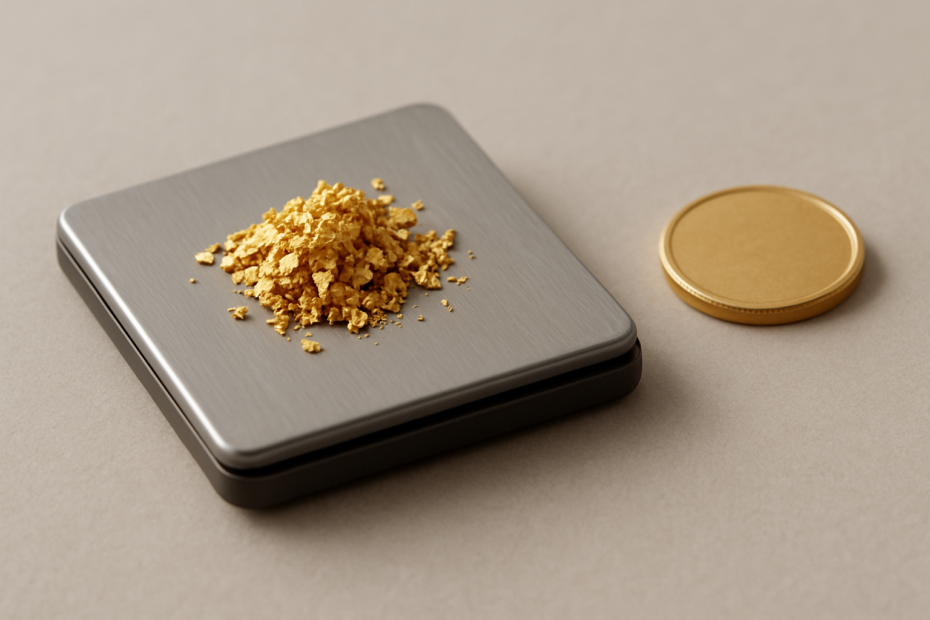
If you want the short answer: 14 milligrams (mg) of pure 24K gold is usually worth less than $2 at typical spot-price ranges. The exact value changes daily with the live gold price.
TL;DR
- 14 mg = 0.014 grams.
- 24K value formula: 0.014 x spot price per gram.
- If spot is $70/g, then 14 mg of 24K gold is about $0.98.
- 14K gold is only 58.5% pure, so value is much lower than 24K.
How much is 14 milligrams of gold worth?
Use this exact formula:
Gold value = weight in grams x purity x spot price per gram
For 14 mg of 24K gold (purity = 1.00):
- 14 mg = 0.014 g
- Value = 0.014 x spot price per gram
For 14 mg of 14K gold (purity = 0.585):
- Fine-gold content = 0.014 x 0.585 = 0.00819 g
- Value = 0.00819 x spot price per gram
24K vs 14K: Example With Real Math
Assume spot gold = $70 per gram:
| Type | Fine Gold Content | Estimated Value |
|---|---|---|
| 14 mg, 24K | 0.014 g | $0.98 |
| 14 mg, 14K | 0.00819 g | $0.57 |
This is why confusion between “14 mg” and “14K” causes pricing mistakes. If you need a deeper karat refresher, see our related explainer on how karat affects actual gold value.
The GoldConsul Editorial Perspective
For micro-weights like 14 mg, people overfocus on spot price and ignore transaction friction. In many real transactions, fees, minimum buy/sell quantities, and spreads matter more than the raw metal value.
Melt Value vs What You Can Actually Sell For
Melt value is theoretical. Dealer payout is usually lower because of spread, handling, and assay risk. On tiny amounts such as 14 mg, payout can be heavily discounted or not accepted at all.
- Melt value: mathematical metal content value.
- Payout value: melt value minus spread/fees.
- Tiny quantity penalty: many buyers require minimum weights.
This payout gap is one reason we emphasize framework-based pricing in guides like gold price factors explained.
What Most Buyers Miss
The biggest mistake is assuming tiny physical amounts can always be sold at spot. In reality, minimum lot rules and buyback spreads can reduce realized value sharply.
Knowledge Gap: 14 mg Gold vs Gold-Plated Claims
Many listings mix terms like “14 mgs 24k” and “14K gold plated.” These are not equivalent:
- 14 mg of pure gold: measurable fine-gold mass.
- 14K item: alloy purity, not weight.
- Gold plated: usually a thin layer; recoverable gold may be minimal.
Quick Conversion Table (Spot = $70/g Example)
| Weight | 24K Value | 14K Value |
|---|---|---|
| 10 mg | $0.70 | $0.41 |
| 14 mg | $0.98 | $0.57 |
| 25 mg | $1.75 | $1.02 |
| 50 mg | $3.50 | $2.05 |
For market structure references, you can cross-check with World Gold Council demand reports and general driver explainers such as Investopedia’s gold price factor guide.
Bottom Line
14 milligrams of gold has a very small metal value, even when gold prices are high. To avoid pricing errors, always separate weight, karat purity, and real dealer payout conditions before buying or selling.
FAQ: 14 mg Gold Value
Is 14 mg of gold the same as 14K gold?
How do I convert mg to grams for gold pricing?
Why is my payout lower than spot-value math?
Does plated gold have the same value as 14 mg pure gold?
Is buying tiny amounts of gold a good investment?
 When you purchase a service or a product through our links, we sometimes earn a commission, at no extra cost to you.