
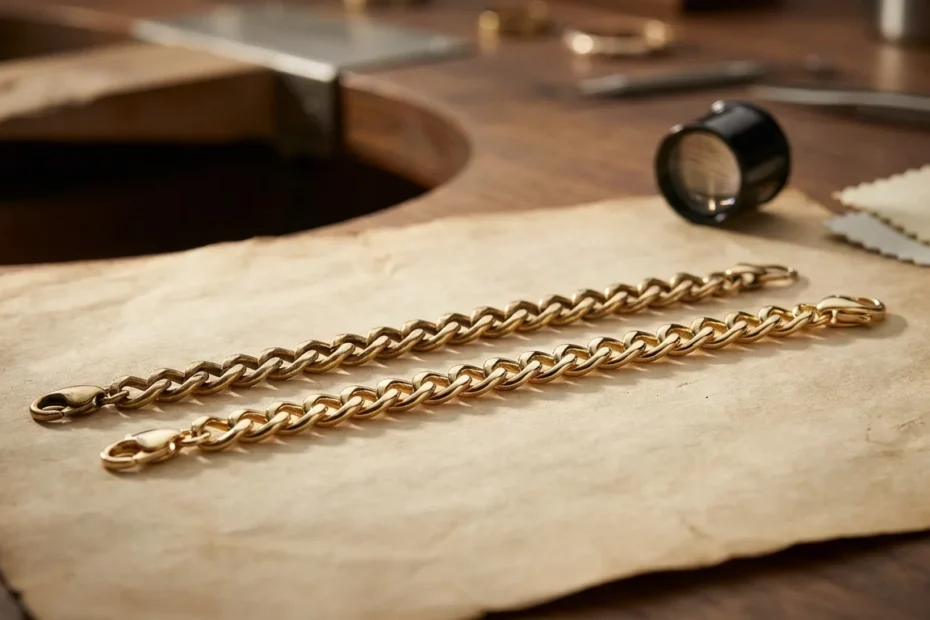
Gold-filled jewelry can last for many years and sometimes much longer, but the honest answer depends on what you bought, how often you wear it, and where the friction happens.
In buyer terms, gold-filled usually lasts much better than basic plating and often makes sense for daily necklaces or earrings. It is less convincing when shoppers expect solid-gold performance from rings, stackers, or heavy-wear bracelets.
TL;DR
- Gold-filled usually lasts longer than gold-plated and often longer than vermeil under everyday use.
- Necklaces and earrings tend to perform best; rings and bracelets wear faster.
- The real lifespan driver is friction, sweat, products, and cleaning habits, not just marketing claims.
- Gold-filled is often excellent cost-per-wear, but it is not the same as solid gold for longevity or value retention.
How Long Does Gold-Filled Jewelry Last? The Direct Answer
Gold-filled jewelry can last years and, in lower-friction use cases, sometimes much longer. It generally outperforms basic gold-plated jewelry because the gold layer is materially thicker and bonded under stricter standards. The key regulatory framework is the FTC jewelry-guides basis on gold-filled standards, which is why gold-filled is not just another marketing synonym for plated.
But broad claims like “it lasts a lifetime” are too loose to be useful. A chain worn carefully can still look strong years later. A ring exposed to sanitizer, desk friction, handwashing, workouts, and stacking contact will age much faster.
Chart 1: Gold-Filled vs Vermeil vs Plated vs Solid Gold
Buyer-facing durability comparison:
Interpretation: gold-filled is often the best middle ground for cost-per-wear, but it is still not a substitute for solid gold where long-term retention is the goal.
What Most Buyers Miss
Gold-filled does not fail evenly. It fails at contact points, clasp zones, undersides, edges, and high-friction surfaces. That is why piece type matters more than generic lifespan claims.
Why Gold-Filled Lasts Longer Than Basic Plating
Gold-filled jewelry uses a much more substantial bonded gold layer than typical plating. That is why many wearers experience much better lifespan and fewer sudden failures. Retail explainers such as Bonheur’s FAQ and longer-form durability notes such as Golden Bond’s guide are directionally useful, but they often still speak too broadly.
The real buyer issue is not whether gold-filled is “good.” It is whether the exact item you are buying will face enough abrasion to make any surface-based product age fast.
Chart 2: Expected Lifespan by Jewelry Type
Illustrative wear profile by item category:
Interpretation: gold-filled can feel extremely durable in chains and earrings, but far less impressive in high-contact pieces.
The GoldConsul Editorial Perspective
Gold-filled is one of the smartest categories for buyers who want strong cost-per-wear without paying solid-gold prices. The mistake is assuming that “good middle ground” means “works for every use case.”
Knowledge Gap: Lifespan Depends More on Contact Pattern Than Marketing
Many articles say gold-filled lasts “years” or “a lifetime” without explaining the one thing that matters most: where the item will physically rub every day.
- Low friction: earrings, pendants, light chains.
- Moderate friction: bracelets, especially clasp and underside zones.
- High friction: rings, stackers, pieces worn during washing, lifting, typing, and workouts.
What Actually Shortens the Lifespan?
The biggest lifespan killers are not mysterious. They are friction, repeated water exposure, sweat, perfume, lotion, sunscreen, chemical cleaners, and rough storage. If you want context on adjacent categories, compare with does gold vermeil tarnish, does 18k gold tarnish, and how to clean gold chains.
- Daily hand contact: rings age fastest because they live in the hardest environment.
- Chemicals and products: especially chlorine, saltwater, and beauty-product residue.
- Improper storage: mixed-metal friction and loose-pile storage accelerate wear.
- Aggressive polishing: over-cleaning can remove surface life sooner than expected.
Chart 3: Cost-Per-Wear Logic
Where gold-filled often wins economically:
Interpretation: gold-filled often beats frequent plated re-buys on value, even when it is not the premium material.
When Gold-Filled Is the Smart Buy
- You want a daily-wear chain, necklace, or earrings with better durability than plated jewelry.
- You care about value and appearance, but solid gold is not the right price tier for this purchase.
- You understand that high-friction use still shortens life.
- You are buying from a seller that clearly discloses material quality and care guidance.
When You Should Probably Upgrade Instead
- You want one ring to wear continuously for years without much maintenance.
- You expect strong resale or long-term material value.
- You wear the piece during workouts, water exposure, or heavy daily contact.
- You dislike replacing or refinishing jewelry over time.
For adjacent buying logic, see how to tell if rose gold is real and is gold jewelry cheaper in Mexico.
Video walkthrough: visual context on what gold-filled is and why it often lasts longer than simple plating.
Bottom Line
Gold-filled jewelry can last a long time and is often one of the best value categories for buyers who want better durability than plating without paying for solid gold. The right conclusion is not “it lasts forever.” The right conclusion is that it lasts well when the wear pattern fits the material.
FAQ: How Long Does Gold-Filled Jewelry Last?
Can gold-filled jewelry really last for years?
Does gold-filled last longer than vermeil?
Can you shower with gold-filled jewelry?
What type of gold-filled jewelry lasts the longest?
Is gold-filled worth it over plated jewelry?
 When you purchase a service or a product through our links, we sometimes earn a commission, at no extra cost to you.