
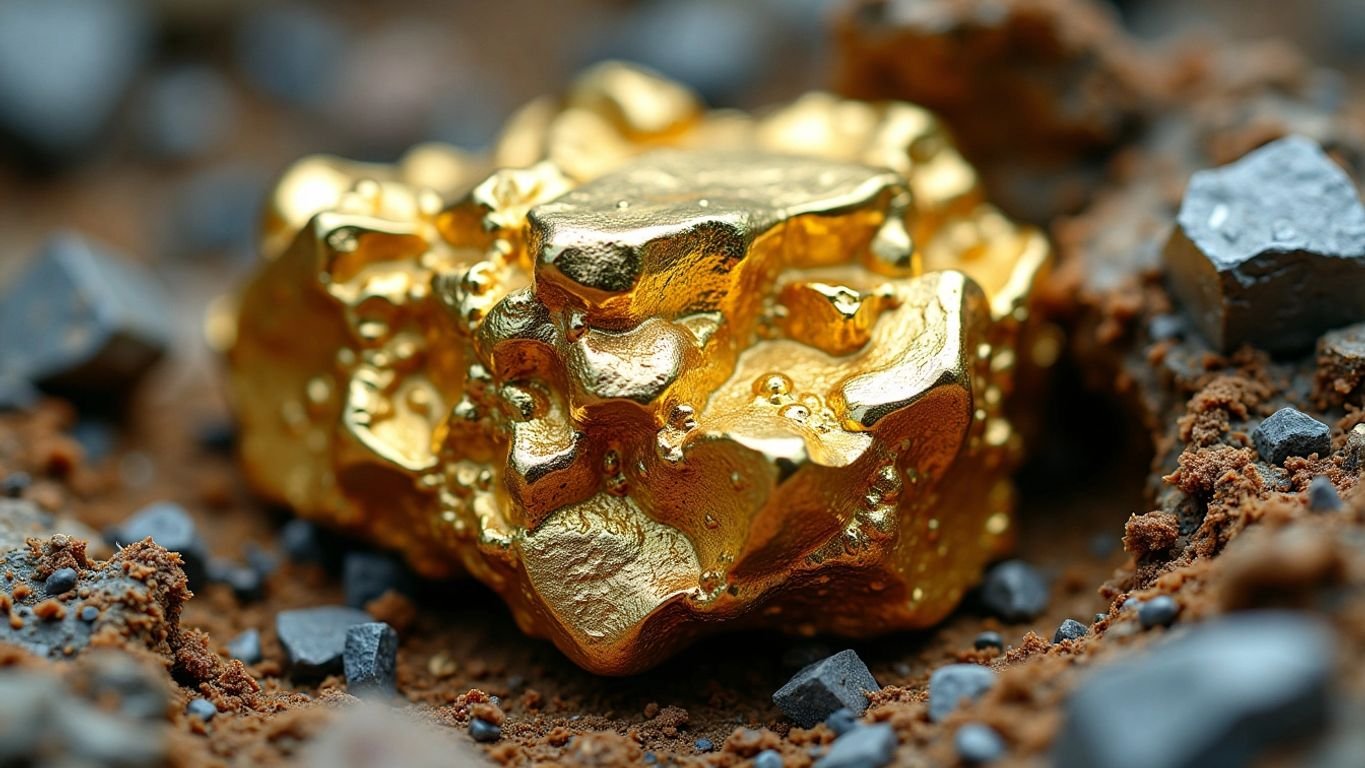
This page is about ore that contains gold, not just rock with visible metal in it. In geology and mining, ore means rock that contains enough valuable metal to be mined economically, and that definition matters because many real gold-bearing rocks do not look obviously gold-colored at all.
That is why this page needs a different job from how to identify gold ore. This article explains what ore means in a gold-mining context, how it forms, and why visible gold is only one small part of the full deposit story.
TL;DR
- Ore containing gold is rock that holds enough metal to be mined profitably, not simply rock that looks gold-colored.
- Some ore deposits contain visible native gold, but much ore hosts microscopic or chemically bound gold in sulfides or altered rock.
- Quartz veins are only one common setting, not the whole story.
- Placer gold, nuggets, and ore are related topics, but they are not the same category.
- The best beginner framework separates geology, appearance, and economic mineability.
What Most Readers Miss
The biggest mistake is assuming gold ore has to look like bright yellow metal in white quartz. In reality, some of the most important gold ores show almost no obvious “gold” appearance to the eye.
Geology:
Ore is a deposit concept first, not a color test.
Appearance:
Visible gold is one subset, not the default look of every gold-bearing rock.
Economics:
A rock can contain gold and still not qualify as ore if concentration or extraction economics are weak.
What Is Gold Ore?
Gold ore is rock that contains gold in concentrations high enough to justify mining and processing. That definition is closer to economic geology than to casual rock identification, which is why “gold ore” and “gold-bearing rock” are not always identical in practical use.
National Geographic’s basic explanation of ore is useful here because it reminds readers that ore is a resource term, not just a mineral-collector term. Britannica’s overview of gold occurrences also helps because it anchors the discussion in real occurrence settings rather than beginner myths.
Chart 1: Gold-Bearing Rock vs Gold Ore
Not every gold-bearing rock is automatically ore.
| Term | Meaning | Why beginners confuse it |
|---|---|---|
| Gold-bearing rock | Rock that contains some gold | People assume any gold content means mineable value. |
| Gold ore | Gold-bearing rock worth mining economically | The economic part is often skipped in beginner guides. |
| Visible native gold | Gold you can actually see in hand sample form | Readers often mistake this for the only real kind of gold ore. |
| Placer gold | Loose gold concentrated in sediments | People blend nuggets and stream gold into the ore category. |
Interpretation: “ore” answers a mineability question, not only an appearance question.
What Gold Ore Can Look Like
Some gold ore does show visible gold in quartz veins, fractures, or brecciated host rock. That is the image many people carry in their heads, and it is not wrong. It is just incomplete.
Other gold ore looks far less dramatic. Gold may occur with sulfides, iron staining, altered wall rock, or microscopic inclusions that cannot be recognized visually in the field. The USGS gold ores collection is useful precisely because it shows how visually varied real gold ore can be.
- Some gold ore shows visible metallic gold.
- Some gold ore is associated with quartz but not visibly gold-rich.
- Some gold ore appears dark, sulfide-rich, or heavily altered instead of bright and obvious.
Visible Gold vs Invisible Gold
This is one of the most important distinctions on the page. Visible gold means native gold can be seen directly in the specimen. Invisible gold means the gold is present, but it is too fine, too dispersed, or too chemically associated to identify with the naked eye.
That invisible category matters because many commercially important deposits are not hand-sample showpieces. They become meaningful only through assay, processing, or deposit-scale geology rather than through obvious specimen beauty.
Chart 2: Visible vs Invisible Gold Framework
Why “I can’t see gold” does not automatically mean “there is no gold.”
| Type | What the sample may look like | What it means for the reader |
|---|---|---|
| Visible native gold | Quartz veins, fractures, metallic flecks, coarse specimen gold | Easy to overfocus on because it matches beginner expectations. |
| Microscopic / invisible gold | Sulfides, altered rock, no obvious yellow metal | Often needs testing and deposit context to understand. |
| Non-ore gold-bearing rock | Some gold may be present, but not enough to mine profitably | Important distinction for beginners who confuse any trace content with ore. |
Interpretation: visibility helps specimen recognition, but it does not define the full geology of gold ore.
Common Geological Settings for Gold Ore
Gold ore forms in several settings, which is why one stock photo of quartz and gold cannot explain the whole subject. Some deposits are vein-hosted. Others are disseminated, sulfide-related, or linked to altered rock systems.
The USGS/Geology.com overview of gold occurrence and production is useful because it shows that gold geology spans multiple deposit styles and mining contexts rather than one iconic image.
- Quartz-vein systems: classic and visually memorable, but not the only model.
- Sulfide-associated ore: gold tied to pyrite, arsenopyrite, or related minerals.
- Altered host rock systems: ore defined more by geology and chemistry than by visible gold.
- Byproduct settings: gold recovered alongside other economically important metals.
This is also why the practical field page on how to identify gold ore needs to stay separate. That article is about screening clues. This page is about what the deposit actually is.
Gold Ore Is Not the Same as Placer Gold or Nuggets
Gold ore belongs to the bedrock or source-rock side of the story. Placer gold and nuggets belong to the weathered, transported, and concentrated sediment side.
That distinction matters because beginners often search for “gold ore” while imagining loose nugget finds. Those are related through geological history, but they are not the same kind of material.
Chart 3: Ore, Placer, and Nugget Distinction
Three linked concepts that answer different questions.
| Category | Where it belongs | Main question it answers |
|---|---|---|
| Gold ore | Source rock / deposit geology | What rock contains mineable gold? |
| Placer gold | Stream or sediment concentration | Where has gold been moved and naturally concentrated? |
| Gold nuggets | Coarser transported or residual pieces | What visible coarse gold survived transport or weathering? |
Interpretation: ore explains source geology; placers and nuggets explain concentration after erosion and transport.
Helpful Reader Filter: Ask Three Questions in Order
This quick filter helps separate specimen excitement from actual ore logic.
The GoldConsul Editorial Perspective
The strongest correction on this topic is simple: ore is a geology-plus-economics concept, not a beginner image search result. Once readers understand that, the subject becomes much easier to navigate.
Knowledge Gap: Gold ore is defined by mineability, not by looking gold-colored
Readers often ask what gold ore looks like. The better question is what qualifies as ore in the first place. Once that shifts, beginners stop confusing visible gold, trace gold, placer material, and actual ore deposits.
- Visible gold can help recognition, but it does not define the full category.
- Invisible or sulfide-hosted gold can still belong to major ore systems.
- Economic geology matters as much as specimen appearance.
Video walkthrough: this geology-focused clip is useful if you want visual context for what kinds of rocks and settings prospectors watch before they ever assume a sample is actual gold ore.
Bottom Line
Gold ore is not just rock with obvious visible gold. It is rock that contains gold in a form and concentration that matters economically, and that can look very different depending on deposit type.
The better way to learn the subject is to separate appearance, geology, and mineability. Once you do that, the topic becomes much clearer and much harder to oversimplify.
FAQ: What Is Gold Ore?
Is gold ore always visible gold in quartz?
No. That is one well-known type, but many gold ores contain microscopic or sulfide-associated gold that is not visibly obvious in hand sample form.
What makes rock count as gold ore?
It must contain enough gold to be mined and processed profitably. The term ore includes an economic threshold, not just the presence of metal.
Can a rock contain gold without being ore?
Yes. A rock may contain trace or low-grade gold but still fall below economic mineability.
Is placer gold the same thing as gold ore?
No. Placer gold is gold that has been transported and concentrated in sediments, while gold ore refers to the source-rock or deposit side of the story.
What is the biggest misunderstanding about gold ore?
The biggest misunderstanding is assuming ore must look like bright yellow metal in white quartz. Real gold ore can be visually subtle and still be geologically or economically important.
 When you purchase a service or a product through our links, we sometimes earn a commission, at no extra cost to you.