
TL;DR
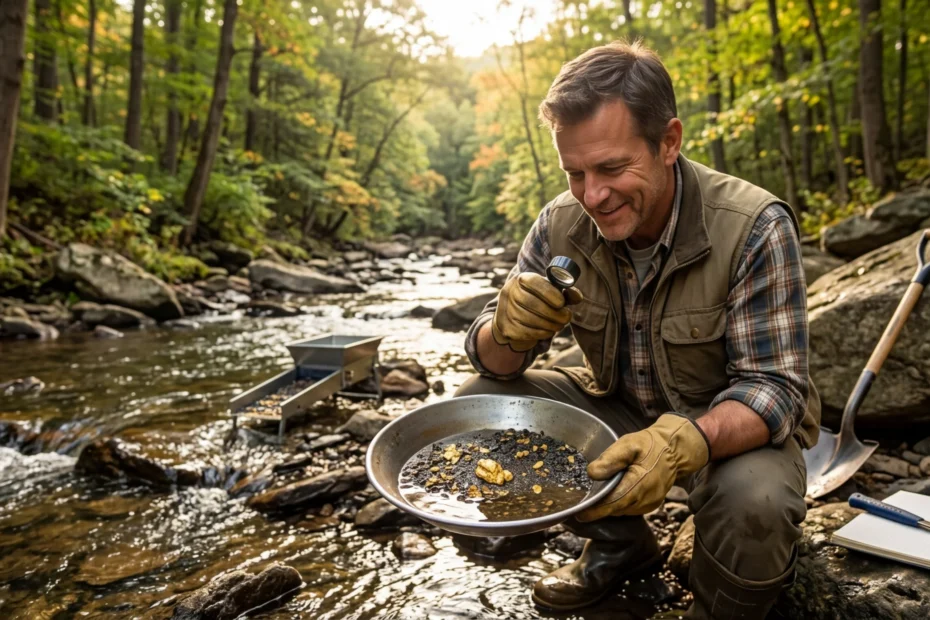
- Recreational non-motorized panning in Pennsylvania waterways is usually allowed without a permit, but site access rules still apply.
- Motorized equipment and larger excavation can trigger DEP coordination, waivers, or permits.
- Pennsylvania is a realistic hobby prospecting state, not a high-yield production state for most individuals.
- Your outcomes depend more on legal access discipline and sampling consistency than on buying more gear.
Gold mining in Pennsylvania can be a solid hobby, but only if you treat it as an access and process problem first.
The biggest mistakes are usually legal access errors, unrealistic yield expectations, and random one-day sampling without a repeatable method.
Where Pennsylvania Prospecting Is Legal, and Where It Is Not
Pennsylvania DEP states that non-motorized panning in waterways generally does not require a permit, while motorized methods may require one depending on setup and disturbance level.
Use DEP’s Mining for Gold and Gemstones in Pennsylvania page as your first compliance checkpoint before you plan a trip.
You still need landowner permission on private land, and prospecting is not allowed in all public areas.
DEP’s Noncoal Mines and Quarries FAQ is useful for understanding where hobby activity ends and regulated extraction begins.
What Most Buyers Miss
Prospecting success in Pennsylvania is usually constrained by legal access quality and sample discipline, not by buying expensive hardware early.
Access: Permission and location rules decide whether your day is valid at all. | Method: Structured repeat sampling beats random creek hopping. | Decision: Scale gear only after multiple sessions show consistent color. |
The GoldConsul Editorial Perspective
For Pennsylvania hobby miners, your edge is not prediction. Your edge is running a legal, low-disturbance workflow that can be repeated and improved.
Knowledge Gap: “Gold found” vs “Gold recoverable”
A few flakes in one test pan can still lead to zero meaningful weekly yield.
- Find signal: At least 3-5 sessions with repeatable color in similar structures.
- Access signal: You can legally revisit and work the same area without conflict.
- Scale signal: Your cleanup process captures fines consistently before adding cost.
Practical Workflow: 30-Minute Pre-Trip Compliance and Yield Check
Use this quick sequence before every outing.
It prevents most costly beginner errors in Pennsylvania.
- Access check: confirm land status and permission.
- Method check: non-motorized vs motorized setup and permit impact.
- Target check: define one stretch and 3 specific micro-locations to sample.
- Record check: log pan count, concentrate quality, and cleanup recovery notes.
- Decision check: continue, adjust, or stop based on repeatability, not optimism.
Chart 1: Prospecting Session Yield Pattern (Line Chart)
Conceptual micro-yield signal across six sessions (relative score)
Interpretation: A gradual rise in repeat sessions is a stronger scale signal than a single high outlier day.
Chart 2: Time Allocation for Productive Hobby Prospecting (Donut)
Suggested effort split per trip cycle
- 35% Location research and legal checks
- 25% On-site sampling process
- 20% Cleanup and fine-gold recovery
- 20% Log review and next-trip adjustment
Interpretation: Most consistent hobby results come from preparation and process quality, not raw digging time alone.
Chart 3: Area-Type Friction Map (Heatmap)
Relative friction score (1 = low friction, 5 = high friction)
| Area Type | Access Friction | Permit Complexity | Yield Uncertainty |
|---|---|---|---|
| Private creek with permission | 2 | 1 | 3 |
| Public waterway (non-motorized) | 3 | 1 | 4 |
| Motorized setup in stream | 4 | 5 | 4 |
Interpretation: Low-friction legal access often beats theoretically better geology you cannot work consistently.
How to Set Realistic Expectations in Pennsylvania
Pennsylvania prospecting is generally best treated as a hobby-first activity with occasional small recovery upside.
For national supply context, review the USGS gold statistics and information page and avoid over-extrapolating from social clips.
Video walkthrough
This clip is tightly aligned to Pennsylvania prospecting context and helps calibrate expectations before gear upgrades.
Related GoldConsul Reads
If you are building a state-by-state view, compare this guide with gold mining in Virginia, gold mining in Nevada, and gold mining in Idaho.
For process context, also review gold mining methods and gold price factors to connect recovery work with market reality.
Bottom Line
Gold mining in Pennsylvania can be worthwhile for disciplined hobbyists who prioritize legal clarity, repeatable sampling, and realistic output assumptions.
Treat each trip as structured fieldwork, and your decision quality will improve faster than your equipment budget.
FAQ
Do I need a permit for gold panning in Pennsylvania?
For many non-motorized panning methods in waterways, a permit is generally not required, but access and location rules still apply. Always verify current DEP guidance and local land status before prospecting.
Can I use a motorized dredge or high-banker?
Motorized equipment can trigger additional permitting or restrictions depending on the setup and location. Confirm requirements before you bring powered equipment to a stream.
Is Pennsylvania a good state for full-time gold income?
For most individuals, Pennsylvania is better framed as hobby prospecting rather than dependable full-time income. Treat revenue expectations conservatively and focus on learning and process quality.
What is the most common beginner mistake?
The most common mistake is skipping access validation and sampling discipline. A structured, repeatable method usually outperforms random location hopping.
How do I decide whether to scale my setup?
Scale only after several sessions show repeatable results and you fully understand local legal boundaries. Upgrade process quality before you upgrade equipment cost.
 When you purchase a service or a product through our links, we sometimes earn a commission, at no extra cost to you.