

Compare allocated vs unallocated gold storage by ownership, bar lists, insurance, provider risk, fees, and what to verify before choosing custody.
- Confirm whether you own specific bars or only a provider claim.
- Ask for bar lists, audit rights, insurance details, and delivery terms.
- Lower fees can come with higher counterparty and access risk.

Allocated vs unallocated gold storage is not just a vaulting detail. It decides whether you own specific metal or a claim against someone who owes you metal.
That difference matters most when gold is no longer just a price chart on your screen. It matters when you want delivery, when a provider has financial stress, when insurance is disputed, or when your heirs need to prove exactly what you owned.
TL;DR
- Allocated gold means specific bars or coins are assigned to you and held in custody.
- Unallocated gold usually means you hold a claim for a quantity of gold, not specific bars.
- Allocated storage costs more, but it better matches the reason many people buy physical gold: ownership outside a provider balance sheet.
- Unallocated storage can be useful for short-term trading convenience, but it carries counterparty and redemption risk.
- The key test is not the word “vault”. The key test is whether you receive proof of title, bar detail, insurance scope, and withdrawal rights.
What Most Buyers Miss
The mistake is treating allocated and unallocated storage as two price levels of the same service. They are different legal and operational structures.
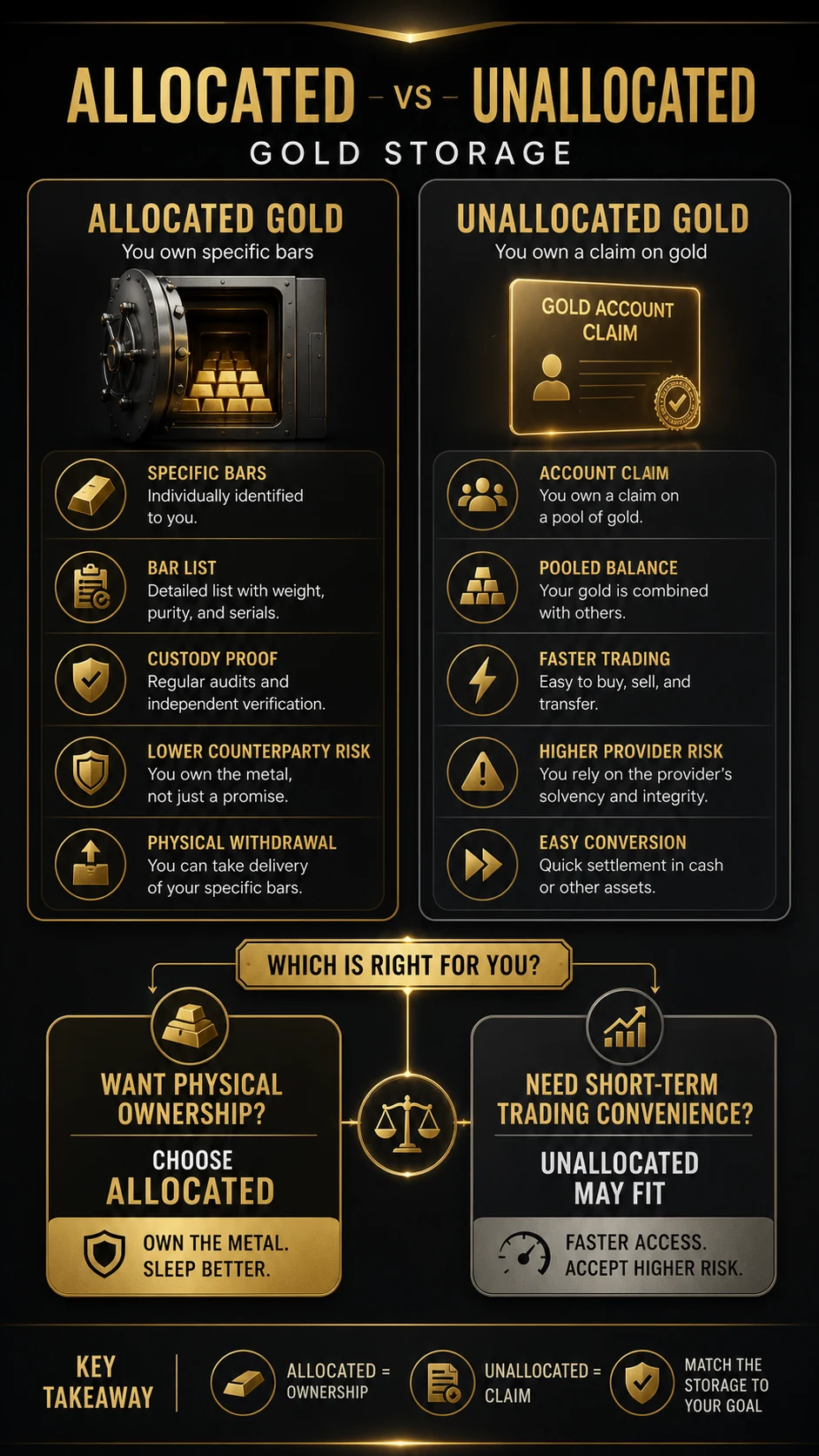
Allocated vs Unallocated Gold Storage: The Core Difference
In allocated gold storage, specific bars, coins, or lots are held for you. The account should show enough detail to identify what belongs to you: bar number, weight, refiner, fineness, and sometimes vault location.
In unallocated gold storage, your statement usually shows an amount of gold owed to you. It may be useful for market exposure, but you usually do not have specific metal sitting in your name.
The LBMA guide to precious metal accounts makes the distinction clearly: unallocated balances create a contractual claim against the clearer, while allocated accounts are backed by specific metal.
| Feature | Allocated gold | Unallocated gold | Why it matters |
|---|---|---|---|
| Ownership evidence | Specific bars, coins, or lots assigned | Account balance or claim | Determines whether you can prove title to particular metal |
| Provider balance sheet risk | Lower if true custody structure is clean | Higher because you depend on provider solvency | Important during insolvency, stress, or legal disputes |
| Cost | Usually higher | Usually lower | Lower fees can hide higher counterparty risk |
| Liquidity | Good, but more operational steps | Often faster for trading | Convenience can be the real reason unallocated exists |
| Withdrawal quality | Should be contractually clear | May involve delay, conversion, or cash settlement | Critical if you bought gold for physical access |
Why Unallocated Gold Exists
Unallocated gold is not automatically a scam. It exists because wholesale precious-metals markets need speed, flexibility, and settlement efficiency.
The LBMA notes that most wholesale OTC precious-metals trading clears over unallocated Loco London accounts. That structure is convenient because it avoids assigning and moving specific bars for every transaction.
For a bank, dealer, or institutional trader, that convenience can be rational. For a private buyer who wants long-term physical ownership, the same convenience may be the wrong priority.
Chart 1: Risk Profile Heatmap
Interpretation: Allocated storage is strongest when ownership certainty matters. Unallocated storage is strongest when speed matters more than specific-metal ownership.
The Buyer Test: What Proof Should You Ask For?
Do not stop at the marketing phrase “secure vault”. A secure vault can still hold metal under a weak ownership structure.
Before using any storage provider, ask for proof that answers these questions:
- Will my gold be allocated, segregated, pooled allocated, or unallocated?
- Do I receive a bar list, serial numbers, weight, refiner, and fineness?
- Is the metal legally mine, or do I hold a contractual claim against the provider?
- Is the gold insured, and what exactly does the insurance cover and exclude?
- Can I withdraw physical metal, and what are the fees, delays, minimums, and identity checks?
- What happens if the storage provider, dealer, or custodian becomes insolvent?
- Are audits independent, regular, and reconciled to customer holdings?
Allocated Does Not Always Mean Segregated
This is where many articles under-explain the topic. Allocated, pooled allocated, and segregated are related terms, but they are not identical.
Allocated means metal is assigned to you. Segregated usually means your metal is physically separated from other clients’ holdings. Pooled allocated may mean your ownership is backed by physical metal, but you share bars or lots with other clients in accounting form.
The practical question is simple: if you ask for delivery or the provider fails, can your ownership be identified clearly enough to avoid a fight?
Chart 2: Custody Quality Ladder
Interpretation: The higher the custody quality, the more you should expect documentation, fees, and operational friction.
When Allocated Gold Storage Makes Sense
Allocated storage fits investors who are buying physical gold for ownership certainty, not just price exposure. It is especially relevant when the holding is large enough that a provider failure would matter.
It also fits buyers who care about estate proof, insurance records, and future resale. If your heirs need to understand what exists, where it is stored, and how to claim it, a vague account balance is weaker than a clean custody record.
If you are still deciding whether physical bullion is the right format, GoldConsul’s guides to gold and silver bullion and how to buy gold bars are useful starting points.
When Unallocated Gold Can Still Be Rational
Unallocated gold can make sense for short-term trading, small tactical exposure, or institutional-style settlement where convenience is the priority. It is usually cheaper because the provider does not need to dedicate specific bars to each client.
The danger is using a trading structure for a wealth-preservation goal. If your reason for owning gold is to reduce counterparty risk, an unallocated balance may reintroduce the same risk you were trying to avoid.
Chart 3: Convenience vs Ownership Certainty
Interpretation: This conceptual score measures convenience, not safety. The easiest account is not always the strongest ownership structure.
Safe Deposit Boxes Are a Different Issue
A safe deposit box is not allocated storage in the bullion-market sense. It is rented space at a bank, and you still need to manage access, insurance, and records.
The FDIC warns that safe deposit box contents are not FDIC-insured. That matters if you store gold coins, receipts, or ownership documents there.
For a broader storage decision, see GoldConsul’s guide to home safe vs private vault for gold and the overview of private gold vaults in Europe.
The GoldConsul Editorial Perspective
The point of owning physical gold is not only price exposure. It is ownership quality. If a storage structure turns your metal into someone else’s promise, the low fee deserves much closer inspection.
Knowledge Gap: The Contract Matters More Than the Label
Many providers use reassuring words that sound similar: allocated, vaulted, insured, secured, reserved, pooled, segregated, fully backed. The contract is where those words become real or weak.
- Title: who legally owns the metal?
- Identification: can specific metal be matched to you?
- Insurance: is coverage for your benefit or only the provider’s?
- Audit: does a third party reconcile actual metal to customer records?
- Exit: can you withdraw, transfer, or sell without unreasonable friction?
GoldBroker and Allocated Storage Context
If your goal is physical bullion ownership with professional storage options, GoldBroker is one provider to include in your comparison process. The point is not to choose a brand first; it is to compare custody structure, jurisdiction, fees, insurance, and withdrawal terms before you commit.
Provider Comparison Rule
Compare storage providers by legal ownership, bar documentation, insurance, audit quality, jurisdiction, and withdrawal rules. Do not compare only annual storage fees.
Affiliate disclosure: GoldConsul may earn a commission if you use some external partner links, at no extra cost to you.Worked Example: Two Buyers, Same Gold Price, Different Risk
Imagine two buyers each put $50,000 into gold exposure.
| Buyer | Structure | What they own | Main hidden risk | Better fit? |
|---|---|---|---|---|
| Buyer A | Unallocated account | A claim for gold quantity | Provider credit and redemption risk | Short-term trading or tactical exposure |
| Buyer B | Allocated vault account | Identified metal under custody records | Fees, withdrawal process, provider due diligence | Long-term physical ownership |
Both may track the gold price. Only one structure is designed primarily around specific-metal ownership.
Decision Checklist: Which Storage Type Fits You?
Choose allocated storage if:
- You are buying gold for long-term wealth preservation.
- You want ownership evidence, not only price exposure.
- You need better estate, insurance, or audit documentation.
- You would want the option of physical withdrawal.
Consider unallocated exposure only if:
- You understand you may hold a provider claim rather than specific bars.
- You are using it for short-term trading convenience.
- The amount is small enough that provider risk is acceptable to you.
- You have read the contract and understand redemption limits.
Bottom Line
Allocated vs unallocated gold storage comes down to ownership quality. Allocated storage is usually the better match for buyers who want physical gold as a long-term store of value.
Unallocated storage can be cheaper and easier to trade, but it is often closer to owning a gold-denominated claim than owning specific gold. If your goal is true physical ownership, ask for the bar list, title language, insurance details, audit process, and withdrawal terms before you rely on the account.
For related next steps, read GoldConsul’s guides to where to store gold, live gold price today, and gold vs crypto.
FAQ: Allocated vs Unallocated Gold Storage
Is allocated gold better than unallocated gold?
Allocated gold is usually better for long-term physical ownership because specific metal is assigned to you. Unallocated gold may be more convenient for trading, but it usually carries more provider credit risk.
Does unallocated gold mean the gold does not exist?
Not necessarily. It means specific bars are not assigned to you. The key risk is that you may hold a claim against the provider rather than direct ownership of identifiable metal.
What should an allocated gold statement show?
A strong allocated record should show enough detail to identify the metal, such as bar number, weight, refiner, fineness, and location or custody reference.
Is pooled allocated gold safe?
It depends on the contract, records, audits, and withdrawal rules. Pooled allocated can be stronger than unallocated, but weaker than clearly segregated allocated custody.
Can I switch from unallocated to allocated gold?
Some providers allow conversion, but terms vary. Check minimum sizes, fees, timing, available bar formats, and whether conversion creates clear title to specific metal.
 When you purchase a service or a product through our links, we sometimes earn a commission, at no extra cost to you.