
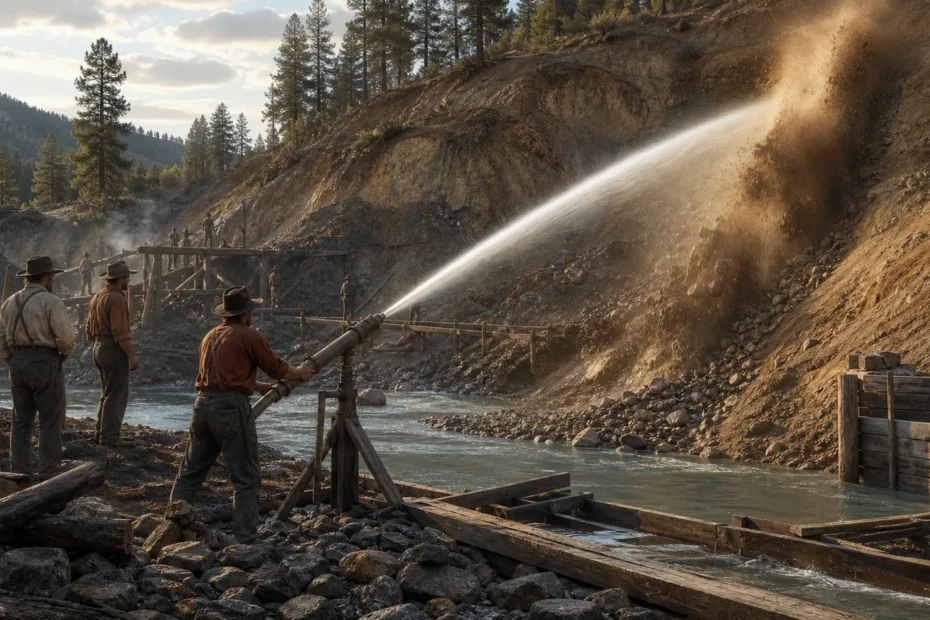
See how hydraulic mining worked during the Gold Rush, why it produced gold at scale, and how debris, rivers, law, and public backlash changed mining.
- Compare higher gold recovery with the sediment damage sent downstream.
- Use the Sawyer Decision to understand the legal backlash.
- Treat hydraulic mining as both technology history and environmental lesson.
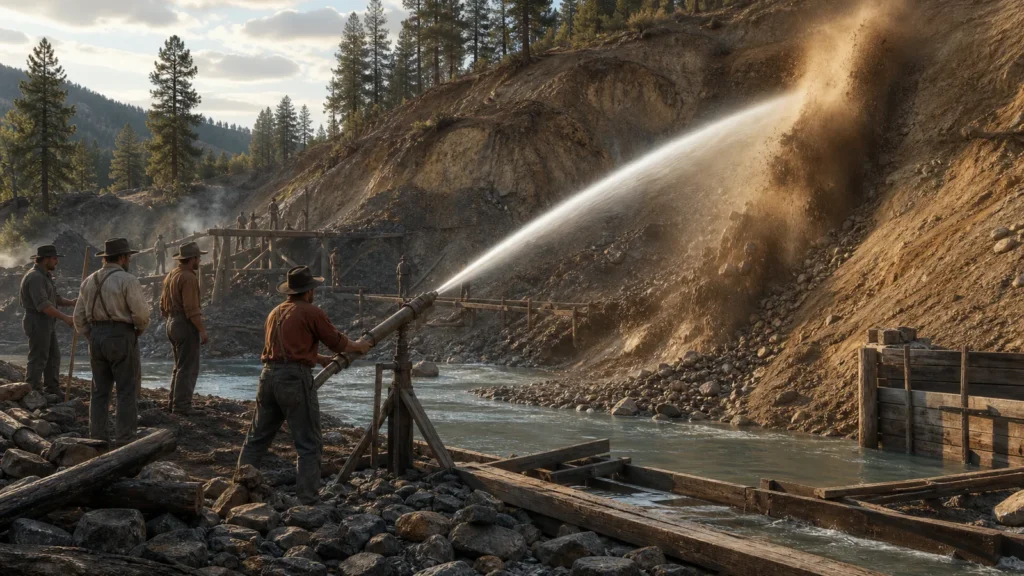
Hydraulic mining in the Gold Rush was one of the most powerful and controversial technologies used to extract gold from ancient river gravels. It made large-scale placer mining possible where picks, pans, and ordinary sluices were too slow, but it also moved whole hillsides into rivers. The method matters because it shows both sides of mining innovation: higher productivity and serious public costs.
Hydraulic mining in the Gold Rush was one of the most powerful and controversial technologies used to extract gold from ancient river gravels. It made large-scale placer mining possible where picks, pans, and ordinary sluices were too slow, but it also moved whole hillsides into rivers.
The method matters because it shows both sides of mining innovation: higher productivity and serious public costs. The same water cannon that exposed buried gold also sent sediment downstream, damaged farms, changed river channels, and helped trigger a major legal turning point in U.S. environmental history.
TL;DR: Hydraulic Mining Gold Rush
- Hydraulic mining used high-pressure water jets, called monitors, to wash gold-bearing gravel into sluices.
- It expanded after the easiest surface placers were depleted in California’s northern mines.
- The method was productive, but it released enormous sediment loads into rivers and farmland.
- The 1884 Sawyer Decision sharply restricted debris-producing hydraulic mining in the Sacramento and San Joaquin watersheds.
- Its legacy is both technical and environmental: a lesson in counting downstream costs, not just mine output.

What Hydraulic Mining Was
Hydraulic mining was a placer mining method that directed high-pressure water against a bank of gold-bearing gravel. The loosened slurry flowed through sluice boxes, where dense gold particles settled behind riffles while lighter sand, clay, and cobbles washed away.
The equipment was simple in concept but large in scale: ditches and flumes brought water from higher elevations, iron pipes concentrated pressure, and a swiveling nozzle, often called a monitor or giant, aimed the water jet. The method is a useful companion topic to Gold Rush mining techniques because it shows how the industry moved from individual labor toward engineered water systems.
Why It Spread During the Gold Rush
Early miners worked shallow stream gravels with pans, rockers, and small sluices. As those deposits became crowded or exhausted, miners targeted older river gravels left high above modern streams in the Sierra Nevada foothills.
Those buried and cemented gravels could contain gold, but they were expensive to move by hand. Hydraulic mining solved the labor problem by using water as the digging tool.
That shift fits the broader pattern of the California Gold Rush: the first phase rewarded mobility and luck, while later phases rewarded water rights, capital, engineering, and legal leverage. Large operations needed reservoirs, ditches, pipe, timber, claims, and crews, not just a pan and a shovel.
Hydraulic Mining Timeline
| Period | What changed | Why it mattered |
|---|---|---|
| 1848-1852 | Surface placer mining dominated. | Low-cost methods worked where gold was easy to reach. |
| 1850s | Water delivery systems and hydraulic monitors expanded. | Mining moved into deep gravel banks and required more capital. |
| 1860s-1870s | Large hydraulic operations reshaped hillsides and drainage systems. | Downstream sediment conflicts intensified. |
| 1884 | The Sawyer Decision restricted hydraulic debris discharge. | Courts recognized major downstream injury from mining sediment. |
| After 1884 | Some mining continued under debris controls, but the free-discharge era ended. | The industry became more regulated and less dominant in California placer mining. |
How the System Worked
A hydraulic mine depended on elevation. Water stored or diverted uphill gained pressure as it moved through ditches, flumes, and pipes toward the mine face.
At the working face, the monitor operator aimed the jet at compacted gravel. The water broke down the bank, and the slurry moved through sluices lined with riffles, mercury-coated plates in some operations, or other settling surfaces designed to capture gold.
The physical principle was gravity separation. Gold is much denser than common rock, so it tends to settle when flow slows, a basic concept also used in simpler gold ore identification and placer recovery discussions.
What Made It Productive
Hydraulic mining was productive because it replaced slow manual digging with continuous mechanical force. A crew could process a volume of gravel that would have overwhelmed miners using hand tools.
- Scale: water moved far more material than hand labor.
- Reach: operations could attack elevated ancient river gravels.
- Continuity: water systems allowed long working seasons where supply was reliable.
- Concentration: sluices processed large flows and captured dense particles efficiently.
The method was not a miracle technology. It only made sense where water, grade, gravel volume, gold content, and legal access aligned.
Editorial Perspective
Hydraulic mining is often described as a revolution in extraction. That is partly true, but the better framing is narrower: it revolutionized the movement of gold-bearing gravel, not the basic physics of gold recovery.
Its historical significance comes from the tradeoff. It raised mine output while transferring sediment costs to farmers, towns, waterways, and navigation systems downstream.
The Environmental Cost
The main problem was debris. Hydraulic mining did not merely remove gold; it converted hillsides into sediment and sent much of that material into creeks and rivers.
California State Parks’ history of Malakoff Diggins preserves one of the clearest landscapes of this method. The exposed cliffs show how water power could carve a mine face on a scale that still reads clearly today.
Downstream, the sediment could raise riverbeds, worsen flooding, bury agricultural land, and interfere with navigation. The U.S. Geological Survey’s work on historic gold-mining contamination in California is a useful reminder that mining impacts can remain in river systems long after active extraction declines.
The Sawyer Decision and Regulation
The legal turning point was Woodruff v. North Bloomfield Gravel Mining Company, commonly associated with Judge Lorenzo Sawyer’s 1884 ruling. The decision restricted hydraulic mining debris that harmed downstream properties and waterways.
The case is important because it connected private mining activity to public and downstream injury. In practical terms, it ended the most damaging free-discharge hydraulic mining in major California watersheds.
Readers interested in the legal history can compare this with broader Gold Rush property questions such as how miners staked claims in the Gold Rush. Mining rights were never only about discovery; they also depended on water, land, courts, and competing economic uses.
Knowledge Gap
What remains hard to quantify: many popular accounts give dramatic descriptions of hydraulic mining, but site-by-site gold recovery, sediment volume, mercury loss, and downstream damage are not always recorded in comparable units.
The strongest historical reading separates what is well documented, such as the method, the legal conflict, and major landscape impacts, from what is often estimated, such as exact recovered ounces or the full long-term ecological cost of each operation.
Hydraulic Mining vs. Other Gold Rush Methods
| Method | Best suited for | Capital need | Main drawback |
|---|---|---|---|
| Panning | Small samples and shallow placers | Very low | Slow and labor intensive |
| Rocker or long tom | Moderate placer work | Low to moderate | Limited throughput |
| Hydraulic mining | Large gravel banks with water pressure | High | Severe sediment impact |
| Hard-rock mining | Gold locked in quartz veins | High | Requires underground work and milling |
For a broader regional comparison, see GoldConsul’s guides to gold mining in Arizona, gold mining in Tennessee, and gold mines in Georgia. Different geology and water conditions produced different mining cultures.
How to Read Hydraulic Mining Claims Today
When a historical source says hydraulic mining was efficient, ask what is being measured. Efficient at moving gravel is not the same as efficient at protecting rivers, farms, or downstream towns.
- Check whether the source distinguishes gross gold output from net social cost.
- Look for the mine’s water source, drainage path, and debris-control system.
- Separate hydraulic placer mining from later industrial open-pit or hard-rock mining.
- Treat exact production numbers cautiously unless the source cites mine records or official reports.
- Use landscape evidence, legal records, and technical descriptions together.
The Library of Congress image collections and historical maps can help readers see the equipment and landscapes in context, while technical summaries from agencies such as the U.S. Geological Survey are useful for understanding sediment, rivers, and mining geology.
Bottom Line
Hydraulic mining in the Gold Rush was a major leap in placer mining technology. It used water pressure to turn ancient gravel banks into recoverable gold-bearing slurry, making large operations possible after the easiest deposits were gone.
Its legacy is not just the gold it helped recover. The stronger lesson is that extraction technology has boundaries. When a method sends costs downstream, the history of mining becomes a history of law, water, land, and public accountability as much as one of engineering.
FAQ: Hydraulic Mining Gold Rush
What is hydraulic mining in the Gold Rush?
Hydraulic mining was a method that used high-pressure water jets to break down gold-bearing gravel banks. The resulting slurry passed through sluices that trapped dense gold particles.
Why did miners use hydraulic mining?
Miners used it because many easy surface placers had been depleted. Hydraulic systems could process large volumes of older gravel deposits that were too difficult to mine by hand.
Was hydraulic mining successful?
It was successful at moving gravel and recovering gold from large placer deposits. It was also damaging because it released sediment into rivers and farmland, creating conflicts that led to major restrictions.
What ended hydraulic mining in California?
The 1884 Sawyer Decision sharply limited debris-producing hydraulic mining in affected California watersheds. Some mining continued later under controls, but the earlier free-discharge system was no longer legally acceptable.
Is hydraulic mining still used today?
Large-scale historical-style hydraulic mining is not a normal modern gold-mining practice in regulated watersheds. Modern placer and hard-rock operations face environmental permits, water rules, reclamation requirements, and sediment-control standards.
 When you purchase a service or a product through our links, we sometimes earn a commission, at no extra cost to you.