

Compare recycled, certified, and due-diligence gold claims, then ask six questions that reveal the evidence and where traceability stops.
- Judge ethical gold by its standard, traceability model, audit, and disclosure.
- Distinguish recycled content from mine-linked and chain-of-custody claims.
- Ask six specific questions before paying a premium for responsible sourcing.
Ethical gold is gold that is mined, refined, recycled, or sold under standards intended to reduce human-rights, environmental, and conflict-financing risks. The strongest claims are backed by traceability, audits, and clear disclosure; vague “responsible” language is not enough.
- Ethical gold is a sourcing claim, not a single universal metal type.
- Credible programs disclose standards, audit scope, and chain-of-custody limits.
- Recycled gold can reduce mining demand, but it still needs honest sourcing disclosure.
- Small-scale mining can be ethical when labor, safety, and environmental controls are real.
- Buyers should ask what is verified, who verified it, and where traceability stops.
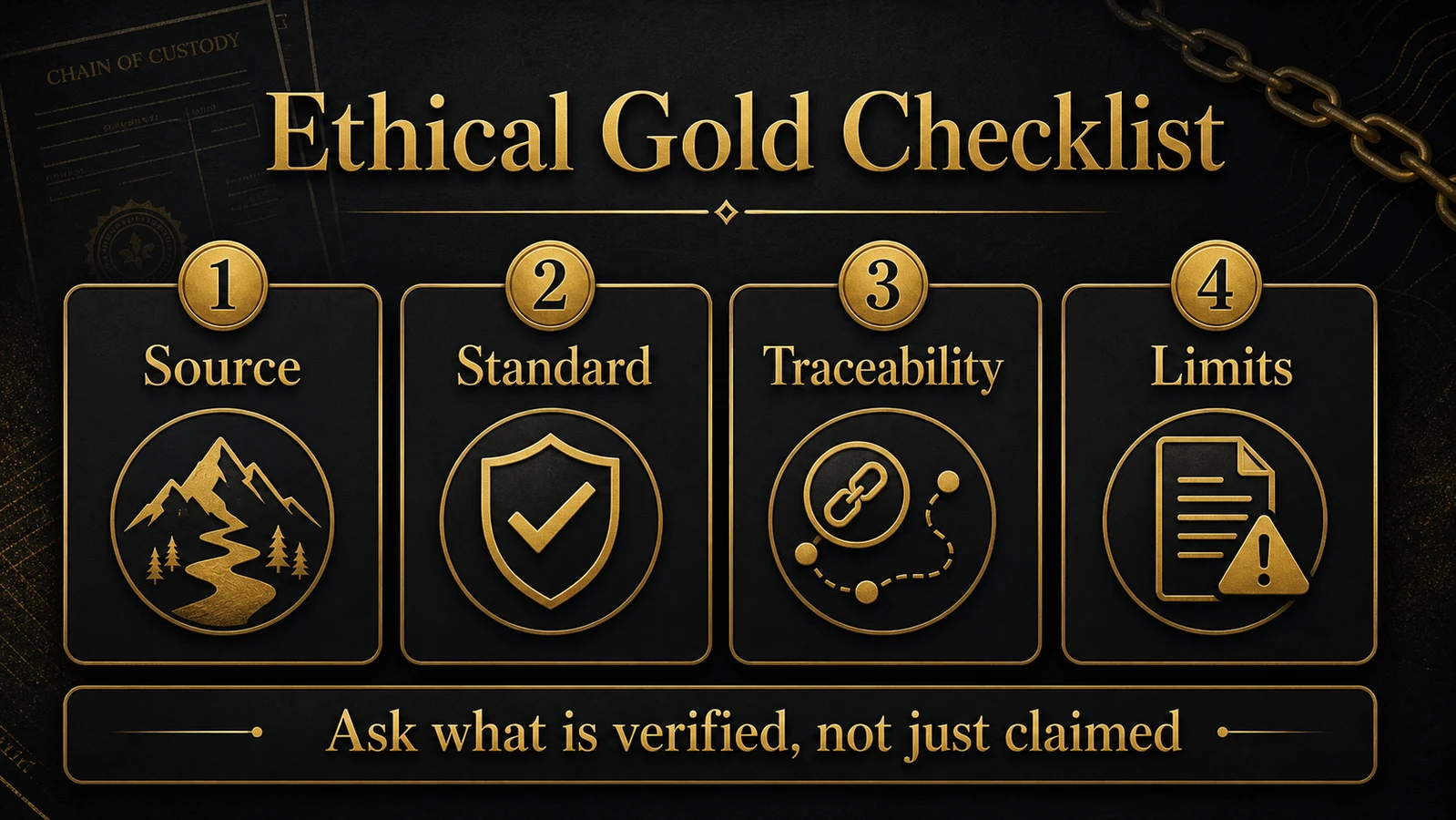
What Ethical Gold Actually Means
Evidence check: The OECD mineral-supply-chain guidance treats responsible sourcing as an ongoing process of identifying, preventing, mitigating, and reporting risk. A certification or recycled-content claim can support that process, but it does not prove that every environmental and labor risk has disappeared.
Ethical gold usually refers to gold connected to responsible mining, recycled supply, fair labor practices, environmental controls, and anti-conflict due diligence. The phrase is useful, but it is broad enough to be misused.
A serious seller should be able to explain whether the gold is recycled, newly mined under a named standard, segregated through the supply chain, or simply sourced from suppliers that follow a responsible sourcing policy.
This is especially important when comparing jewelry, coins, and bars. A buyer looking at bullion may also want GoldConsul’s guides to gold and silver bullion, how to invest in gold, and where to store gold. For a cross-border jewelry purchase, normalize the price to fine-gold grams and verify the hallmark, seller, receipt, exchange rate, and import cost before calling it cheaper.
Ethical Gold Claims Compared
| Claim type | Stronger evidence | Main limitation |
|---|---|---|
| Recycled gold | Refiner or supplier documentation | May not prove the original source was ethical. |
| Responsible mined gold | Named mining standard and audit | Coverage may apply only to part of the supply chain. |
| Fair or community gold | Transparent origin and producer benefits | Availability and scale can be limited. |
| Generic ethical claim | Detailed policy plus verification | Often vague without audit evidence. |
The LBMA Responsible Sourcing program, the World Gold Council’s responsible gold principles, and the OECD due diligence guidance for minerals are useful reference points for understanding what credible frameworks look like.
Questions to Ask Before You Buy
- Is the gold recycled, newly mined, or mixed-source?
- Which standard or policy applies?
- Is the claim audited by an independent party?
- Can the seller explain the chain of custody?
- Does the claim apply to the exact item, or only to the company policy?
These questions work for jewelry and for investment metal. If you are buying physical metal rather than jewelry, combine sourcing questions with normal checks around dealer reputation, premium, liquidity, and secure storage.
Recycled Gold Is Useful but Not Perfect
Recycled gold can reduce demand for newly mined material and is common in jewelry supply chains. It is not automatically a full ethical answer because recycled gold may still be mixed, re-refined, and separated from its original history.
The practical question is not whether recycled gold is “good” or “bad.” It is whether the seller is transparent about what recycled means, whether the claim is documented, and whether the buyer’s goal is lower mining impact, traceability, or both.
Editorial Perspective
For readers, the safest approach is to treat ethical gold as a claim that needs evidence, not as a comforting label. A seller should be able to explain what is verified, who verified it, and where the traceability stops.
Trust specific standards, named audits, and honest caveats more than polished marketing copy. A modest but verifiable sourcing claim is more useful than an ambitious ethical promise with no paper trail.
Knowledge Gap
Most consumer content does not separate recycled gold, responsible mining, conflict minerals, and fair-labor programs. Those are related, but they answer different buyer concerns.
The missing piece is usually traceability. Buyers need to know not only that a standard exists, but whether it follows the exact item or only the broader supplier network.
Use a Claim-Strength Ladder
“Ethical,” “responsible,” and “sustainable” are broad claims. The useful question is not whether a label sounds positive, but what source, standard, chain-of-custody model, audit, and public evidence sit behind it.
| Claim level | Evidence to look for | Remaining limitation |
|---|---|---|
| Vague responsible-sourcing statement | Named policy and supplier requirements | May not identify metal origin or verification |
| Recycled-content claim | Definition of recycled input, refiner records, audit scope | Does not automatically prove the pre-recycling origin was low-risk |
| Industry due-diligence program | Published standard, refiner audit, corrective-action process | Often verifies a process rather than a mine-to-product identity |
| Chain-of-custody certification | Segregation or documented custody through each handler | Scope can stop before every component or subcontractor |
| Mine-linked certified gold | Named mining organization, independent audit, premium and traceability model | Limited availability and higher administrative cost |
The OECD Minerals Guidance sets a risk-based process for companies across mineral supply chains. It covers identifying, preventing, mitigating, and reporting risks; it does not turn a single audit badge into a guarantee that no harm occurred.
For refiners, the LBMA Responsible Gold Guidance translates due diligence into market requirements. For artisanal and small-scale mining, the Fairmined Standard addresses legal operations, labor conditions, environmental practices, traceability, and a premium for mining organizations.
Six Questions That Expose Weak Claims
- What exactly is being claimed? The whole product, only the gold, a percentage of annual purchases, or a certificate contribution?
- Is the gold newly mined, recycled, or mixed? Ask for the definition used.
- Which published standard applies? A company policy is not the same as an independent standard.
- Who audited it, and how recently? Ask whether findings or corrective actions are public.
- Where does traceability stop? Mine, refiner, fabricator, supplier, or finished product?
- Does the purchase improve conditions? Look for premiums, long-term sourcing, remediation, or support for legitimate small-scale mining—not only exclusion.
Recycled Gold: Strong Benefit, Narrower Claim
Recycling can reduce the need for additional extraction and makes practical use of existing metal. But recycled describes a material flow, not every social and environmental property of the supply chain. The OECD gold supplement distinguishes recyclable gold by the point at which previously refined material returns to a refiner or recycler; documentation and due diligence still matter.
Prefer a narrow, documented statement over a sweeping promise. “This ring contains segregated Fairmined gold from a named certified organization” is more testable than “made with planet-friendly gold.”
Continue with GoldConsul’s guides to gold recycling, recovering gold from e-waste, gold mining methods and their environmental risks, traceability risks in emerging-market gold mining, and gold extraction and refining.
Ethical Does Not Mean Impact-Free
Every gold source has tradeoffs. Newly mined gold can support jobs, tax revenue, and formalized small-scale mining while also creating land, water, safety, and governance risks. Recycled gold avoids new extraction for that unit of metal but still requires collection, transport, refining, energy, and controls against illicit material entering scrap streams.
The strongest programs therefore use continuous due diligence rather than a one-time declaration. They identify risks, respond to findings, document custody, and explain remediation. Excluding every high-risk region can also push legitimate artisanal miners out of formal markets, which is why OECD guidance emphasizes responsible engagement and progressive improvement where possible.
What documentation can look like
- a supplier policy tied to a named standard;
- a refinery or chain-of-custody certificate with scope and validity dates;
- a transaction document connecting the purchased gold to a certified source or model;
- public audit summaries and corrective actions;
- a clear statement of whether physical metal is segregated, mixed with documentary accounting, or represented only by certificates.
A logo without scope is not enough. Save the product claim and supporting documents at purchase, because sustainability pages and supplier relationships can change later.
FAQ: ethical gold
Is recycled gold the same as ethical gold?
Not exactly. Recycled gold can be part of an ethical sourcing strategy, but the ethical value depends on documentation, transparency, and the buyer’s goal.
What is the best ethical gold certification?
There is no single universal best certification. Look for named standards, independent audits, clear chain-of-custody language, and honest disclosure of limitations.
Can newly mined gold be ethical?
Yes, if mining standards, labor protections, environmental controls, and due diligence are credible and verified. The claim should be specific rather than generic.
Is ethical gold more expensive?
It can be, especially when traceability and audits add cost. Recycled gold may be priced similarly to conventional gold depending on the seller and product.
What should I ask a jeweler about ethical gold?
Ask whether the gold is recycled or mined, which standard applies, who verifies the claim, and whether the claim applies to the exact item you are buying.
Bottom Line
Ethical gold is strongest when the seller can show the source, the standard, the verification method, and the limits of the claim. Use the label as a starting point, then ask for evidence.
 When you purchase a service or a product through our links, we sometimes earn a commission, at no extra cost to you.