
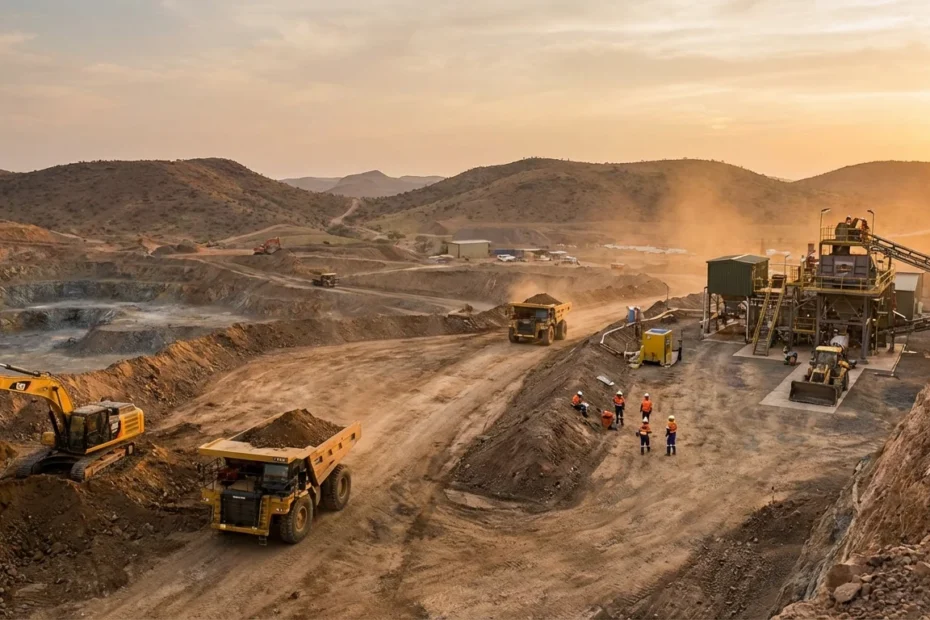
Compare gold mining in emerging markets by production data, country risk, ASGM, resource nationalism, traceability, ESG and investor reality.
- Emerging-market gold mining is a country-risk story, not just a geology story.
- Compare royalties, permits, infrastructure, ESG, traceability, FX and community risk.
- Use production data as context, then verify project filings and responsible-sourcing evidence.
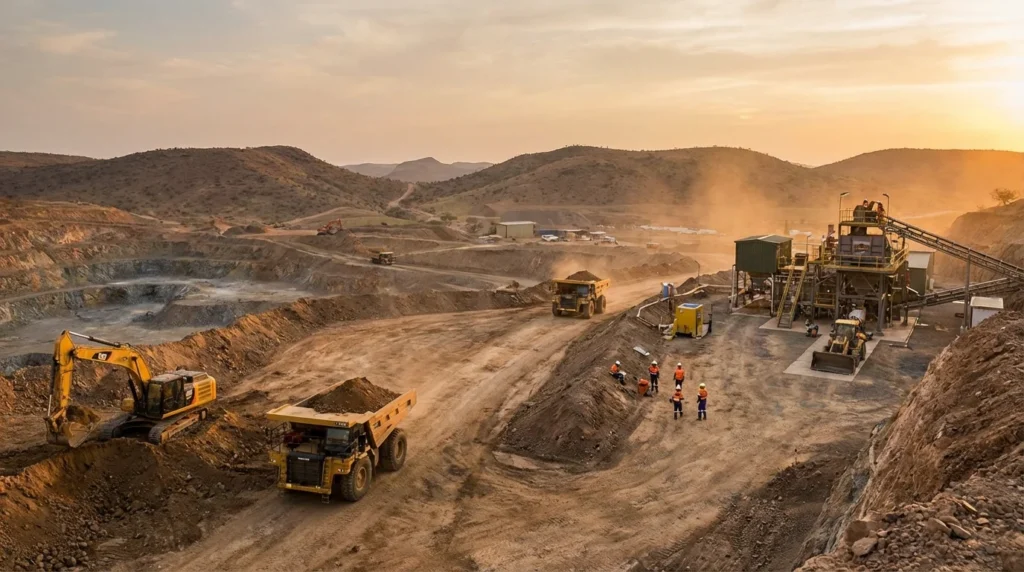
Gold mining in emerging markets can add important production growth and underexplored deposits, but the opportunity only matters after country risk is understood. A mine can have good geology and still disappoint if royalties, permits, power, water, security, foreign-exchange rules, community relations, or traceability problems absorb the upside.
- Use production data as context, not as an investment ranking.
- Separate industrial mines from artisanal and small-scale gold mining supply chains.
- Check resource nationalism through royalties, state purchase rules, export controls and local refining mandates.
- Traceability matters most at the mine, doré, export and refining stages.
- Mining equities are not the same as owning gold; they add operating, equity and jurisdiction risk.
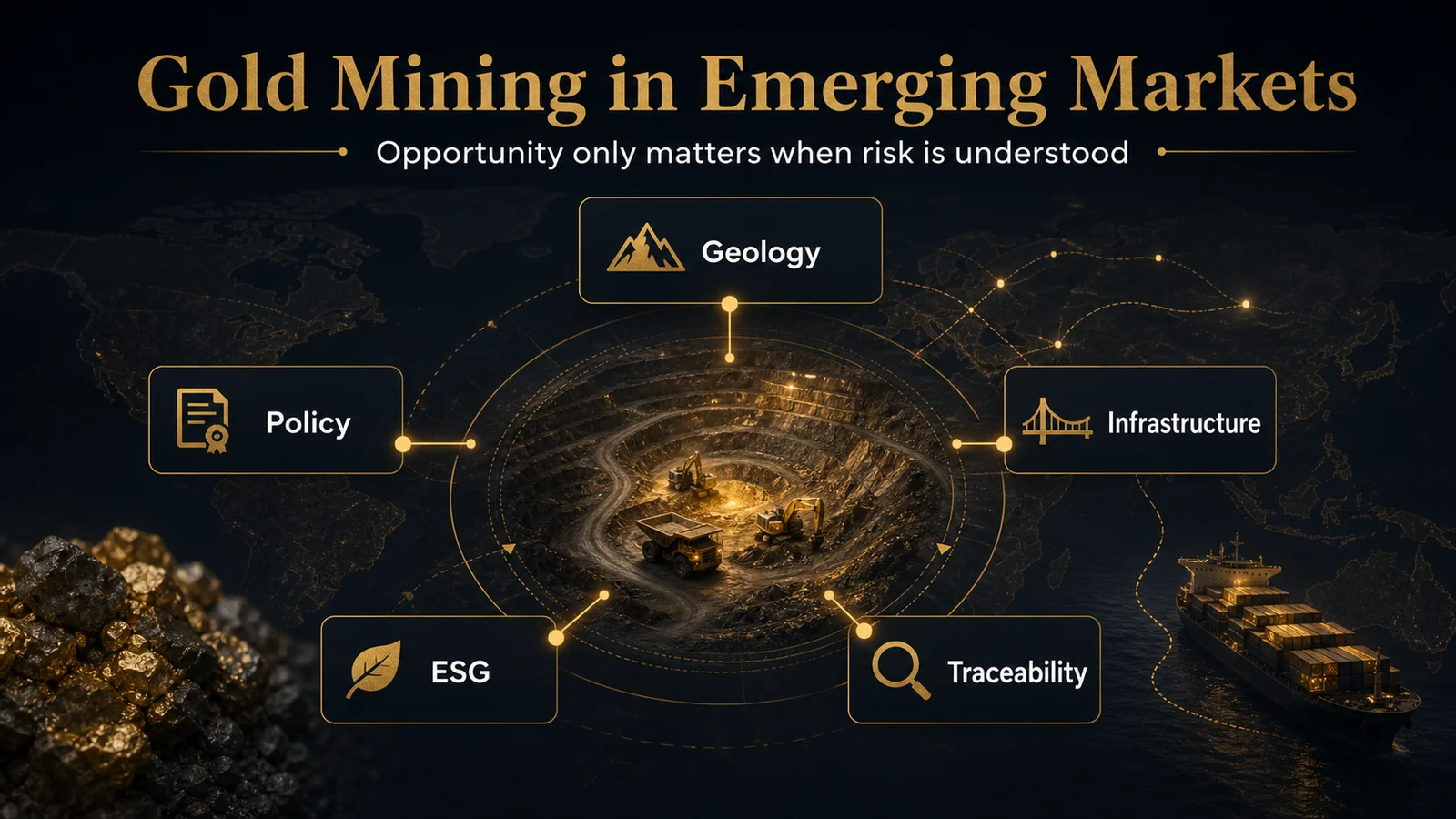
A useful emerging-market gold framework starts with geology, then tests whether policy, infrastructure, ESG and traceability allow the ounces to become reliable supply. Mining supply is only one side of the market; the emerging-market demand guide separates jewelry, bars and coins, ETFs, and central-bank buying.
Emerging-market gold mining is often presented as a simple growth story: more deposits, lower historic exploration, rising local mining sectors and greater leverage to the gold price. That is only half the picture.
The better question is whether a specific country, company and mine can turn mineral potential into permitted, financed, traceable and profitable production. This guide compares the practical risks behind the ounces, using current USGS production estimates and high-authority responsible-sourcing frameworks.
Top emerging-market gold producers by mine output.
The chart below uses selected 2025 mine-production estimates from the USGS Mineral Commodity Summaries 2026 gold chapter. It is not a recommendation list. It shows where production scale is large enough that country risk, refining routes, informal flows and policy decisions can matter to the global gold market.
| Country | 2025 estimate | Context |
|---|---|---|
| China | 380 tonnes | large domestic producer, policy-heavy market context |
| Ghana | 150 tonnes | major African producer with industrial and ASGM exposure |
| Mexico | 140 tonnes | large Latin American producer with security and permitting considerations |
| Kazakhstan | 130 tonnes | Central Asian producer with state and refining context |
| Uzbekistan | 130 tonnes | state-influenced Central Asian gold producer |
| Peru | 110 tonnes | Andean producer with community, permitting and illegal-mining risk |
| Indonesia | 90 tonnes | large deposits with licensing and resource-policy sensitivity |
| South Africa | 90 tonnes | mature but still emerging-market risk profile in costs, power and depth |
| Brazil | 80 tonnes | Amazon, illegal-mining and environmental-risk context |
Methodology note: values are USGS 2025 estimates in metric tonnes of gold content. The chart deliberately excludes mature-market examples such as Australia, Canada and the United States so the comparison stays focused on emerging-market and jurisdiction-risk context.
Why production numbers can disagree.
Gold supply data is not always clean. The USGS estimated worldwide mine production at about 3,300 tonnes in 2025. The World Gold Council’s Q1 2026 market commentary, using Metals Focus data, discussed a different global mine-production figure and noted that revisions can occur as data coverage improves.
That gap is useful for readers. It shows why country-level gold mining analysis should not rely on one number without checking methodology, update timing and whether artisanal or informal production is captured.
Country estimate lens
Useful for country mine production, reserves and commodity-supply context.
Market-flow lens
Useful for supply, demand, recycling, investment and quarterly market context.
Project-level lens
Useful for reserves, grade, mine life, AISC, capex, jurisdiction and operating execution.
Resource nationalism is broader than expropriation.
Resource nationalism in gold mining does not always mean a government takes a mine. More often, it appears through fiscal and operating rules that change how much value stays inside the country.
Country cases readers should compare carefully.
The countries below are not ranked from best to worst. They show why production size must be read beside governance, infrastructure, ASGM, policy and community context.
| Country | Why it matters | What to verify first |
|---|---|---|
| Ghana | Large African gold producer with both industrial mining and major ASGM relevance. | Royalty terms, community relations, illegal mining exposure, refinery/export controls and EITI disclosures. |
| Peru | Important Andean producer where permitting, social conflict and illegal mining can affect supply. | Project permits, community agreements, water risk, security and government enforcement. |
| Indonesia | Large deposit base with policy sensitivity around mining rights, exports and domestic value capture. | License terms, state participation, processing obligations and environmental approvals. |
| Mexico | Major producer with regional security, tax and permitting questions. | Mine location, security costs, community agreements, fiscal changes and operating continuity. |
| Brazil | Brazil combines industrial mining with Amazon-region illegal-mining and environmental concerns. | Legal title, environmental licensing, protected-area exposure, traceability and refinery due diligence. |
| Kazakhstan / Uzbekistan | Central Asian production can be large and state-influenced. | Ownership structure, state role, currency rules, refining route and disclosure quality. |
For a broader company comparison, use GoldConsul’s guide to gold companies. For the market context behind physical supply and demand, see the global gold market.
Artisanal and small-scale mining changes the risk map.
Artisanal and small-scale gold mining is not a footnote. It can support livelihoods while also creating serious mercury, labor, tax, traceability and environmental risks. That makes ASGM one of the hardest parts of emerging-market gold analysis.
Not just illegal mining
ASGM can be a major income source where formal jobs are limited. Formalization can matter more than simple exclusion.
Minamata matters
The Minamata Convention treats ASGM as a central mercury-risk category and pushes reduction or elimination where mercury amalgamation is used.
Doré is a key checkpoint
Mine-site, trader, export and refinery records are where informal flows can become hard to verify.
For sourcing decisions, readers should also compare GoldConsul’s guide to ethical gold. Responsible sourcing is not just a marketing claim; it depends on due diligence, documentation and auditability.
Traceability needs named frameworks, not vague ESG language.
If a company says its gold is responsible, traceable or conflict-free, the next step is to ask which framework supports that claim. Stronger analysis names the standard, the verification path and the point in the supply chain it covers.
| Framework | Where it helps | Reader caution |
|---|---|---|
| OECD Due Diligence Guidance | Risk-based mineral supply-chain due diligence, especially conflict-affected and high-risk areas. | A policy reference is not proof that a specific shipment was traced. |
| LBMA Responsible Sourcing | Refinery and Good Delivery responsible-sourcing context for gold and silver. | Check whether the refinery, not just the seller, is covered. |
| EITI Standard | Transparency around licenses, government revenue, beneficial ownership and state-owned enterprises. | EITI improves disclosure; it does not make every project low risk. |
| Minamata Convention | Mercury risk and ASGM policy response. | National implementation and enforcement still vary. |
| Responsible Gold Mining Principles | Industrial gold-mining performance expectations. | Principles need site-level evidence and reporting to be useful. |
| Global Industry Standard on Tailings Management | Tailings governance and catastrophic-failure risk. | Review site-specific tailings disclosure and independent review. |
Mining exposure is not the same as owning gold.
Physical gold tracks the metal. Gold mining exposure adds operating leverage, management decisions, capex, financing, permits, costs, geology and country risk. That leverage can help when everything works, but it can also destroy value when local friction absorbs the gold-price upside.
| Exposure type | Potential advantage | Main risk |
|---|---|---|
| Physical gold | No single mine or country risk. | Storage, spread, insurance and no operating upside. |
| Large-cap miners | Diversified mine portfolios and professional reporting. | Cost inflation, jurisdiction mix, project execution and equity-market beta. |
| Junior miners | Exploration or restart upside. | Financing, dilution, permitting, technical failure and liquidity risk. |
| Royalty / streaming companies | Less direct operating-cost exposure. | Counterparty risk, asset concentration and contract quality. |
| Gold mining ETFs | Diversified mining-equity exposure. | Index composition, fees, broad equity volatility and weaker project-level control. |
| Local emerging-market miners | Directer country and deposit exposure. | Governance, FX, disclosure, liquidity and legal-title risk. |
Educational note: This article is for general education only. It is not financial, legal, tax, ESG or investment advice.
How to evaluate an emerging-market gold project.
Use this sequence before trusting a mine presentation, country headline or simple production-growth claim.
Start with geology, but do not stop there.
Check reserves, resources, grade, recovery, strip ratio, metallurgy and mine life. A strong deposit still needs executable mining.
Read the fiscal terms.
Look for royalties, taxes, state-carried interest, export rules, local refining requirements and foreign-exchange restrictions.
Test infrastructure reality.
Power, water, roads, ports, security and skilled labor can change cash cost and timeline more than the headline grade suggests.
Check social license and permits.
Review community agreements, land access, water conflict, environmental approvals, tailings plans and closure obligations.
Follow the gold after the mine.
Trace doré, transport, export, refinery, offtake and third-party verification documentation. Supply-chain credibility depends on the path, not only the mine.
For practical mining terminology, compare gold mining methods. For ownership and allocation context, see how to invest in gold.
Verify gold mining claims against stronger sources.
Emerging-market gold claims can become stale quickly. Use primary and high-authority references when production, reserves, policy, responsible sourcing or ASGM risk matters.
Continue with the next practical guide.
Use these related guides when the question moves from country risk to companies, market structure, sourcing or ownership.
FAQ: gold mining in emerging markets.
Which emerging markets produce the most gold?
USGS 2026 estimates put China at about 380 tonnes of mine production in 2025, followed among emerging-market examples by Ghana at about 150 tonnes, Mexico at 140 tonnes, Kazakhstan and Uzbekistan at 130 tonnes each, and Peru at 110 tonnes. Production size is useful context, but it is not an investment ranking.
Why do USGS and World Gold Council gold production numbers differ?
They can differ because of methodology, timing, revisions, reporting coverage, and how informal or artisanal production is captured. Treat the gap as a data-quality signal, not as proof that one number is always wrong.
What is resource nationalism in gold mining?
Resource nationalism usually means a government wants more domestic value from mineral resources. In gold mining it can appear through higher royalties, state purchase rules, local-refining mandates, export controls, local-content rules, foreign-exchange restrictions, or renegotiated fiscal terms.
Why does artisanal and small-scale gold mining matter?
ASGM matters because it can represent a meaningful share of gold supply while also carrying high mercury, labor, traceability, tax and security risks. It is a livelihood issue as well as a supply-chain issue, so simple good-versus-bad framing is not enough.
Is emerging-market gold mining always high risk?
No. Some jurisdictions and operators are transparent, experienced and investable. The risk is that country-level friction, infrastructure weakness, permitting conflict, cost inflation or supply-chain controls can absorb the benefit of strong gold prices.
How should investors evaluate emerging-market gold miners?
Start with reserves, grade, mine life, AISC, balance sheet, dilution risk, jurisdiction, permits, power and water access, community relations, tailings, tax terms and offtake/refining route. Then compare company claims with technical reports, annual reports and official country or industry data.
What is AISC in gold mining?
AISC means all-in sustaining cost. It is a mining-industry metric intended to show the cost of sustaining current production, but it does not replace project-level due diligence, capital needs, taxes, debt, royalties or political risk.
What is a gold doré bar?
A doré bar is a semi-refined gold-silver bar produced at or near a mine before further refining. Doré flows matter because customs data, refinery due diligence, responsible sourcing and smuggling risk often meet at this stage.
 When you purchase a service or a product through our links, we sometimes earn a commission, at no extra cost to you.