
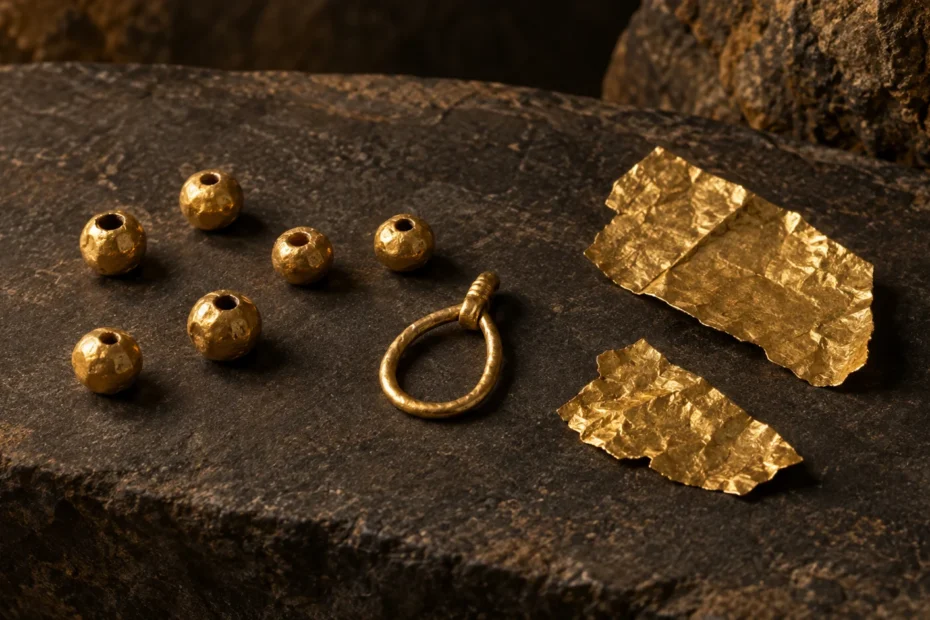
When was gold discovered? No first date is recorded. Explore the earliest artifacts, Varna and Yunatsite evidence, Egyptian gold, and first Lydian coins.
- No surviving record gives the first date or person who found gold.
- Archaeology dates objects and contexts, not the first human discovery.
- Compare Bulgarian finds, early Egyptian gold, and much later Lydian coinage.
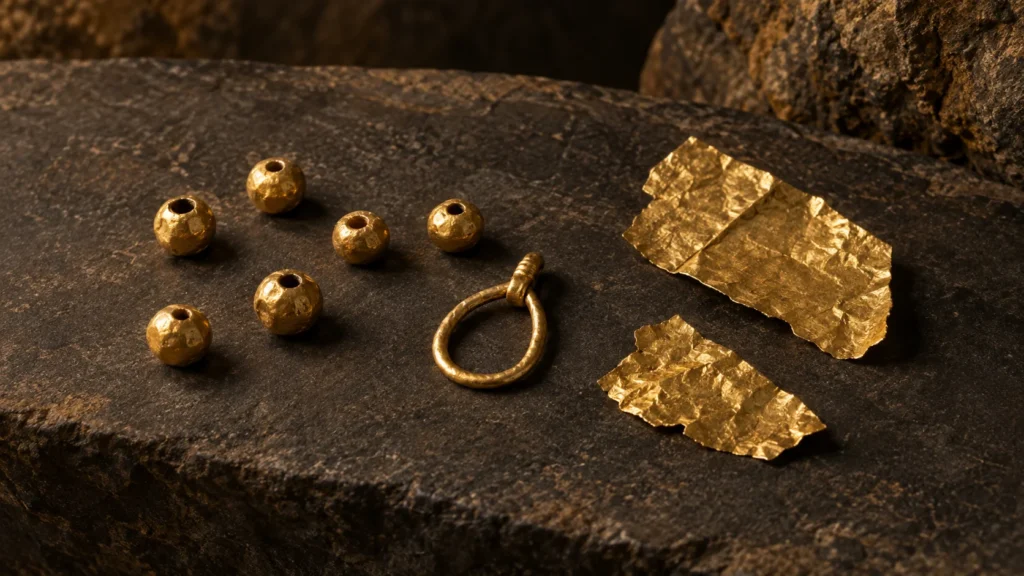
There is no recorded date or named person for the first time humans found gold. Gold occurs naturally in metallic form, so people could notice and collect it long before written history. Archaeology can date surviving objects and their burial contexts—not the first human discovery. The best-known early evidence comes from fifth-millennium-BCE sites in Bulgaria, including the Varna cemetery; a 2025 study argues that one gold object from Tell Yunatsite may predate Varna.
- First noticed: unknown; it happened before written records.
- Earliest evidence: archaeologists date surviving gold objects and the layers or burials where they were found.
- First coins: a much later milestone, beginning with electrum coinage in Lydia around 600–625 BCE.
What is the earliest evidence for people using gold?
Native gold can occur as visible grains or pieces in river sediment and rock. Unlike metals that had to be extracted from ore by smelting, naturally occurring gold could be picked up, hammered, or shaped. That makes the first discovery especially hard to date: the first person to notice a gold flake left no identifiable record.
Historians therefore answer a narrower question: what are the oldest gold objects that have survived in a datable archaeological context? Even that record can change when new finds are excavated or existing finds are dated again.
Varna and Tell Yunatsite: what the newer evidence changes
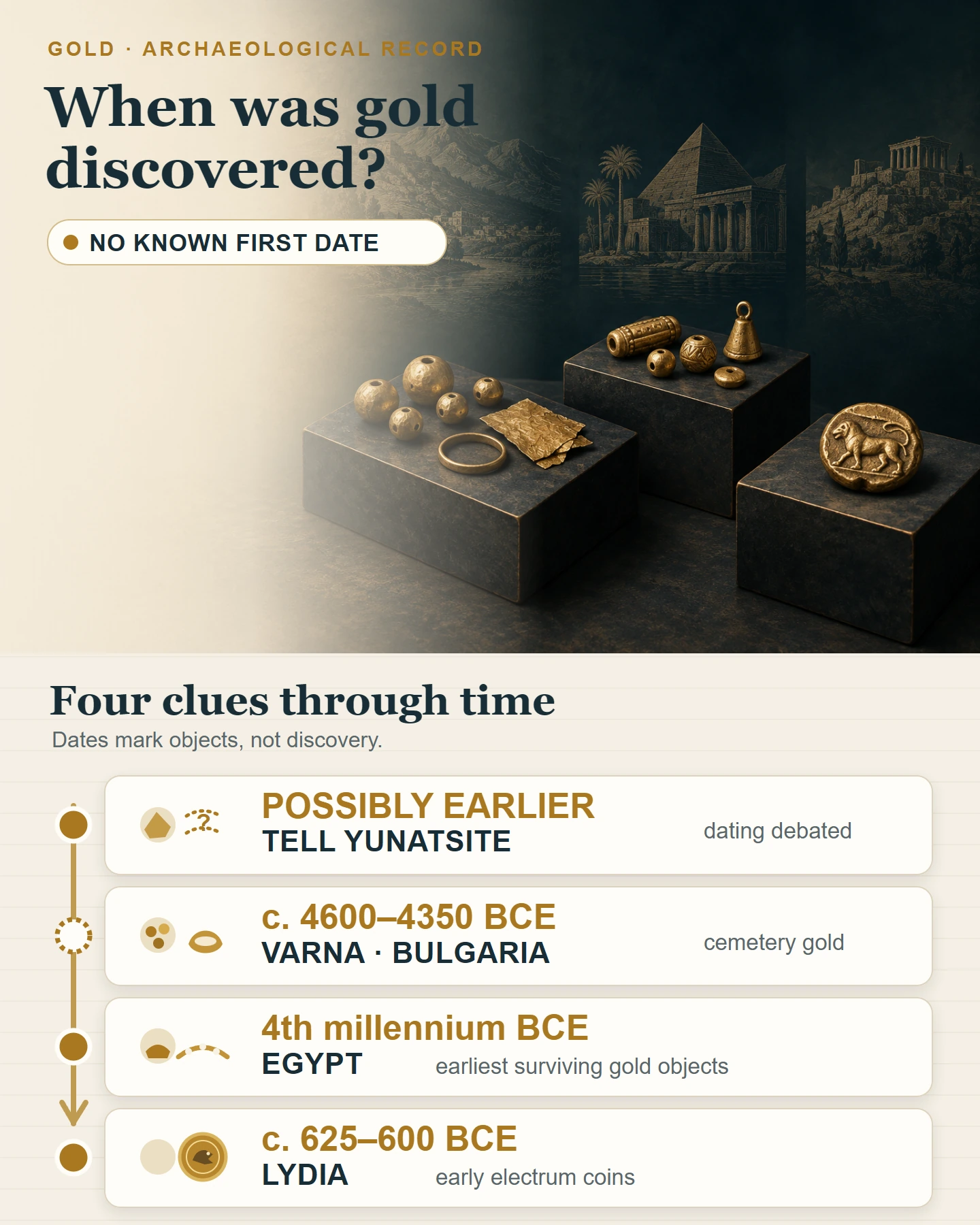
The Varna Chalcolithic cemetery on Bulgaria’s Black Sea coast is important because it contains an unusually large, diverse set of worked gold objects in securely studied burial contexts. The site’s history places the community between about 4600 and 4350 BCE. A Cambridge-led AMS study modeled 71 dates from 53 graves and estimated a cemetery span of roughly 120–260 years. Those dates refer to activity at the cemetery; they are not a direct radiocarbon test of each gold object.
In 2025, researchers published five gold artifacts from a Chalcolithic layer at Tell Yunatsite in southern Bulgaria. Based on stratigraphy, pottery, and radiocarbon dates, they argue that the earliest of those objects predates the Varna I cemetery. The same paper notes a local radiocarbon anomaly that complicates comparisons between Bulgarian sites. The careful conclusion is that Tell Yunatsite may push the record earlier; it does not reveal when the first human ever found gold.
Gold objects were being made and used in southeastern Europe by the fifth millennium BCE.
A peer-reviewed study presented Tell Yunatsite objects and argued one may precede the Varna I cemetery.
The identity, place, and date of the first person to notice or collect natural gold.
For the excavation story, the official Varna discovery account explains that workmen uncovered the necropolis during construction in 1972. The present article separates that modern archaeological discovery from the prehistoric use of gold.
Two-minute museum film · VISIT Varna
See the Varna Archaeological Museum’s gold collection
This visual introduction from Varna’s official tourism channel shows the museum and its archaeological collection. The dates and evidence caveats in the timeline above come from the cited museum and research sources.
The original video is published by VISIT Varna.
Gold artifacts, gold mining, and gold coins are different milestones
Search results often mix these events together. Separating them makes the history easier to follow:
- Finding native gold means noticing gold that already occurs in nature. It does not require a mine or a furnace.
- Working gold means shaping natural metal into an object. Read more about early gold-mining techniques and ancient gold mining.
- Smelting or refining is a technical step in processing ores or separating metals. Gold artifacts can predate large-scale mining systems; our guide to ancient gold smelting in Europe covers that separate history.
- Coinage standardized metal for exchange. The first known Lydian coins were electrum, not pure gold bars, and came thousands of years after the earliest prehistoric gold objects.
The history of gold trade and ancient economies shows how gold’s role changed after people were already making and exchanging objects. The later gold rush era and the Klondike Gold Rush are further chapters, not answers to who first discovered gold.
Gold itself does not supply a calendar date. Researchers study the layer, grave, pottery, and other material associated with an object. At Varna, radiocarbon dates from human and animal remains were modeled to estimate when the cemetery was used. That dates the archaeological context, not the moment a person first noticed gold.
Frequently asked questions
Who first discovered gold?
No one knows. Gold was encountered in prehistory, before written records could name a discoverer or record a date.
Is Varna definitely where gold was first discovered?
No. Varna is famous for the earliest large-scale assemblage of gold artifacts known for a long time. A 2025 study argues that an object from Tell Yunatsite may predate the Varna I cemetery, and neither site can identify the first human discovery.
When did people first use gold in Egypt?
The Metropolitan Museum says the earliest surviving Egyptian gold artifacts date to the preliterate fourth millennium BCE. These are evidence of early Egyptian use, not proof of the first global use of gold.
When were the first gold coins made?
Early coins from Lydia in western Anatolia were made of electrum around 600–625 BCE. Lydian gold and silver coinage followed by the middle of the sixth century BCE.
Does a gold rush mark the first discovery of gold?
No. A gold rush is a later mass movement of miners to a newly publicized field. People had worked gold thousands of years earlier.
Sources and further reading
- VISIT Varna Municipality: About the discovery — the 1972 discovery of the necropolis and the site’s local chronology.
- Higham et al., Radiocarbon / Cambridge University Press — AMS dating and modeled cemetery chronology at Varna.
- Boyadzhiev, Boyadzhiev & Georgiev, Archaeologia Bulgarica (2025) — five gold artifacts from Tell Yunatsite and the proposed chronology.
- The Metropolitan Museum of Art: Gold in Ancient Egypt — early Egyptian gold artifacts and their archaeological record.
- LBMA: Lydian Electrum Coin — early electrum coinage and later Lydian gold coins.
 When you purchase a service or a product through our links, we sometimes earn a commission, at no extra cost to you.