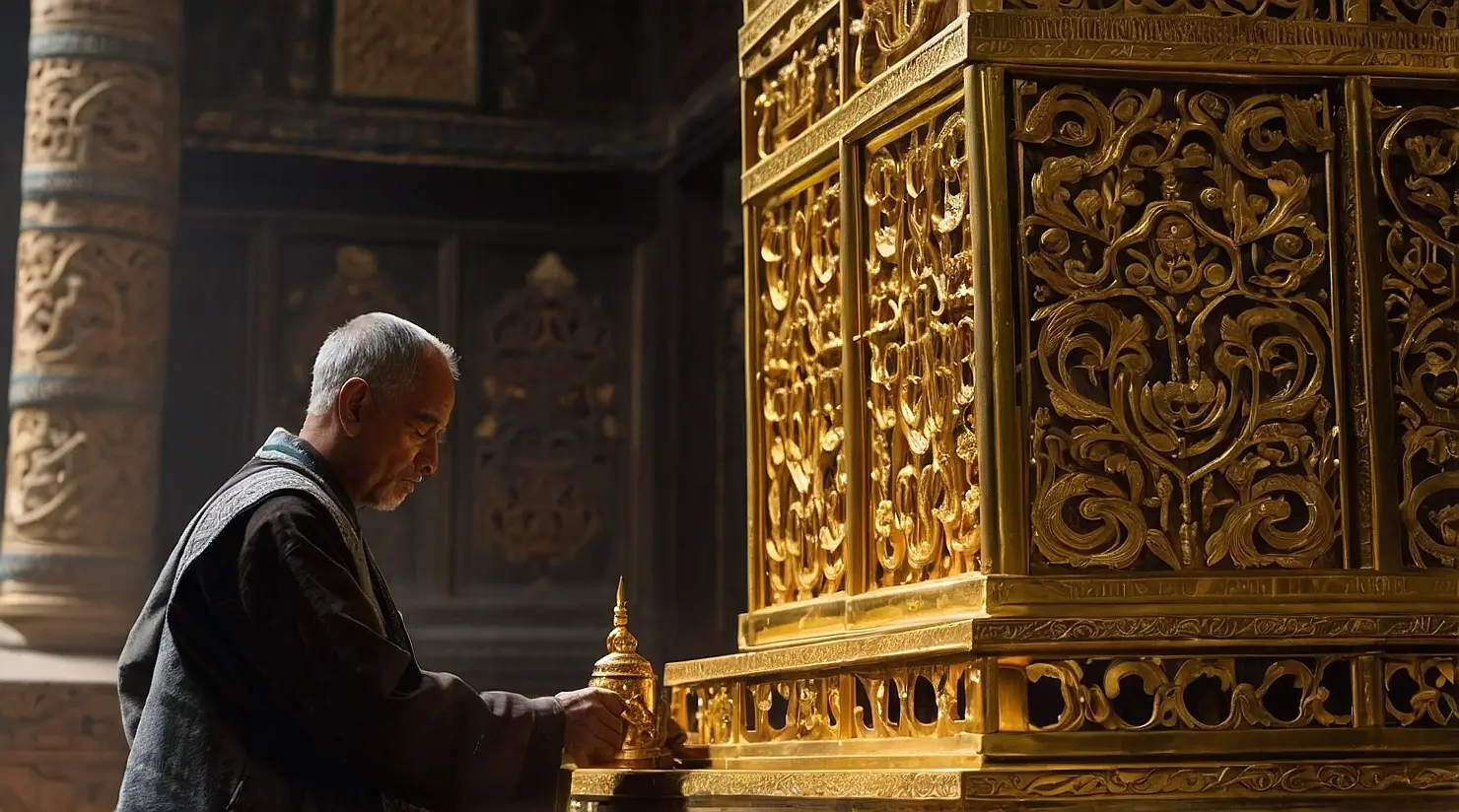
The golden altar of incense was the small gold-covered altar that stood inside the Holy Place, directly before the veil leading into the Most Holy Place. Its job was not to burn animal sacrifice like the bronze altar outside, but to hold the daily incense service that marked priestly approach to God.
That distinction is where many summaries go soft. They call it important, but they do not clearly explain what it did, where it stood, and why readers get confused when Hebrews 9 seems to speak about it in unusually close connection with the inner sanctuary.
TL;DR
- The golden altar of incense was a priestly-access altar in the Holy Place, not the outer sacrifice altar.
- Exodus 30 presents it as the regular site of incense burning before the Lord.
- Its position before the veil made it symbolically tied to the divine presence behind the veil.
- The main confusion comes from mixing it up with the bronze altar outside or with the Day of Atonement censer.
- The best explanation treats it as a boundary object: close to the presence of God, but not identical to the inner sanctuary furnishings.
What Most Readers Miss
The key mistake is reading the golden altar of incense as just another decorative temple object. It sat at the threshold of the holiest space, so its placement mattered as much as its material.
Function:
Daily incense service, not ordinary slaughter or grain offerings.
Location:
Inside the Holy Place, immediately before the veil.
Meaning:
It marked restricted approach, holiness, and priestly mediation.
What Was the Golden Altar of Incense?
The golden altar of incense was a small acacia-wood altar overlaid with gold, with horns on its corners and rings for transport. In the tabernacle description, it belonged to the interior priestly furniture rather than to the open courtyard system.
Britannica’s tabernacle overview is useful here because it keeps the furnishings grouped by sacred zones. That is the first structural point most readers need before they start asking about symbolism.
Chart 1: Two Different Altars, Two Different Functions
This is the distinction many summaries blur.
| Altar | Location | Main use | Common reader mistake |
|---|---|---|---|
| Bronze altar | Courtyard | Animal and fire offerings | Treating it as the same object as the golden altar |
| Golden altar of incense | Holy Place before the veil | Priestly incense service | Assuming it was another sacrifice station in the courtyard sense |
Where Did It Stand?
The altar stood in the Holy Place, directly before the veil that separated the Holy Place from the Most Holy Place. That meant it was not behind the veil with the ark, but it was positioned as close to that boundary as a standing priestly object could be.
This point becomes clearer when you read it alongside gold in the tabernacle and the ark of the covenant. The altar makes much more sense when readers see it as part of a layered sacred geography rather than as an isolated gold artifact.
- The courtyard handled open sacrificial activity.
- The Holy Place handled restricted priestly ministry.
- The Most Holy Place marked the innermost divine-presence zone.
- The altar of incense sat right at the threshold between the second and third of those zones.
What Happened on the Altar?
According to Exodus 30, incense was burned on it morning and evening as part of regular priestly service. The text also restricts its use tightly by forbidding unauthorized incense and separating it from ordinary offering categories.
That restriction matters because it tells you the altar was not just a gold platform for fragrance. It was a controlled ritual object whose use signaled order, authorized access, and covenant discipline.
Chart 2: Golden Altar Workflow
The object makes sense when you read it as a controlled service sequence.
| Step | What happens | Why it matters |
|---|---|---|
| 1. Priest enters Holy Place | Ministry occurs in a restricted interior zone | Access is already narrower than courtyard worship |
| 2. Incense is offered | Fragrant incense is burned before the Lord | The action is symbolic, ordered, and non-random |
| 3. Service remains boundary-facing | The altar stands before the veil rather than beyond it | The ritual is close to divine presence without collapsing sacred boundaries |
Why Did Incense Matter So Much?
Incense in Israelite worship was not casual atmosphere. It marked consecrated priestly service and reinforced the idea that access to God’s presence was mediated, structured, and never common.
That is why the golden altar belongs in the same conversation as holiness rules, priestly order, and sanctuary boundaries. The object mattered because it turned daily ritual into visible sacred architecture.
Helpful Reading Filter
If you want to understand this altar correctly, ask these questions in order.
What zone is this in?
Holy Place, not courtyard.
What action happens here?
Incense ministry, not ordinary outer-altar sacrifice.
What is its symbolic job?
To mark approach before the veil without erasing the veil.
Why Does Hebrews 9 Create Confusion?
The interpretive tension comes from the way Hebrews 9 speaks about the inner sanctuary and mentions the altar or incense-related furniture in close association with it. Readers then jump to one of two bad conclusions: either Exodus and Hebrews contradict each other, or the altar physically stood inside the Most Holy Place all along.
A more careful reading is better. The altar stood before the veil, but it was so tightly bound to the veil-facing ministry and the approach to the divine presence that later theological discussion could associate it with the inner sanctuary’s holiness without relocating it as ordinary furniture.
Britannica’s Holy of Holies entry is useful here because it keeps the sancta distinction visible. The cleaner explanation is symbolic and relational, not careless geography.
Chart 3: The Hebrews 9 Confusion Map
What readers often think versus the cleaner explanation.
| Reader assumption | What goes wrong | Better explanation |
|---|---|---|
| The altar was just another piece of Holy Place furniture | Misses its veil-facing boundary role | Its location gave it unusual symbolic proximity to the inner sanctuary |
| The altar literally stood behind the veil | Collapses the tabernacle layout of Exodus | Hebrews can speak in relation to sacred function, not only floor-plan coordinates |
| The text is simply contradictory | Stops interpretation too early | The tension is better explained by liturgical association than by contradiction |
How Does It Connect to the Temple Tradition?
The golden altar theme did not end with the tabernacle pattern. It continued into later temple imagination and helps explain why gold, incense, and interior sanctuary symbolism remain linked in discussions of worship, priesthood, and sacred kingship.
This also becomes clearer when you place it alongside gold in Solomon’s Temple and the Temple of Herod. The altar is one node in a larger biblical architecture of gold, holiness, and controlled access.
The GoldConsul Editorial Perspective
The right way to read the golden altar of incense is not as a generic symbol of prayer or as a decorative gold object. It is a boundary marker inside the sanctuary system, and that is why its placement matters so much.
Knowledge Gap: The altar’s importance comes from sacred proximity, not just from gold
Many readers remember the object because it was made with gold. That is visually memorable, but it is not the main interpretive key.
- Its role was priestly and restricted.
- Its location was threshold-facing and symbolically charged.
- Its importance comes from function plus placement, not ornament alone.
Video walkthrough: this clip is useful if you want a quick visual explanation of how the altar of incense fits into the tabernacle layout and priestly service pattern.
Bottom Line
The golden altar of incense was the interior incense altar that stood before the veil in the Holy Place. Its importance comes from what happened there, where it stood, and how it marked approach to the divine presence without erasing the sanctuary boundary.
If you keep the function, location, and symbolic proximity together, the object becomes much easier to understand. If you split those apart, the whole subject starts to look more confusing than it really is.
FAQ: What Was the Golden Altar of Incense?
Was the golden altar of incense the same as the bronze altar?
No. The bronze altar stood in the courtyard for sacrificial offerings, while the golden altar stood inside the Holy Place for incense ministry.
Did the golden altar stand inside the Holy of Holies?
No in the ordinary layout sense. It stood before the veil, but it was closely associated with the inner sanctuary because of its function and boundary-facing position.
Why was incense offered there every day?
The daily offering marked ordered priestly ministry before the Lord and reinforced the holiness structure of the sanctuary.
Why does Hebrews 9 sound different from Exodus 30?
The tension is best explained by sacred association and liturgical logic, not by assuming the tabernacle layout was forgotten.
Why does this altar matter in biblical interpretation?
It helps readers understand how gold, priesthood, incense, and sacred boundaries worked together in biblical worship.
 When you purchase a service or a product through our links, we sometimes earn a commission, at no extra cost to you.