
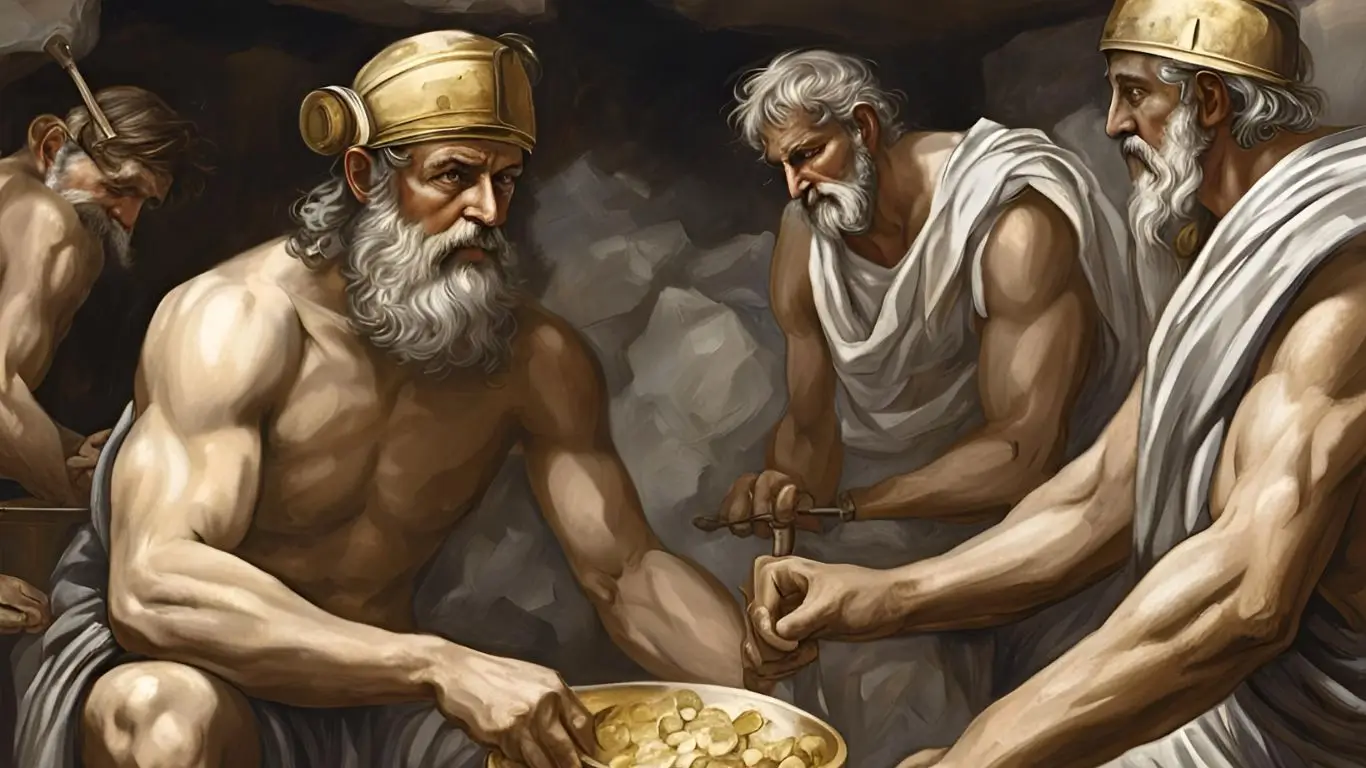
Ancient Greece did mine gold, but not in one simple, unified “Greek gold field.” The real story is regional: southern Greece is remembered for Laurion and silver, while the stronger gold story sits farther north around Pangaion, Thasos-linked mainland districts, and later Macedonian control.
That distinction matters because many summaries accidentally describe ancient Greek mining in general and call it a gold story. If you want to understand Greek gold, you need to separate mining geography from later political control.
TL;DR
- Ancient Greece did mine gold, but the most important gold zones were unevenly distributed and concentrated more strongly in northern districts than in the classic Laurion area.
- Laurion matters for Greek mining history, but it is mainly a silver story and should not dominate the explanation of Greek gold.
- Northern zones linked to Pangaion, Thasos, and later Macedonian expansion are more central to the political history of Greek gold.
- Gold mining mattered because it fed state finance, military power, coin production, and regional control, not just luxury consumption.
- The best historical reading separates what is archaeologically clear from what later narrative summaries overstate.
What Most Readers Miss
The common mistake is treating all ancient Greek mining as one system. The better framework is to separate silver-heavy Attica from the more strategically important northern gold districts that later fed Macedonian power.
Laurion:
Essential to Greek mining history, but mostly as a silver complex tied to Athenian finance.
Pangaion:
More relevant to the gold story because it sits in the northern resource zone tied to Thrace and Macedonia.
Power:
Gold mattered where rulers could control extraction, labor, transport, and minting, not just where ore existed.
Did Ancient Greece Really Mine Gold?
Yes, but the answer needs precision. As the broad antiquity survey in History of Gold in Antiquity makes clear, the Greek world knew and extracted gold, yet its deposits and output profile were not identical to the silver-heavy systems that dominate many textbook summaries.
That is why “gold mining in ancient Greece” is a regional question first. You cannot answer it properly by describing Attic silver mines alone.
Chart 1: Greek Mining Geography (conceptual regional split)
Where the ancient Greek mining story is usually remembered, and where the stronger gold emphasis actually sits.
| Region / district | Gold relevance | Main historical significance |
|---|---|---|
| Laurion / Attica | Low to limited | Mining history is real here, but the site is primarily remembered for silver and Athenian state finance. |
| Pangaion area | High | Northern gold zone tied to strategic control, extraction, and later Macedonian leverage. |
| Thasos-linked mainland districts | High | Shows that island power and nearby mainland resource control could be tightly linked. |
| Macedonian / Philippi zone | High | Important for understanding how resource control translated into political and military expansion. |
Interpretation: the Greek gold story is strongest in the north, while the popular memory of Greek mining still leans heavily toward Laurion because Laurion is better known in general history.
Reader Tool: 30-Second Claim Credibility Check
Use this quick filter whenever you read a claim like “the Greeks mined huge amounts of gold everywhere.” If a claim fails two or more checks, treat it as oversimplified.
Why this helps: it prevents a real mining history from being flattened into one generic “gold-rich Greece” claim.
Why Laurion Is Important but Not the Best Gold Example
Laurion belongs in this article because it shaped Greek mining memory. The problem is that Laurion is mostly a silver example, which means it often hijacks discussions that should be about gold geography instead.
The mining chapter in Cambridge’s environmental history of the ancient Greek and Roman world is useful here because it frames mining as an environmental, labor, and state-organized activity rather than a loose treasure hunt. That wider lens helps explain why Laurion became so famous even when the gold story points elsewhere, especially compared with gold mining in ancient Nubia.
- Laurion is essential for understanding extraction infrastructure.
- Laurion is essential for understanding Athenian state finance.
- Laurion is not the clearest district if the reader specifically wants ancient Greek gold.
Where the Stronger Ancient Greek Gold Story Actually Sits
The more important gold story sits farther north. Pangaion and nearby districts mattered because they linked mineral wealth to frontier control, trade routes, and later Macedonian power.
Britannica’s entry on Mount Pangaion is concise but useful because it preserves the long-standing connection between that region and precious-metal wealth. The older specialist literature, including French scholarship on gold mining and metallurgy in the Greek world, supports the need to discuss gold through named districts rather than through a single national narrative.
Chart 2: Mining-to-Power Workflow
How a gold district becomes politically important in the ancient Greek world.
Gold matters only if a community or ruler can hold the district and keep extraction going.
Mining requires organized labor, water, tools, and a chain for washing, crushing, or smelting.
The value of the district rises when routes, ports, and nearby political control reduce friction.
Resource control becomes real power when rulers can convert metal into revenue, coinage, and military capacity.
Interpretation: the ancient gold story is not just about geology. It is about which polity could turn geology into durable state power.
How Gold Mining Likely Worked
Specific techniques varied by district and ore type, but ancient mining was never just a matter of picking metal off the ground. It required a chain of extraction, separation, and movement.
- Find workable ore or gold-bearing zones.
- Organize labor for excavation and basic processing.
- Use washing, crushing, or metallurgical steps suited to the deposit.
- Move output through routes that rulers or city-states could protect and tax.
This is one reason the political map matters so much. A district with gold but weak route control is far less important than a district whose output can be captured consistently, which also makes a useful contrast with gold mining in the Indus Valley.
Why Gold Mining Mattered to Greek and Macedonian Power
Gold changes history when it is monetized. That is why the question is not only where the mines were, but who could convert their output into political leverage.
Britannica’s profile of Philip II matters here because Macedonian ascent cannot be separated from control of resource-rich northern territories. Once gold districts are framed as revenue systems rather than background scenery, their strategic value becomes much clearer, much like the logic explained in gold price factors.
Chart 3: Political Use-Case Matrix
What gold districts could support once control was consolidated.
| Use case | Why gold mattered | Historical payoff |
|---|---|---|
| Coinage | Standardized precious metal improves state capacity and exchange power. | Supports wider reach than uncoordinated bullion holding. |
| Military finance | Portable wealth helps fund troops, equipment, and campaigns. | Turns local extraction into regional leverage. |
| Political legitimacy | Control of rich districts signals strength and staying power. | Resource control reinforces dynastic and territorial authority. |
| Trade influence | Precious-metal output improves bargaining power across wider networks. | Links mining districts to ports, colonies, and frontier strategy. |
Interpretation: gold mattered because rulers could turn it into coin, pay, and control. Without that conversion, a mine remains a local fact rather than a geopolitical one.
What the Archaeology Supports and What It Does Not
The evidence is real, but it is uneven. Some districts are much better known through literary memory, political history, or broad antiquity surveys than through clean, simple public-facing mine diagrams.
That means careful wording matters. It is reasonable to say ancient Greek and Greek-controlled northern districts mined gold, but weaker summaries often move too fast from “gold existed here” to “the entire Greek world was a major gold-mining civilization.”
- Strong claim: the Greek world had real gold extraction and politically meaningful gold districts.
- Stronger claim: northern zones mattered more for gold than popular Laurion-first summaries suggest.
- Weaker claim: all Greek mining can be summarized as one unified gold system.
The GoldConsul Editorial Perspective
The biggest mistake in this topic is using the fame of Laurion to explain the gold story. Laurion explains Greek mining memory, but northern districts explain Greek gold power.
Knowledge Gap: Greek gold is a geography problem before it is a mining problem
Readers usually ask, “Did ancient Greece mine gold?” The higher-value question is which districts mattered and who controlled them. That is where the article becomes historically useful.
- Laurion belongs in the story, but mostly as a silver benchmark.
- Pangaion and northern districts belong in the story because that is where the gold angle sharpens.
- Macedonian control matters because resource ownership becomes political only when extraction and revenue are captured.
Video walkthrough: this short clip is mainly useful as visual context for ancient Greek mining methods and why Laurion dominates public memory, even though the stronger gold story sits farther north.
Bottom Line
Ancient Greece did mine gold, but the best explanation is regional, not generic. If you want the strongest historical answer, start by separating Laurion’s silver fame from the northern districts where Greek gold was more strategically important.
That framing makes the topic far more useful. It turns a vague myth-of-riches question into a clear story about geography, labor, and political control, much like other foundational explainers such as why gold is an element.
FAQ: Gold Mining in Ancient Greece
Did ancient Greece really have gold mines?
Yes. The Greek world had real gold extraction, but the most important gold districts were regionally concentrated rather than evenly spread across Greece.
Was Laurion a gold mine?
Laurion is mainly famous as a silver-mining complex. It matters for Greek mining history, but it is not the clearest headline example for Greek gold.
Why is Pangaion important in the story of Greek gold?
Pangaion is important because the northern district is repeatedly tied to precious-metal wealth and to the political control that later strengthened Macedonian power.
Why does gold mining matter politically in ancient Greece?
Gold matters politically when rulers can turn extraction into coinage, revenue, military finance, and regional leverage. Mining only becomes power when control is organized.
What is the biggest misunderstanding about gold mining in ancient Greece?
The biggest misunderstanding is treating all Greek mining as one unified gold system. The stronger explanation separates silver-heavy Laurion from the more gold-relevant northern districts.
 When you purchase a service or a product through our links, we sometimes earn a commission, at no extra cost to you.