
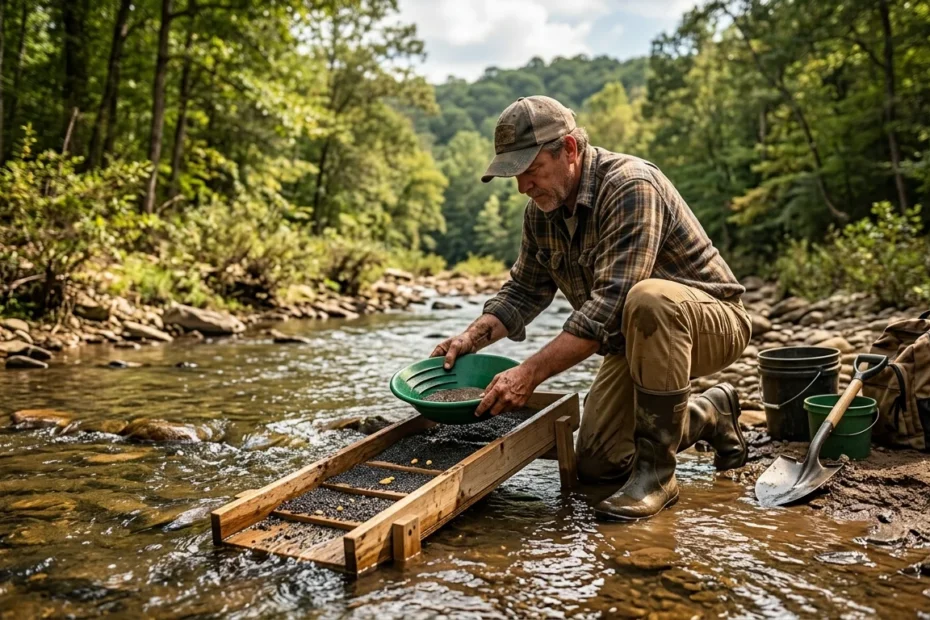
Gold mining in Alabama is real, but expectations need calibration. Most recreational prospectors find fine gold and small flakes, not regular nugget-size payouts. The win is a legal-access plan, the right creek strategy, and consistent field process.
TL;DR
- Alabama has documented gold history, especially in the east-central belt, but recreational finds are usually small.
- Your first filter is legal access: private-land permission, site rules, and local environmental boundaries.
- Beginners do best with creek-based panning + a strict sampling routine, not random digging.
- Treat this as a field hobby with upside, not guaranteed income.
Where Gold Mining in Alabama Still Makes Sense in 2026
Alabama’s practical prospecting focus is small-scale placer style work in creeks and historic belt-adjacent areas. If you expect “TV-gold-rush” outcomes, this is the wrong state thesis. If you want repeatable weekend prospecting with real mineral-learning upside, Alabama is viable.
Related reads: gold mining in Texas, gold mining in Michigan, and gold mining in Idaho.
Chart 1: County Opportunity vs Access Difficulty
Prospecting-priority score (higher bar = stronger recreational fit):
Interpretation: eastern-belt counties usually offer better hobby potential, but permission quality and actual creek access still dominate outcomes.
What Most Prospectors Miss
The biggest mistake is choosing a county before choosing a legal, repeatable access route. Access quality beats county hype.
Chart 2: Yield Reality by Prospecting Environment
Expected find profile score (1=lowest practical return profile, 10=highest):
Interpretation: controlled-access creeks often produce better recreational results because pressure is lower and repeat visits are possible.
Chart 3: Starter Budget vs Learning Speed
Setup efficiency score (higher = better beginner learning curve per dollar):
Interpretation: most beginners improve faster with a simple repeatable kit before upgrading to heavier equipment.
Legal Access and Compliance: The Non-Negotiable Filter
Before any field trip, verify permission and compliance boundaries. Start with Alabama environmental resources via ADEM, confirm current mineral context using USGS Alabama mineral summaries, and check land-use constraints where relevant through the US Forest Service mining guidance.
Practical rule: if ownership or use permission is unclear, skip the location.
The GoldConsul Editorial Perspective
In Alabama prospecting, legal-access quality is your alpha. A legal, repeatable creek with modest grades often beats a “better” location you cannot revisit reliably.
Knowledge Gap: Why Beginners Underperform
Most new prospectors change locations too quickly and never build sample history.
- Trip 1-2: sample map + black-sand concentration notes.
- Trip 3-4: revisit only top two micro-zones.
- Trip 5+: adjust classifier/pan technique before buying new gear.
County Quick-Start Matrix
| County | Best Beginner Play | Main Constraint |
|---|---|---|
| Clay | Controlled creek sampling | Land access permissions |
| Tallapoosa | Shallow-bar panning pattern | High pressure on known spots |
| Cleburne | Fine-gold retention training | Access logistics |
| Randolph/Coosa | Targeted weekend scouting | Inconsistent location quality |
First 3 Trips: Practical Field Plan
- Trip 1: test 6-10 micro-spots and record black-sand concentration.
- Trip 2: revisit top three spots only; increase pan consistency and retain fines.
- Trip 3: focus on one winner zone and compare output per hour vs prior visits.
For broader extraction context, see how to use cornstarch to extract gold and can gold be recycled.
Video walkthrough: Alabama field context and practical panning mindset.
Bottom Line
Gold mining in Alabama is best approached as legal, repeatable creek prospecting with realistic yield expectations. If you control access, document your sampling, and keep equipment simple at first, your results and learning curve both improve.
FAQ: Gold Mining in Alabama
Can you still find gold in Alabama?
Do I need permission to pan for gold?
Which county is best for beginners?
How much should I spend on gear first?
Is Alabama prospecting profitable?
 When you purchase a service or a product through our links, we sometimes earn a commission, at no extra cost to you.