

In medieval myths and legends, gold was rarely just about money. In story after story, it marked something larger: divine favor, royal legitimacy, cursed temptation, hidden treasure, or a test of the hero who reached for it.
That is why this topic should not be folded into a generic page about medieval wealth. It connects more naturally to gold in medieval Europe, gold in the Middle Ages, and symbolic pages like the golden apples of the Hesperides.
The knowledge gap is simple. Many summaries list dragon hoards, saint legends, or relic stories one by one, but they do not explain why medieval storytelling kept reusing gold as both holy and dangerous at the same time.
TL;DR
- Medieval legends used gold as a symbol long before it was just a store of wealth inside the story.
- The same metal could represent holiness, kingship, temptation, or cursed treasure depending on the narrative.
- Dragon gold and hidden hoards usually signaled danger, trial, or moral testing rather than simple abundance.
- Saint legends and relic stories often used gold to show divine worth, not ordinary market value.
- The strongest reading frame is to ask what gold means in the story, not only where the treasure sits.
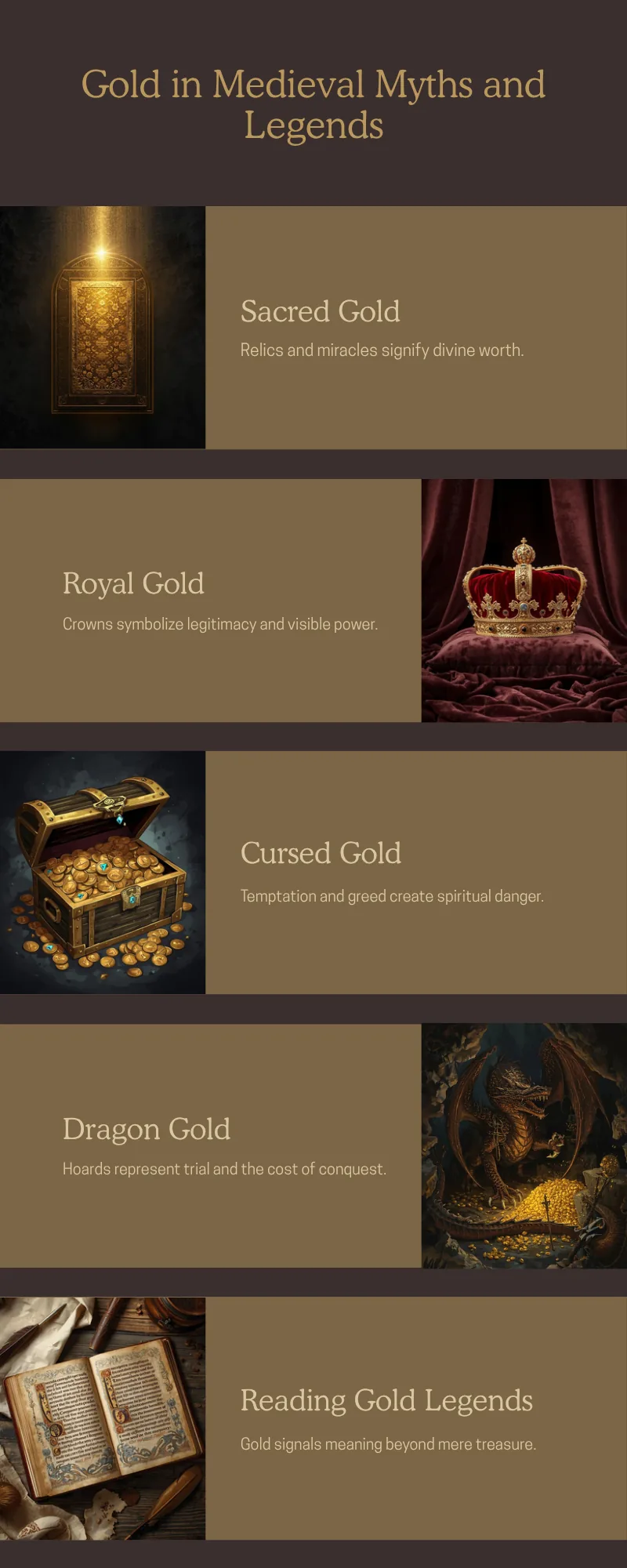
What Most Readers Miss
The biggest mistake is reading medieval gold literally. Storytellers often used gold as a fast symbolic language for sacred value, corrupting desire, royal authority, and supernatural danger.
Sacred gold:
Signals holiness, relic value, or contact with divine order.
Royal gold:
Supports legitimacy, rank, and the visible power of kingship.
Cursed gold:
Tests greed, pride, and the moral weakness of the seeker.
Why Gold Carried So Much Narrative Weight
Medieval audiences already knew gold as a liturgical, royal, and artistic material. That background meant writers did not need to explain its prestige every time it appeared in a legend.
Instead, gold worked like compressed symbolism. A golden object could instantly imply sanctity, danger, miracle, inheritance, or a realm set apart from ordinary life.
Medievalists.net’s discussion of gold’s symbolic role in magical and religious contexts is helpful here because it shows how deeply the metal sat inside medieval thought. That broader symbolic culture also helps explain why pages like gold in medieval religion and gold in medieval medicine overlap with legendary storytelling without being the same topic.
Historical Reading Filter
When a medieval legend uses gold, ask three questions before you treat it as simple treasure.
- Is the gold marking sacred status or ritual importance’
- Is it measuring power and royal legitimacy’
- Is it functioning as temptation, curse, or heroic test’
The Four Main Jobs Gold Performs in Medieval Legends
Gold usually falls into a small number of narrative roles. Once readers see those patterns, medieval legends become easier to compare.
Chart 1: The Main Symbolic Uses of Gold Across Medieval Storytelling
Interpretation: the same metal changes meaning based on the story function around it.
| Legend function | Typical setting | What gold usually means |
|---|---|---|
| Sacred gold | Relics, altars, miracle stories, saintly objects | Holiness, incorruptibility, divine worth |
| Royal gold | Crowns, thrones, gifts, dynastic treasure | Authority, continuity, visible legitimacy |
| Hidden or cursed gold | Buried treasure, magical hoards, warning tales | Temptation, danger, spiritual risk |
| Monster-guarded gold | Dragon lairs, perilous quests, heroic epics | Trial, greed, and the cost of conquest |
Sacred Gold Was About Value Beyond Price
In hagiography and miracle stories, gold often signaled that an object belonged to a divine register of value. The point was not that the thing could be sold for more money. The point was that it had been lifted above ordinary use.
The Fordham Medieval Sourcebook version of the Golden Legend matters here because it preserves the saint-legend world in which radiant materials and precious objects carried spiritual force. Gold could therefore mark reward, reverence, or miraculous confirmation rather than economic exchange.
- Gold in saint legends often frames sacred recognition.
- Gold reliquaries or coverings make holiness visible to the eye.
- The metal’s incorruptibility made it ideal for stories about eternal truth.
Royal Gold Turned Power into a Visible Surface
Gold also worked politically. Medieval rulers needed signs that could be seen from a distance and remembered after the ceremony ended.
That made gold perfect for crowns, reliquaries gifted by rulers, treasure inventories, and royal objects designed to outlive one reign. A useful object lesson is the L’ECOLE School of Jewelry Arts material on medieval precious arts and bestiary symbolism, which shows how precious materials were bound up with rank, prestige, and narrative display.
This is also where broader pages such as famous medieval gold artifacts help. They show how real elite objects and legendary storytelling fed each other.
Chart 2: Gold by Story World
Interpretation: sacred and royal stories usually stabilize order, while cursed-treasure stories destabilize it.
| Story world | Typical gold object | Emotional effect | Moral direction |
|---|---|---|---|
| Saint legend | Relic case, miracle gift, radiant ornament | Awe | Upward toward holiness |
| Courtly legend | Crown, cup, treasure room, dynastic gift | Prestige | Toward hierarchy and legitimacy |
| Warning tale | Buried hoard, enchanted treasure, payment with a curse | Anxiety | Toward caution and restraint |
| Heroic monster tale | Dragon hoard or guarded treasure | Peril | Toward trial, conflict, and cost |
Cursed Gold and Hidden Treasure Warned Against Greed
Not every medieval gold object was admirable. Many stories use treasure to expose what happens when desire outruns judgment.
Gold here is less a prize than a trap. Buried hoards, enchanted wealth, and treasure that brings violence or betrayal all point to the same lesson: the metal is powerful, but the seeker may not be morally fit to possess it.
This interpretive pattern also helps connect the page to El Dorado, even though that story is not medieval Europe. The recurring structure is similar: gold promises total reward while threatening total distortion of judgment.
Dragon Gold Was About Trial, Not Just Riches
One of the most durable images in medieval-style storytelling is the dragon hoard. Readers often reduce this to a simple equation of dragon plus treasure equals fantasy wealth.
That misses the moral structure. Gold guarded by a monster is usually wealth placed behind danger so that courage, greed, violence, and cost get tested together.
Chart 3: Dragon Gold vs Sacred Gold
Interpretation: both are high-value gold, but one protects holiness while the other intensifies danger.
| Dimension | Dragon-guarded gold | Sacred gold |
|---|---|---|
| Access | Blocked by violence or peril | Restricted by ritual or sanctity |
| Main danger | Greed, death, corruption, destruction | Unworthiness, desecration, moral distance |
| Story effect | Conflict and testing | Awe and reverence |
| Core lesson | Treasure can destroy the unfit seeker | Value points beyond material possession |
Medieval Legends Also Reused Older Gold Motifs
Medieval storytelling did not invent every gold symbol from scratch. It inherited classical, biblical, and folkloric material and then reworked it inside Christian and courtly worlds.
That is one reason pages like gold in Greek mythology and the golden apples of the Hesperides still matter to a medieval-reading cluster. Older motifs survived because gold was already a nearly universal shorthand for rarity, immortality, divine favor, and perilous desire.
Britannica’s Hesperides overview is useful here as a reminder that medieval culture often inherited earlier gold-symbol narratives rather than replacing them completely.
Helpful Reading Filter
If you want the strongest reading of any medieval gold legend, move through the story in this order.
1. Object:
Identify whether the gold is sacred, royal, hidden, or monster-guarded.
2. Pressure:
Ask what moral or political pressure the gold creates around the characters.
3. Lesson:
Decide whether the story rewards reverence, warns against greed, or stages a heroic test.
Why Some Legends Keep Gold Ambiguous
Medieval writers often wanted gold to do more than one job at once. A golden object could be beautiful and dangerous, holy and politically useful, miraculous and socially divisive.
That ambiguity is not a flaw in the stories. It is the point. Gold was powerful because it sat at the line between material desire and transcendent value.
The National Museum in Wroc’aw material on the ‘roda Treasure’s legends and myths is a useful example of how later storytelling keeps layering mystery, dynastic imagination, and treasure psychology around major treasure finds.
The GoldConsul Editorial Perspective
The strongest way to read gold in medieval legend is not as treasure count but as narrative pressure. Gold tells the audience what kind of value is at stake and what kind of danger follows if the wrong person reaches for it.
Knowledge Gap: medieval gold was symbolic before it was numeric
Many summaries read medieval gold as if it were just a medieval version of modern net worth. That misses the literary logic.
- Gold could sanctify an object without making the story about commerce.
- Gold could crown a ruler without making the story about ordinary wealth.
- Gold could tempt a hero without functioning as a realistic inventory of treasure.
Video walkthrough: this short medieval-legends roundup works here because it gives visual context for dragon lore, heroic treasure motifs, and the broader atmosphere in which gold-coded legends were told.
Bottom Line
Gold in medieval myths and legends mattered because it condensed value into a story symbol everyone recognized. Depending on the narrative, that symbol could point toward sanctity, kingship, temptation, or peril.
Once readers stop treating gold as simple treasure, the stories become much clearer. Medieval legend uses gold less as bookkeeping and more as moral, political, and spiritual shorthand.
FAQ: Gold in Medieval Myths and Legends
Why does gold appear so often in medieval legends’
Because gold already carried strong associations with holiness, kingship, rarity, and danger. Writers could use it as instant symbolic shorthand.
Did medieval stories use gold only to show wealth’
No. Many stories use gold to represent sacred worth, royal legitimacy, temptation, or a supernatural test rather than simple riches.
Why is dragon treasure so important in medieval-style legend’
Because monster-guarded gold turns treasure into a trial. It tests courage, greed, violence, and the cost of taking what is protected.
How is sacred gold different from cursed gold in these stories’
Sacred gold usually points upward toward holiness or reverence. Cursed or hidden gold usually warns that desire can become destructive.
Did medieval legends invent these gold symbols from scratch’
No. Medieval culture reused and reshaped older biblical, classical, and folkloric gold motifs, then adapted them to new religious and courtly settings.
 When you purchase a service or a product through our links, we sometimes earn a commission, at no extra cost to you.