
See how Georgia gold mines shaped Dahlonega, the first major U.S. gold rush, hard-rock mining, the mint, Cherokee land history, and local legacy.
- Georgia's gold story starts before California, especially around Dahlonega.
- Separate creek placers, hard-rock mining, mint history, and removal politics.
- Use Georgia as a major U.S. gold-rush chapter, not a local footnote.
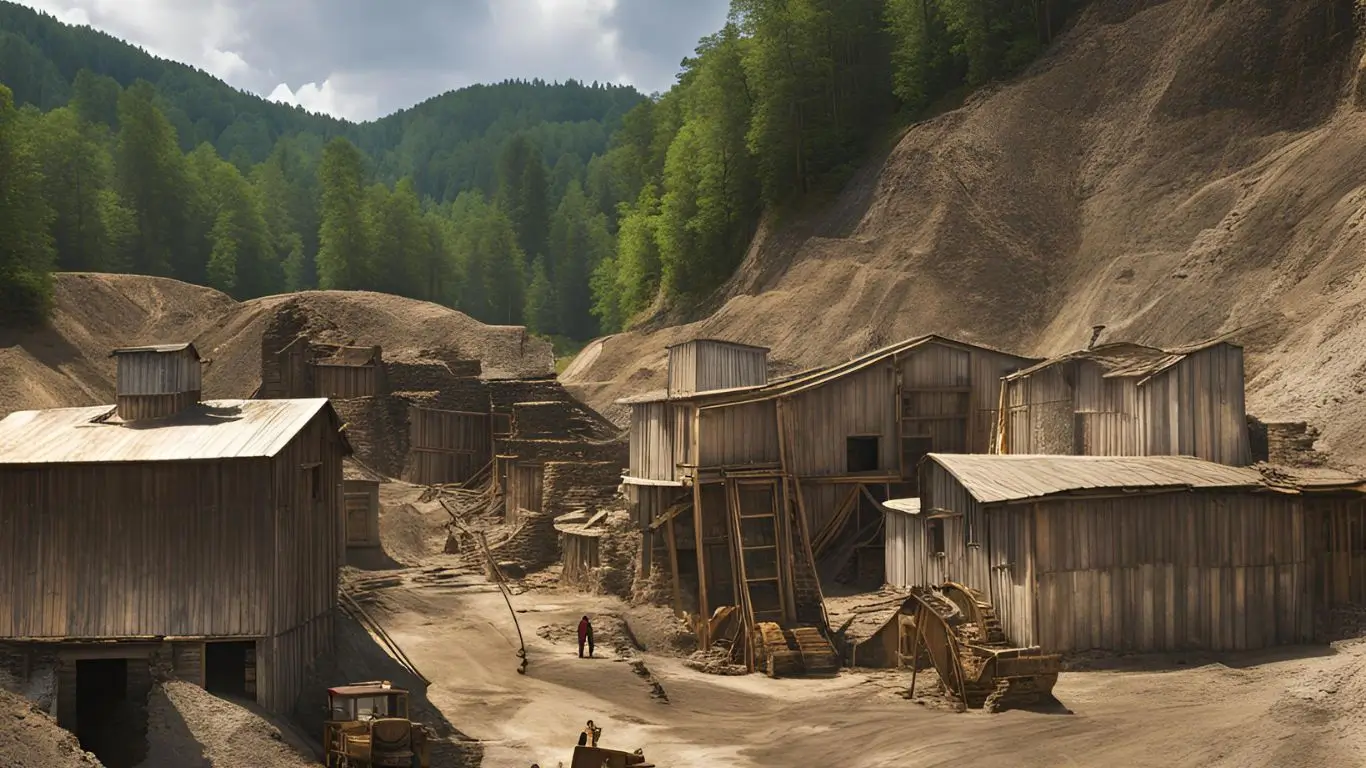
Georgia’s gold-mining story was not a minor prelude to California. It was the first major U.S. gold rush, centered in the North Georgia gold belt around Dahlonega, and it moved from creek discoveries into more organized hard-rock mining faster than many readers realize.
That is one reason Georgia belongs in the same national timeline as gold rush towns and when gold was discovered. It should not sit in a state-history sidebar as if the district had only local importance.
That is also why generic summaries of Georgia’s mines underperform. They usually mention the rush and the pans, but they skip the real system: placer finds, lode development, the Dahlonega Mint, and the Cherokee-removal context that sat behind the boom.
TL;DR
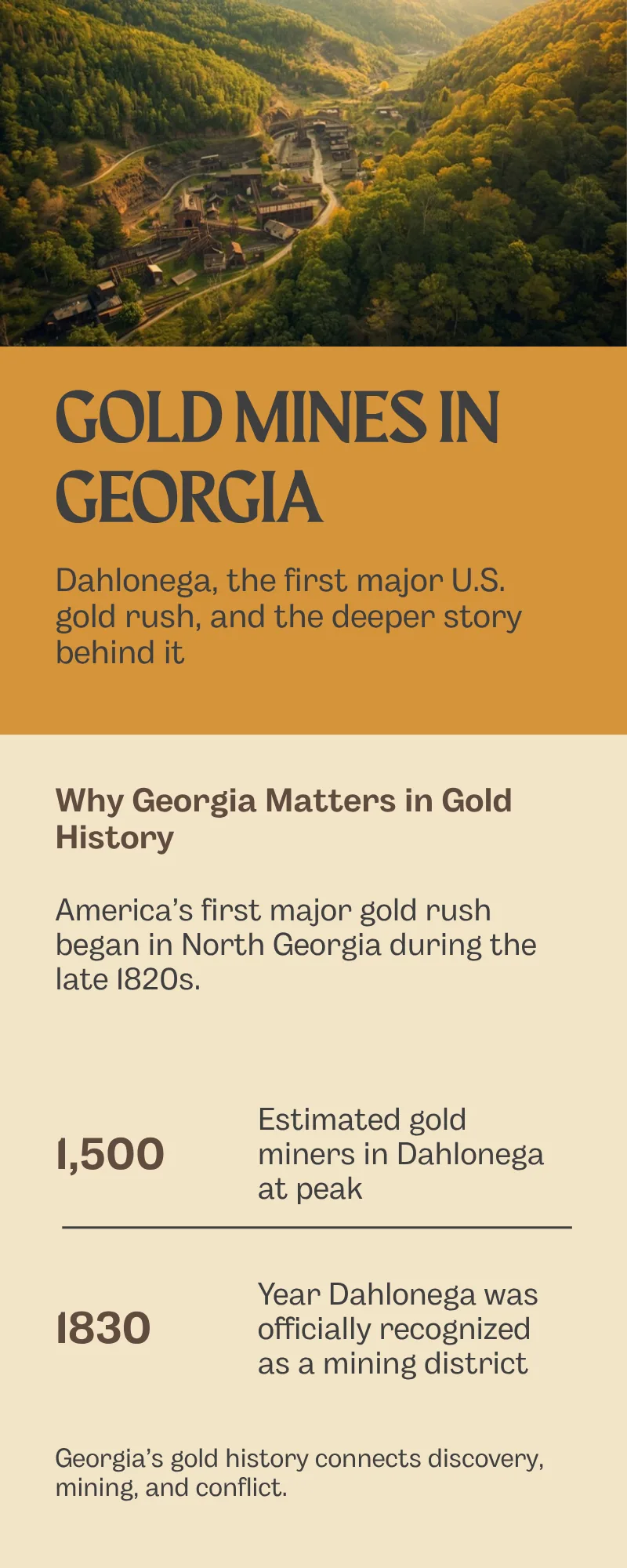
- Georgia was the site of America’s first major gold rush, beginning in the late 1820s around Dahlonega.
- The story started with creek and placer discoveries, then shifted toward deeper hard-rock mining.
- Dahlonega mattered because it became both a mining hub and a branch-mint town.
- The rush cannot be understood cleanly without the Cherokee-land and removal context.
- The strongest modern reader framework is timeline plus mining method plus political context.
What Most Readers Miss
The biggest mistake is treating Georgia gold as a quaint local story before California made gold important. Georgia already had the elements of a true gold system: rush behavior, mining transition, minting infrastructure, and land conflict.
Rush phase:
Creek and placer discoveries pulled in fast prospecting attention.
Mining phase:
The district moved toward more organized lode and underground work.
State impact:
The rush fed Dahlonega’s rise and the creation of a branch mint.
Where Was Georgia’s Gold Belt?
The core of the rush sat in North Georgia, especially around Lumpkin County and Dahlonega. That district was not an isolated single-mine event. It was part of a broader regional gold belt with multiple workings, stream locations, and later mine development points.
Georgia State Parks’ Dahlonega Gold Museum page is useful here because it anchors the district in the state’s own historical interpretation. Britannica’s Dahlonega entry helps frame why the town became nationally important rather than just locally memorable.
Chart 1: Georgia Gold Story by Phase
The rush makes more sense when broken into operational phases.
| Phase | Main activity | What readers usually miss |
|---|---|---|
| Early discovery | Creek and placer finds | People imagine only recreational panning, not the start of a real district rush |
| Rush expansion | Inflow of miners and small workings | The district spread through multiple sites rather than one famous pit |
| Hard-rock transition | Lode and underground extraction | Georgia did not stay in a pan-only phase |
| Institutional phase | Dahlonega Mint and regional consolidation | The gold story entered federal monetary infrastructure |
How the Rush Started
The Georgia rush began with discoveries in the late 1820s that made North Georgia suddenly legible as a gold landscape. Once surface and stream finds gained attention, prospectors moved in quickly and the district entered a recognizable boom pattern.
The Dahlonega Gold Rush historical timeline is helpful because it makes the early sequence easier to follow. The usual weak summary says only that gold was found in Georgia. The stronger version shows how discovery, movement, and district formation happened in sequence.
- Gold did not become important in Georgia only after large industrial mining.
- Surface and stream finds created the first rush energy.
- Those discoveries made Dahlonega the symbolic center of the story.
- The district’s early fame is one reason Georgia still claims such an important place in U.S. gold-rush history.
From Placer Gold to Hard-Rock Mining
This is the operational shift many articles skip. Creek gold and panning are the easiest parts to visualize, but the more important part of the story comes after the easiest material was noticed and worked first.
Georgia’s story moved from stream-based prospecting toward more developed lode and underground extraction. That transition is what separates a brief rush episode from a real mining district with staying power.
If readers want the method side in more detail, this also connects well to gold mining techniques during the gold rush and related state-level posts like gold mining in Alabama.
Chart 2: Method Shift in Georgia Mining
A rush district usually changes method as surface opportunity tightens.
| Method | What it targets | Why it matters in Georgia |
|---|---|---|
| Pan-based prospecting / simple placer work | Loose gold in creeks and sediments | Represents the rush-entry stage most people remember |
| More organized placer processing | Higher-volume sediment handling | Shows movement beyond casual discovery |
| Hard-rock / lode mining | Gold still locked in rock | Proves Georgia was a mining system, not only a panning story |
Why Dahlonega Mattered So Much
The History of the Gold Rush places this event in the wider sequence of discoveries, migrations, booms, and long-term consequences.
Dahlonega became the historic anchor of Georgia gold because it concentrated the district’s identity. It turned local discoveries into a named rush center and later into a mint town, which gave Georgia’s gold story a federal monetary connection that many boomtown histories never achieved.
Discover Dahlonega’s museum overview is useful here because it ties the rush story to the courthouse-turned-museum and the branch-mint memory that still shapes public understanding of the town.
The Dahlonega Mint and the 1838 Threshold
The establishment of the Dahlonega Mint marked the moment when Georgia gold moved beyond local rush excitement into the federal coinage system. That matters because it shows how seriously the district was taken in its time.
This is one of the cleanest ways to show readers that Georgia was not simply a forgotten pre-California footnote. Mining districts do not get branch mints unless their metal output and strategic significance are large enough to matter nationally.
Chart 3: Why the Mint Changes the Story
The mint is the line between local rush memory and national economic importance.
| Before mint focus | After mint focus | Interpretive takeaway |
|---|---|---|
| Local discovery and district growth | Federal-level coinage connection | Georgia gold mattered beyond county-level history |
| Pans, creeks, and prospectors | Monetary infrastructure and transport | The rush became part of the national gold story |
| Frontier excitement | Institutional recognition | The district had lasting economic weight |
The Cherokee-Land Context
This is the part too many polished history pages soften. Georgia’s gold boom did not happen in a political vacuum. It unfolded in Cherokee territory and became entangled with the broader removal era and pressure on Indigenous land.
That does not make the district story less real. It makes it more historically complete. A serious page on Georgia gold should not describe the rush as if it were only a charming Appalachian prospecting episode.
- The rush increased pressure on already contested Cherokee land.
- The mining story and removal history overlapped rather than occurring in separate moral compartments.
- Readers understand Georgia more clearly when they see both the mining system and the dispossession context together.
What Remains Today?
Modern Georgia gold memory survives through museums, mine tours, public history, and the durable identity of Dahlonega as a gold-rush town. That memory layer matters because it shapes how modern readers first encounter the subject.
But the public-history version can also blur the harder parts of the timeline. The best way to read the district now is as three things at once: a rush site, a mining district, and a state-memory landscape.
Helpful Reading Filter
If you want the stronger historical version of Georgia’s mines, check these in order.
1. Discovery:
Where and when did the first district momentum start?
2. Method:
Did the story stay placer-only, or did it move into hard rock?
3. Context:
What political and land-conflict reality sat behind the boom?
The GoldConsul Editorial Perspective
The strongest correction on Georgia gold is simple: it was an early American gold system, not just a charming local rush. Once you connect mining method, mint history, and Cherokee-land context, the story becomes much more serious and much more useful.
Knowledge Gap: Georgia was not just before California
Many summaries treat Georgia only as an early prelude to the bigger western gold rushes. That framing is too small.
- Georgia had real district development, not just scattered lucky finds.
- Dahlonega tied mined metal to federal minting.
- The rush also sat inside one of the hardest land-conflict eras in U.S. history.
Video walkthrough: this Georgia State Parks clip is the best fit here because it treats Dahlonega as America’s first gold-rush story rather than dropping the topic into a generic mining montage.
Bottom Line
Georgia’s gold mines belong to the first major U.S. gold-rush system, centered on Dahlonega and the North Georgia gold belt. The story only becomes clear when you connect placer beginnings, hard-rock development, mint history, and the Cherokee-removal context in one frame.
If you leave out any of those parts, the page becomes thinner than the history deserves. If you keep them together, Georgia stops looking like a footnote and starts looking like the early national gold story it really was.
FAQ: Gold Mines in Georgia
Was Georgia really the first major U.S. gold rush?
Yes. Georgia’s rush around Dahlonega predates California and is widely treated as America’s first major gold-rush story.
Was Georgia gold mining only about panning?
No. The story began with creek and placer discoveries, but it moved into more organized hard-rock mining as the district developed.
Why was Dahlonega so important?
Dahlonega became the symbolic and operational center of the district and later gained major importance through the branch mint connection.
Why should Cherokee history be part of this topic?
Because the gold rush unfolded in Cherokee territory and became entangled with removal-era pressure and land seizure. Leaving that out weakens the history.
Can you still visit Georgia gold-rush sites today?
Yes. Dahlonega’s museum and surviving mine-tour/public-history sites still shape how the district is remembered today.
 When you purchase a service or a product through our links, we sometimes earn a commission, at no extra cost to you.